The Lie We Were All Sold
Somewhere between motivational posters and LinkedIn posts celebrating 80-hour work weeks, an entire generation got sold a dangerous idea: that the more you sacrifice for your career, the more successful you will be. That rest is laziness. That boundaries are excuses. That if you are not grinding, you are falling behind.
It is a compelling story. It has the seductive logic of fairness – put in more, get out more. And for a while, it even seems to work. The promotions come, the salary climbs, the title changes. You are winning, or at least it looks that way from the outside.
But quietly, in the background, something else is happening. Your sleep deteriorates. Your relationships thin out. Your body starts sending signals you keep ignoring. The hobbies you loved vanish. You wake up one day and realize you cannot remember the last time you laughed without a reason, or sat still without guilt, or felt genuinely present with the people you love.
This is not a personal failure. This is the predictable outcome of a system that was never designed with your wellbeing in mind. And understanding that distinction – between a personal problem and a structural one – is the first step toward reclaiming your life.
Work-life balance is not a luxury. It is not a millennial buzzword or a soft concept for people who lack ambition. It is a measurable, scientifically validated condition that determines how long you live, how well your brain functions, how strong your immune system remains, and how deeply you connect with other human beings. Getting it right is not about working less – it is about working in a way that is sustainable, meaningful, and aligned with the full scope of who you are.
This article is about understanding that truth, and more importantly, about what to actually do with it.
What Work-Life Balance Actually Means
Before anything else, let us clear up a common misconception. Work-life balance does not mean spending exactly equal hours on your job and your personal life. It does not mean leaving the office at 5 PM sharp every day or never checking your email on weekends. These are oversimplifications that make the concept easy to dismiss.
Work-life balance, in its truest sense, is about integration and intentionality. It means that neither your professional life nor your personal life is chronically cannibalizing the other. It means you have enough time, energy, and attention for the things that matter most to you – both inside and outside of work. It means you can be fully present at work when you are working, and fully present at home when you are not.
The reason this definition matters is because balance looks different for everyone. A parent of young children will have a completely different version of balance than a single professional in their late twenties. A surgeon’s balance will not look like a freelance designer’s balance. A person going through an intense project deadline will have temporarily different needs than someone in a maintenance phase of their career.
Balance is not a fixed state. It is a dynamic, ongoing negotiation between competing demands – and the skill of managing that negotiation is something you can develop deliberately, like any other skill.
What is consistent across all meaningful definitions of work-life balance, however, is the presence of three core elements: recovery time, relational investment, and personal agency. You need enough time to genuinely recover from the cognitive and emotional demands of work. You need enough space to invest meaningfully in the relationships that sustain you. And you need to feel that your time is, at least in significant part, your own to direct.
When any of these three elements goes missing for an extended period, the consequences are not minor. They are systemic, and they compound.
The Science of Overwork
Let us talk about what actually happens to your body and brain when the balance tips too far toward work.
The human nervous system was not designed for sustained, high-intensity cognitive labor. It was designed for variation – periods of focused effort followed by periods of rest and recovery. When you deny it that variation over weeks, months, and years, you are not demonstrating strength. You are accelerating deterioration.
Cortisol is the body’s primary stress hormone. In healthy doses, it is useful – it sharpens focus, mobilizes energy, and helps you respond to challenges effectively. But chronically elevated cortisol, the kind that comes from sustained overwork, does serious damage. It suppresses immune function, making you more vulnerable to illness. It disrupts sleep architecture, which means even when you do sleep, the quality is compromised. It increases inflammation throughout the body, which is linked to cardiovascular disease, diabetes, and several forms of cancer. It literally shrinks parts of the prefrontal cortex – the region of the brain responsible for decision-making, emotional regulation, and long-term planning.
In other words, the more you overwork, the worse your judgment becomes. The more hours you put in without rest, the less effectively you are using those hours. This is not a motivational speech – it is neurophysiology.
Research from Stanford University found that productivity per hour drops sharply when a person works more than 50 hours per week, and that the output of someone working 70 hours is barely different from that of someone working 55 hours. The extra 15 hours generate almost no additional productive value – but they generate enormous additional cost to the person’s health and personal life.
A landmark study involving more than 600,000 workers across multiple countries found that people who work 55 or more hours per week have a 33 percent higher risk of stroke and a 13 percent higher risk of heart attack compared to those working 35 to 40 hours per week. These are not marginal differences. These are mortality-level consequences.
Sleep deprivation, which almost universally accompanies chronic overwork, compounds all of these effects. Matthew Walker, a neuroscientist and sleep researcher, has described sleep deprivation as a state that impairs performance in ways virtually indistinguishable from alcohol intoxication – yet most chronically sleep-deprived people do not recognize the extent of their impairment, because impaired judgment is one of the first casualties of insufficient sleep.
The irony of hustle culture is complete: in the pursuit of maximum output, it creates the exact conditions that guarantee diminishing output.
How Burnout Happens – And Why It Sneaks Up on You
Burnout is not the same as being tired. You can recover from tiredness with a good night’s sleep or a relaxing weekend. Burnout is a clinical state of chronic exhaustion – physical, emotional, and cognitive – that does not resolve with ordinary rest.
The World Health Organization formally recognizes burnout as an occupational phenomenon. It is characterized by three dimensions: a feeling of energy depletion or exhaustion, increased mental distance from one’s job or feelings of negativism related to one’s career, and reduced professional efficacy. In plain language: you are exhausted, you stop caring, and you stop performing well. Everything you worked so hard to build starts to collapse.
What makes burnout particularly insidious is how gradually it develops. It does not announce itself. It creeps in through a series of small, seemingly reasonable compromises – skipping one more workout to meet a deadline, canceling dinner with a friend to finish a report, checking your phone during your child’s school event, staying up until midnight to get ahead of tomorrow’s schedule.
Each individual compromise seems justified. It is only in retrospect, when you are sitting in a doctor’s office or staring at a resignation letter or realizing you have not felt genuinely happy in months, that the cumulative cost becomes visible.
The early warning signs of burnout are worth knowing by name, because catching them early is immeasurably easier than recovering from full burnout: persistent fatigue that sleep does not fix, increasing cynicism about your work or colleagues, difficulty concentrating or making decisions, physical symptoms like chronic headaches or gastrointestinal issues, growing emotional detachment from people you care about, and a pervasive sense of ineffectiveness despite working harder than ever.
If you recognize three or more of these in yourself right now, it is not a sign that you need to push harder. It is a signal that the system needs to change.
The Relationship Casualty Nobody Talks About
One of the least discussed costs of poor work-life balance is relational. Not because it is less important – it may be the most important – but because it tends to happen slowly and quietly, without the dramatic clarity of a health crisis.
Relationships require presence. Not physical proximity – actual, attentive, emotionally available presence. And the kind of mental exhaustion that comes from chronic overwork makes genuine presence extraordinarily difficult. You can be sitting at the dinner table and be entirely somewhere else. You can be physically home every evening and emotionally absent every one of those evenings.
Over time, this absence registers in the people around you. Partners feel increasingly lonely in the relationship. Children learn that their needs are secondary to the demands of a parent’s phone or laptop. Friendships quietly dissolve from neglect. The social network that is one of the most powerful predictors of long-term health and happiness slowly frays.
The Harvard Study of Adult Development – one of the longest-running studies of human wellbeing in history, spanning over 80 years – concluded that the single greatest predictor of happiness and health in later life was not wealth, fame, or professional achievement. It was the quality of a person’s relationships. People with strong, warm relationships lived longer, reported more satisfaction, and maintained cognitive function later in life than those with weaker social connections.
The professional ambitions that consume so much of our best energy are genuinely important. But they are not, by themselves, the things that will ultimately matter most in the story of your life. The people you love, the moments you were fully there for, the connections you maintained through choice and effort – these are the substance of a life well lived.
This is not an argument against ambition. It is an argument for a kind of ambition that includes your relationships as a non-negotiable priority, not a reward to be deferred until the next milestone.
Why Certain Industries and Cultures Make This Harder
Not all work environments are equally hostile to balance. Some industries and workplace cultures have built structures that actively undermine it, and it is important to name this clearly.
Legal, financial, medical, and technology sectors are notorious for normalizing extreme hours, especially in the early years of a career. There is often an explicit or implicit message that long hours are a demonstration of commitment and competence, and that those who leave at reasonable hours are not serious. In law firms, the billable hour model creates direct financial incentives for overwork. In startups, the mythology of the founder who sleeps at the office creates cultural pressure to sacrifice everything for the company’s success.
In some parts of Asia and South Asia, the cultural overlay of respectability through labor – the idea that a hardworking person is a virtuous person – adds moral weight to overwork. To work less is to be lazy. To prioritize personal time is to be selfish. These cultural narratives are deeply ingrained and can make setting boundaries feel like a character failure rather than a rational health decision.
The digital revolution has compounded all of this by eliminating the physical boundary between work and non-work. When your office is also your phone, the workday never technically ends. The expectation of constant availability has become so normalized in many industries that responding to a message at 11 PM is not remarkable – but failing to respond is.
Understanding these structural factors matters because it shifts the problem from purely individual to partly systemic. Yes, individual choices matter enormously. But individuals are also operating within systems that need to change. Advocating for those systemic changes – through your voice, your choices, your leadership if you have it – is not weakness. It is a contribution to a healthier collective future of work.
What Countries and Companies Are Getting Right
While hustle culture dominates headlines, a quiet revolution in how we think about work is gaining real momentum in several parts of the world.
Scandinavian countries – Denmark, Sweden, Norway, and Finland – consistently rank among the happiest in the world, and their approach to work is a significant part of why. Swedish companies have experimented with six-hour workdays and found that employees are more productive, take fewer sick days, and report significantly higher job satisfaction. Norway’s highly regulated work culture ensures that employees have substantial vacation time, predictable hours, and strong protections against excessive demands.
Japan, ironically one of the countries most associated with extreme overwork – the Japanese even have a word, karoshi, which means death by overwork – has begun implementing national-level reforms. The government passed legislation capping overtime hours and mandating that employees take a minimum number of vacation days. Major corporations like Microsoft Japan ran a four-day work week experiment and reported a 40 percent increase in productivity.
Iceland ran a large-scale trial of a four-day work week involving thousands of workers across multiple sectors. The results were unambiguous: productivity was maintained or improved, worker wellbeing increased substantially, and stress levels dropped. Iceland has since moved to make four-day or shorter work weeks a standard option for most of its workforce.
These are not utopian fantasies. They are documented experiments with measurable results. And what they consistently show is that humans do not perform better when they work more hours – they perform better when they work the right hours, with adequate rest, clear boundaries, and genuine autonomy.
Practical Strategies That Actually Work
The conversation about work-life balance is only useful if it translates into real behavioral change. Here are strategies that research and practice have validated – not as quick fixes, but as genuine structural changes that accumulate into a different kind of life.
Define Your Non-Negotiables
Start by identifying two or three elements of your personal life that you are not willing to compromise. This might be dinner with your family four nights a week. It might be eight hours of sleep. It might be one hour of exercise every morning, or a weekend afternoon that belongs entirely to you.
Write these down. Put them in your calendar with the same seriousness you schedule meetings. When something attempts to invade that time, you have a pre-made answer: that time is already committed.
Non-negotiables are powerful because they remove the decision from your daily to-do list. Decision fatigue is real – the more small choices you make throughout a day, the weaker your judgment becomes on subsequent choices. By deciding in advance what is protected, you conserve that decision-making energy for everything else.
Learn to Protect Your Attention, Not Just Your Time
Most people think of work-life balance as a time management problem. It is more accurately an attention management problem. You can have all the time in the world and still be miserable if your attention is chronically hijacked by work even when you are physically away from it.
The practice of leaving work mentally – not just physically – is one that requires deliberate cultivation. Some people find transition rituals useful: a specific route home, a workout, a brief journaling practice, or even just changing out of work clothes. These rituals serve as signals to the nervous system that one context has ended and another has begun.
Turning off work notifications after a certain hour is not a radical act. It is a basic boundary that many of the world’s most effective people maintain consistently. The expectation of constant availability is one that you can, with care and communication, change in your workplace relationships over time.
Rethink Rest
Rest is not just sleep. Rest is any activity that allows your nervous system to genuinely recover – and different people find recovery in different ways. For some it is physical movement. For others it is creative work that has nothing to do with their job. For others it is deep social connection or quiet time in nature.
What does not count as rest, despite how common it is, is passive screen consumption while mentally rehearsing tomorrow’s to-do list. Scrolling through social media in bed with cortisol still elevated from a stressful workday is not recovery – it is a different form of stimulation layered on top of an already-exhausted system.
Understanding your own recovery profile – what actually replenishes you – is one of the most valuable pieces of self-knowledge you can develop. And scheduling genuine recovery time with the same seriousness you schedule productive work is a shift that changes everything.
Set Boundaries Through Behavior, Not Just Words
Many people understand the importance of boundaries in theory but struggle to maintain them in practice. This is partly because boundary-setting feels confrontational in cultures where overwork is normalized, and partly because the short-term cost of saying no is visible and immediate while the long-term cost of never saying no is diffuse and delayed.
Effective boundary-setting is behavioral, not just declarative. It is not enough to tell your colleagues you do not respond to messages after 7 PM – you have to actually not respond to messages after 7 PM, consistently, until a new expectation is established. It is not enough to tell yourself you will take your vacation days – you have to actually book them and actually disconnect.
The discomfort of establishing new boundaries is temporary. The relief of living inside them is ongoing.
Build Your Identity Outside of Work
One reason work expands to fill all available time is that, for many ambitious people, work is where their identity lives. Their sense of competence, recognition, status, and purpose is almost entirely housed in their professional role. This makes it psychologically threatening to step away from work – to do so is to temporarily step away from the self.
The antidote is to deliberately build a rich identity outside of work. This means investing in hobbies with genuine commitment – not as productivity hacks or networking opportunities, but as things you do purely because they matter to you. It means showing up consistently in your relationships, not just when it is convenient. It means developing a sense of who you are that is not contingent on your job title or professional performance.
This is not just philosophical advice. It is protection. Because careers end, companies fold, roles disappear, and industries transform. The person who has built a full human life alongside their career is far more resilient in the face of those disruptions than the person whose entire identity is tied to what they do for work.
Have the Harder Conversations at Work
If your work environment is structurally hostile to balance, individual coping strategies will only take you so far. At some point, the problem requires organizational solutions.
This might mean having an honest conversation with your manager about workload and capacity. It might mean raising the culture of availability in a team meeting and proposing clearer expectations. If you are in a leadership position, it means modeling the behavior you want to see – leaving at reasonable hours, taking your vacation, not sending messages to your team late at night, and explicitly praising smart work over long work.
These conversations are uncomfortable, but they are necessary. And the number of organizations that are genuinely open to them is growing, especially as the evidence for the productivity cost of burnout becomes impossible to ignore.
The Digital Problem
It would be incomplete to discuss work-life balance in 2026 without addressing the role of technology, specifically the always-on digital infrastructure that has made the separation of work and non-work functionally almost impossible for many knowledge workers.
The smartphone was supposed to be a tool for flexibility and convenience. In many ways it is. But it has also become a leash – a device that keeps us perpetually tethered to professional obligations regardless of where we are physically located or what time of day or night it is.
The problem is not technology itself. The problem is the set of expectations that have been built around it. The expectation that messages will be answered within minutes, regardless of the hour. The expectation that being unreachable is a kind of dereliction of duty. The normalization of checking work email during dinner, on vacation, on weekends, during conversations with people we care about.
These expectations were not inevitable. They were choices – organizational and cultural choices that accumulated into norms over about two decades. And because they are choices, they can be changed.
The practice of digital boundaries – defined times when you are not available on digital channels, devices that are kept out of the bedroom, notifications that are turned off by default rather than on – is not a technophobic retreat. It is a sophisticated recognition that attention is your most valuable personal resource, and that you need to manage who and what gets access to it.
When Balance Becomes Integration
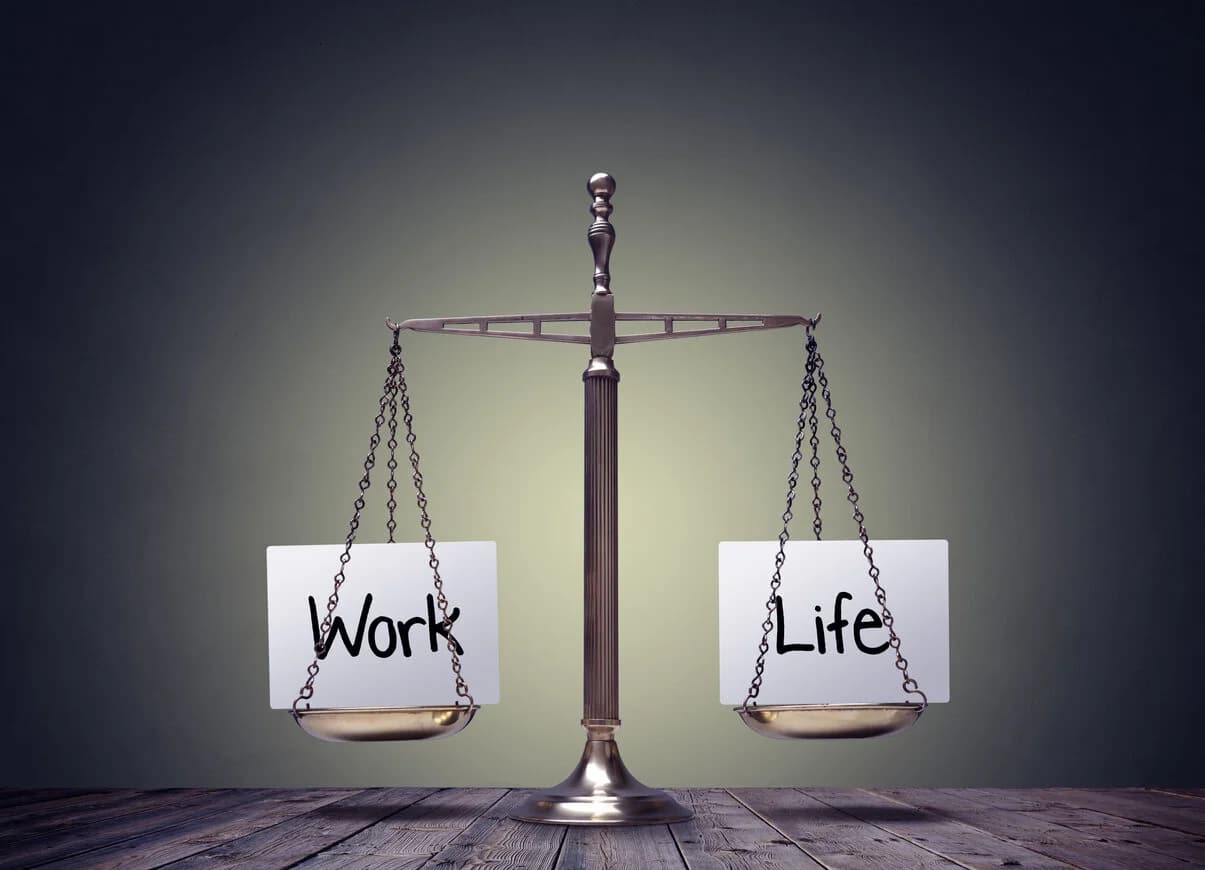
There is a growing school of thought that argues the metaphor of balance – with its implication of two separate, competing things that must be kept equal – is itself part of the problem. Life is not a scale. Work and personal life are not discrete domains that must be carefully kept in equilibrium.
The alternative framing is integration: the idea that a good life weaves together professional meaning, personal connection, physical health, creative expression, and rest in a way that is coherent rather than compartmentalized. In an integrated life, your work reflects your values. Your relationships inform your professional judgment. Your physical health supports your cognitive performance. Your personal curiosity enriches your professional contributions.
This does not mean there are no boundaries. It means the boundaries serve integration rather than separation. You are not trying to keep work from contaminating your life – you are trying to build a life where work is one important and meaningful thread in a much richer tapestry.
For this integration to work, the work itself has to be worth integrating. This is why questions of meaning and alignment matter so much in conversations about work-life balance. When your work feels genuinely meaningful – when it connects to your values, uses your real strengths, and contributes something you care about – the boundary between work and life becomes less fraught. The work does not feel like something to escape. It feels like part of what makes your life full.
This does not require everyone to have a calling or a passion project. It requires something more modest but still essential: a sense that the work you do matters in some way you can articulate, to yourself if to no one else.
Rest as a Radical Act
In a culture that glorifies productivity, rest has become a form of resistance. To genuinely stop – to sit, to play, to be without an agenda – is something that requires active commitment in the face of powerful cultural pressure to always be doing something useful.
But rest, in the deepest sense, is where so much that matters actually happens. It is where creativity incubates. It is where memory consolidates. It is where the nervous system recovers and recalibrates. It is where relationships deepen, because genuine connection requires time that is not organized around productivity.
The philosopher and theologian Josef Pieper wrote, decades before smartphones existed, that leisure is not the absence of work but the condition of genuine human flourishing – the space in which a person is most fully themselves, most fully present to the world, most available to wonder and beauty and love.
That might sound abstract. But translate it into your daily life and it is deeply practical: the walk you take with no destination and no podcast in your ears. The meal you cook and eat slowly with someone you love. The afternoon that belongs to no one and has no deliverable at the end of it. The book you read for the sheer pleasure of the story. These are not indulgences. They are the architecture of a life.
Building Toward a Different Future of Work
The future of work does not have to look like the present. The pandemic, for all its devastation, proved that enormous amounts of knowledge work can be done flexibly, remotely, and on timelines that do not require everyone to be physically present from nine to five. The genie of flexibility is out of the bottle, and while many organizations are attempting to push it back in, the conversation has fundamentally changed.
The four-day work week movement is gaining traction not as a radical experiment but as a serious policy proposal backed by an expanding evidence base. Asynchronous work models that allow deep focus without constant interruption are being adopted by some of the most innovative companies in the world. Mental health benefits are becoming standard rather than exceptional in competitive employment packages.
These changes are not happening because corporations have suddenly developed a conscience about employee wellbeing. They are happening because the evidence has become undeniable that burned-out, exhausted employees are less productive, more likely to quit, and more expensive to replace. The business case for work-life balance has become as compelling as the human case.
For individuals, this moment represents an opportunity. The norms around work are more fluid than they have been in decades. The conversations that would have been dismissed as soft five years ago are being taken seriously in boardrooms. If you have ever wanted to negotiate for a more sustainable work arrangement, the conditions have never been more favorable.
The leverage is yours more than you may realize. Use it.
The Deepest Reason This Matters
Everything in this article could be justified on purely pragmatic grounds. Better balance leads to better health, better relationships, better cognitive performance, and ultimately better professional results. The case is solid and the evidence is substantial.
But underneath all of that is something more fundamental. Your life is the only one you will ever have. The days that pass while you are answering emails that could wait, or attending meetings that serve no one, or performing busyness to satisfy an expectation that was never really examined – those days do not come back.
This is not meant to be morbid. It is meant to be clarifying. The urgency that hustle culture attaches to professional achievement is real but narrow. There is a different kind of urgency – quieter, deeper, more personal – that has to do with showing up for the life you actually have, with the people who are actually in it, while you still have the energy and the presence to do so.
Work-life balance is, at its core, a question about what you are living for. It is a question about which version of success you are actually pursuing – the external kind that looks impressive from the outside, or the internal kind that feels like a life well lived from the inside.
These two versions of success can coexist. The best careers and the fullest lives are not mutually exclusive. But they do require a conscious choice, made over and over again, to protect the things that matter most – including yourself.
The hustle will always be there. Your life is happening right now.