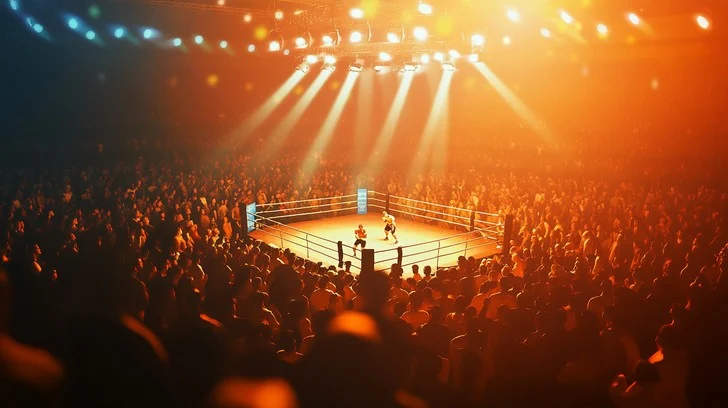
There is a moment in every great fight , a single, suspended second , when the crowd goes completely silent. Not the polite silence of a golf gallery or the reverent hush of a tennis match. This is something older. Something primal. It is the silence of thousands of people holding their breath at once because what they are watching has stripped away every pretense of civilization and reduced human existence to its most elementary question: who survives?
That silence is the reason combat sports endure. That silence is the reason they grow. And that silence is, perhaps, the most honest thing about us.
We like to believe we have evolved past the need for violence as spectacle. We build universities and concert halls, we write poetry and pass legislation, we debate the ethics of artificial intelligence over artisanal coffee. And then, on a Saturday night, millions of us sit in darkened rooms and stadiums, hearts hammering, watching two human beings try to render each other unconscious. We cheer. We groan. We leap to our feet. And then we do it all again next weekend.
Combat sports are not a guilty pleasure hiding at the fringes of respectable culture. They are front and center, generating billions of dollars in revenue, producing some of the most recognizable human beings on the planet, and filling arenas from Las Vegas to London, from Manila to Mumbai. To understand combat sports is to understand something essential about human nature , about what we fear, what we admire, what we need, and what we are incapable of admitting we need.
This is that story.
The Ancient Hunger
Long before there were weight classes or pay-per-view events or promotional contracts, there was the fist. Archaeologists have found evidence of organized combat sports dating back over five thousand years, to ancient Mesopotamia and Egypt. Drawings on tomb walls in the Nile Valley show figures in fighting stances, hands raised, bodies angled in postures any modern boxing coach would recognize. The Greeks formalized it, introducing boxing , called pygmachia , into the ancient Olympics in 688 BCE. Wrestling had been there even longer.
The Romans, as they did with most things, took it further and made it bloodier. The gladiatorial games are perhaps the most famous sporting institution in history, and certainly the most notorious. Gladiators were not simply thugs swinging weapons at each other. They were trained athletes, subject to rigorous physical conditioning, dietary regimens, and tactical instruction. Some were slaves. Some were volunteers. Some were prisoners of war. But all of them, once they entered the arena, became something more complex than their origins: they became symbols.
The gladiator represented Rome’s power over life and death, over conquered peoples, over nature itself. Watching a man fight and survive was a civic event, a religious ritual, a political statement, and popular entertainment all at once. The line between sport and spectacle, between athletic competition and theatrical performance, was deliberately blurred. The crowd’s reaction , their thumbs, their roars, their silence , was part of the event itself.
Sound familiar?
What is remarkable is not how different ancient combat sports were from their modern descendants. It is how similar they are. The structures, the social functions, the psychological needs they fulfill , these have remained almost unchanged across millennia. We have simply upgraded the production values.
The Birth of Modern Boxing
When we talk about modern combat sports, boxing is where the conversation almost always begins. Not because it is the oldest surviving form of organized fighting , wrestling has a better claim to that title , but because boxing, more than any other fighting discipline, became intertwined with the social and political history of the modern world.
The Marquess of Queensberry Rules, introduced in 1867, transformed bare-knuckle brawling into a regulated sport with rounds, gloves, and standardized conduct. But the rules were never just about safety. They were about class. Victorian England wanted to distinguish the refined “sweet science” from the chaotic street fights of the lower orders. Boxing, properly conducted, was a gentleman’s sport. It built character. It instilled discipline. It was, the argument went, morally improving.
Of course, the men who actually did the fighting were rarely gentlemen in the Victorian sense of the word. They were working-class men, immigrants, and minorities who had few other avenues to wealth or recognition. This tension , between the sport’s aspirational mythology and the economic desperation that actually drove men into the ring , has never been fully resolved. It remains at the heart of boxing to this day.
The twentieth century made boxing into something extraordinary. The era between 1910 and 1980 produced fighters whose names have become synonymous with courage, skill, and character: Jack Johnson, the first Black heavyweight champion, who fought not just his opponents but the entire racist architecture of American society. Joe Louis, the Brown Bomber, who defeated Max Schmeling in 1938 and became, for a night, the embodiment of American democratic ideals against Nazi Germany. Sugar Ray Robinson, widely considered the greatest pound-for-pound fighter who ever lived, whose footwork and combination punching redefined what was physically possible inside a ring. Muhammad Ali, who transcended sport entirely to become a political and cultural figure of world-historical importance.
Each of these men used the boxing ring as a stage. But they were not acting. The danger was real, the sacrifice was real, and the meaning the world attached to their victories and defeats was real in ways that extended far beyond sport. When Ali refused induction into the Vietnam War draft and was stripped of his title, the boxing ring became a metaphor for a nation’s argument with itself. When he eventually won it back, his comeback felt less like a sports story and more like the resolution of a moral drama.
This is what combat sports do at their greatest: they give physical form to abstract struggles. They make visible what is otherwise invisible about power, identity, and the human will.
The Rise of Mixed Martial Arts
If boxing was the twentieth century’s defining combat sport, then Mixed Martial Arts , and specifically the Ultimate Fighting Championship , is the defining combat sport of the twenty-first. The story of how a fringe event held in a Denver arena in 1993 became one of the most valuable sports properties on earth is one of the most remarkable in the history of entertainment.
The first UFC event was, by any objective standard, a mess. There were no weight classes, no time limits, no unified rules. The matchmaking was designed to answer a specific and genuinely interesting question: which martial art is most effective in a real fight? The answer that emerged over the following years , Brazilian Jiu-Jitsu, and specifically the Gracie family’s refined ground-fighting system , changed how the world thought about combat.
But the early UFC nearly killed itself. Politicians called it human cockfighting. Cable providers refused to carry it. Several US states banned it entirely. By the late 1990s, the promotion was hemorrhaging money and seemed destined for irrelevance.
What saved it was not a single moment or a single fighter, but a gradual, systematic transformation. When Zuffa LLC, led by brothers Frank and Lorenzo Fertitta and their friend Dana White, purchased the UFC in 2001 for two million dollars, they began the process of legitimizing the sport. They lobbied for unified rules. They instituted weight classes. They partnered with state athletic commissions. They hired matchmakers who understood drama as well as competition. And then, in 2005, they aired The Ultimate Fighter , a reality television show that put MMA fighters in a house together and let America watch them train, fight, and occasionally throw furniture at each other.
The show was a phenomenon. Suddenly, MMA was not just a sport. It was a story. The fighters had names, faces, backstories, rivalries. The casual viewer who had never watched a fight in their life could root for someone. They could invest emotionally. And when that emotional investment reached its peak , when Forrest Griffin and Stephan Bonnar fought their now-legendary finale , the UFC’s future was secured.
What followed was exponential growth that astonished even its most optimistic supporters. Georges St-Pierre became a crossover star who made MMA cool in Canada and Europe. Anderson Silva produced performances of such freakish physical brilliance that they seemed to belong to a different sport entirely. Conor McGregor , brash, gifted, theatrically self-aware , became the first fighter since Ali to turn combat sports into pure cultural spectacle, driving pay-per-view numbers that had never been seen outside of boxing’s greatest events.
The UFC was eventually sold in 2016 for four billion dollars. It was the largest acquisition of a sports franchise in history at the time. The two million dollar investment had become four billion. Not bad for human cockfighting.
What We Talk About When We Talk About Fighting
There is a temptation, when writing about combat sports, to become defensive. To spend a great deal of time explaining why these sports are legitimate, why they are not simply an excuse for sanctioned violence, why the people who watch them are not bloodthirsty savages. This defensiveness is understandable. Combat sports have been condescended to and moralized about for as long as they have existed.
But the defensiveness is also, ultimately, a mistake. Because the things that critics find most troubling about combat sports , the explicitness of the violence, the directness of the physical domination, the rawness of the emotional stakes , are precisely the things that make them valuable as cultural phenomena. The discomfort is the point.
We live in a world of abstraction. Most of us, in our daily lives, never directly experience the consequences of our decisions. A financial trader makes a bet and thousands of people lose their jobs , but the trader never sees those people. A politician votes for a policy and children go hungry , but the politician never meets those children. We have become extraordinarily skilled at insulating ourselves from the physical reality of cause and effect.
Inside a boxing ring or an MMA cage, there is no insulation. Action has immediate, visible, physical consequence. You throw a punch wrong and you break your hand. You leave your chin exposed and you wake up on the canvas. The feedback loop between decision and consequence is measured in milliseconds. For a generation that increasingly experiences life through screens, through mediation, through layers of virtual remove, there is something viscerally clarifying about watching two human beings inhabit a space where every decision matters immediately and completely.
This is not an argument for violence. It is an argument for consequence. And it helps explain why, despite every effort of the squeamish and the sanctimonious to extinguish them, combat sports refuse to disappear.
The Athlete’s Interior World
Ask any serious fighter what they love about their sport and they will almost never say the violence. They will talk about problem-solving. Boxing, they will tell you, is chess with consequences. Every opponent is a puzzle. Every combination is a hypothesis. You propose a theory with your jab, you test it with your cross, you draw a conclusion with your hook.
MMA fighters talk about the same thing with even more variables. A mixed martial artist must be competent in striking, wrestling, and grappling, and must be able to transition fluidly between them under physical stress and sleep deprivation and the knowledge that their opponent is trying to hurt them. The cognitive demands are extraordinary. Studies have found that elite fighters exhibit reaction times, spatial awareness, and pattern recognition capabilities that exceed those of athletes in many other sports.
The training itself is a world unto itself. The culture of a boxing gym , the rhythm of the speed bag, the smell of sweat and leather, the hierarchy that runs from grizzled trainer to nervous newcomer , is one of the most distinctive subcultures in sport. There is an egalitarianism to it that belies its brutal surface. In a good gym, the CEO and the construction worker hit the same bag, run the same drills, and earn the same respect or disrespect based entirely on what they do in the ring. Class, race, and social status dissolve in the heat of honest physical effort.
This is what the philosopher and sociologist Loïc Wacquant discovered when he spent three years training at a boxing gym in Chicago’s South Side in the 1990s. He went in as an academic observer and came out as a genuine fighter, unable to explain his transformation through the usual sociological categories. The gym had seduced him not with violence but with craft , with the subtle, endlessly demanding project of learning to fight well. His account of that experience, published as a book, remains one of the most penetrating explorations of sport as a way of being in the world.
The fighter’s relationship with fear is another dimension that separates combat sports from most other athletic disciplines. In team sports, the worst that typically happens is losing. In combat sports, you can be physically hurt, publicly humiliated, rendered temporarily unconscious in front of thousands of people. This is not a marginal risk but a central feature of the enterprise. Every fighter knows it. Every fighter, before every fight, experiences some version of fear.
What fighters learn , what the training is partly designed to teach , is not the absence of fear but its management. They learn to breathe through it, to channel it, to use the adrenaline it produces without being consumed by it. This skill, which takes years to develop, turns out to be remarkably transferable. Fighters consistently report that the psychological tools they develop in the gym , composure under pressure, the ability to continue performing when afraid, the capacity to recover quickly from setbacks , serve them powerfully in every other area of their lives.
The Economics of Pain
Combat sports are, at their commercial summit, a spectacularly profitable industry. The UFC generates hundreds of millions of dollars in revenue annually. The top boxing promoters , Bob Arum’s Top Rank, Eddie Hearn’s Matchroom, Bob Hearn’s PBC , broker fights that sell millions of pay-per-view buys at fifty or sixty dollars each. A single major fight night can generate more revenue than an entire season of some professional sports leagues.
But beneath this glittering commercial surface lies a very different economic reality for most of the people who actually do the fighting. The UFC, despite its billions in valuation, has faced sustained criticism for the way it compensates its athletes. The pay structure in MMA rewards the top stars handsomely while the vast majority of fighters earn modest guaranteed purses that often fail to cover training costs, gym fees, coaching expenses, nutritionist fees, and travel. A fighter who appears on a UFC card might earn ten thousand dollars to show up and another ten to win , before taxes, before manager’s cut, before every other expense.
Boxing has its own economic dysfunctions. The promotional system, in which promoters control not just the events but often the fighters themselves through exclusive contracts, has historically made it difficult for fighters to negotiate freely or maximize their earning potential. Many fighters who generated enormous wealth for promoters and television networks retired with little or nothing to show for it.
This economic inequality is not incidental to combat sports culture. It is structural. The supply of young men willing to fight is effectively unlimited, because for many of them , from impoverished neighborhoods in America, from working-class communities in the UK and Ireland, from developing nations in Latin America, Africa, and Eastern Europe , combat sports represent one of the very few available paths to social and economic mobility. The promoter and the broadcaster know this, and they price their contracts accordingly.
There is something uncomfortable about watching a sport that enriches its executive class while extracting physical risk and suffering from its athletes, most of whom will never approach the financial security that their sacrifice arguably deserves. This discomfort is legitimate. It does not diminish the beauty or authenticity of the sport itself, but it is a dimension of combat sports that any honest account must include.
Women in the Cage and the Ring
For most of their modern history, combat sports were an almost exclusively male domain. Women’s boxing existed in the margins , as novelty acts in traveling shows, as informal competitions with no official status. The formal exclusion of women from sanctioned combat sports was rarely argued for explicitly. It was simply assumed, as though the idea of women fighting were self-evidently absurd.
This began to change, slowly and against considerable resistance, in the 1990s and early 2000s. Women’s boxing gained Olympic recognition in 2012. But the most dramatic transformation came through MMA, and specifically through a fighter named Ronda Rousey.
Rousey was an Olympic bronze medalist in judo who transitioned to MMA and became, almost overnight, one of the most dominant athletes in the sport’s history. Her first twelve professional fights ended by armbar or by strikes in the first round. But her importance was not just her dominance. It was the audience she brought with her. Rousey demonstrated that women’s combat sports could generate pay-per-view buys, media coverage, and cultural conversation equal to the men’s game. She made the business case for women’s MMA in a language promoters and broadcasters understood perfectly: dollars.
After Rousey came a generation of women fighters who built on the platform she created. Valentina Shevchenko, a Kyrgyz-Peruvian multi-sport martial artist, became arguably the most technically complete fighter in MMA regardless of gender. Amanda Nunes, the Brazilian “Lioness,” defeated Rousey herself and went on to become the first simultaneous two-division champion in UFC women’s history. Claressa Shields, in boxing, became the first American , male or female , to win gold medals in two consecutive Olympics, and then went on to become a world champion as a professional.
These women did not simply participate in combat sports. They redefined what was possible within them. And in doing so, they forced a cultural reckoning with the assumptions about gender, physicality, and aggression that had kept combat sports artificially segregated for so long.
The Question of Brain Health
Any honest treatment of combat sports must reckon with the damage they cause. This is not a minor caveat or a footnote. It is a central moral and practical challenge that the sports and their governing bodies have too often addressed inadequately.
Chronic Traumatic Encephalopathy , CTE , is a degenerative brain disease caused by repeated blows to the head. It was first identified in a significant way in the context of American football, but research has confirmed its presence in the brains of many former boxers as well. The symptoms , memory loss, aggression, depression, cognitive decline , typically emerge years or decades after a fighter’s career has ended, making the connection to the sport difficult to prove and easy to deny.
The history of boxing is filled with fighters who ended their careers having been hit too many times. “Punch drunk syndrome,” it used to be called colloquially , a condition that stripped men of their faculties while leaving them physically intact enough to continue living with the consequences. Some of the sport’s greatest champions spent their final years in states of cognitive decline that bore no resemblance to the sharp, powerful men they had been in their prime.
Muhammad Ali’s Parkinson’s disease , widely believed, though never definitively proven, to be related to his decades of fighting , cast a long shadow over the sport’s relationship with athlete welfare. When the world’s most famous fighter could barely light the Olympic torch at the 1996 Atlanta Games, the cost of boxing’s beauty became impossible to ignore.
MMA has its own brain health concerns, though the research is less settled. The shorter careers, the variety of fighting techniques, and the quicker referee stoppages in MMA compared to boxing may offer some protective effect , but no definitive conclusions have been reached.
What is clear is that the governing bodies of both sports have historically done far less than they could to protect athletes. Medical suspensions after knockouts were inconsistently applied. Fighters who showed signs of decline were allowed to continue competing because they and their teams needed the money, or because they could not conceive of an identity outside the ring. The regulatory frameworks varied so wildly between jurisdictions that a fighter banned in one state could compete in another the following week.
This is changing. The science of brain health in sport is advancing rapidly. Testing protocols, referee training, and ringside medical standards have all improved significantly over the past decade. But the fundamental tension , between an athlete’s right to compete, their economic need to compete, and the society’s interest in not watching them be permanently damaged , has not been resolved and may not be fully resolvable.
Combat Sports and National Identity
Few things reveal the relationship between sport and national identity as clearly as combat sports. A country that produces a heavyweight boxing champion or a dominant MMA champion experiences a surge of collective pride that far exceeds rational proportion. This is not unique to combat sports, of course , the same thing happens with World Cup victories and Olympic gold medals. But combat sports have a particular intensity to them because the identification between fighter and nation is so direct. When your fighter wins, it feels like your country, your people, your identity has been validated by something more fundamental than a goal or a podium finish.
The Philippines has experienced this more vividly than almost any other nation through Manny Pacquiao. For more than a decade, Pacquiao’s fights were treated as national events. Schools closed early. Streets emptied. The GDP, by some accounts, measurably shifted on fight nights as commercial activity ground to a halt and the entire nation gathered around television screens. A poor man from General Santos City who became the only boxer in history to win world titles in eight different weight divisions became a vessel for his country’s aspirations, frustrations, and pride in ways that transcended anything sport alone could explain.
Ireland experienced a version of this with Conor McGregor , a strut with such theatrical aggression that he seemed to personify a certain kind of Irish working-class defiance. The Irish diaspora in America, long assimilated and comfortable, found in McGregor a figure who activated ancestral memories of struggle and outsiderdom. His fights were not just sporting events in Irish communities. They were identity celebrations.
Russia and the former Soviet states have produced generations of elite combat sports athletes , sambo wrestlers, Muay Thai fighters, world-class boxers , who carry with them the ghost of a sporting tradition built by the Soviet state as a form of geopolitical competition. When a Russian fighter wins a world title, something more than individual achievement is being celebrated. History is being asserted.
The Digital Age and the Fighting Game
Social media changed combat sports the way it changed everything: quickly, comprehensively, and with consequences no one fully anticipated. The old model of combat sports promotion was based on scarcity. You created anticipation by limiting access , you teased the fight, built the story over months of press conferences and controlled media appearances, and then charged a premium for the event itself.
Social media blew up that model of scarcity. Suddenly, fighters were accessible every day. Their training, their meals, their family lives, their opinions on everything , all of it was available on Instagram, YouTube, and Twitter. The intimacy this created between fighters and fans was unprecedented. It also meant that fighters could, for the first time, build their own audiences independently of promotional machinery.
This shift in power was profound. A fighter like Jake Paul , a YouTube personality turned professional boxer , demonstrated that the traditional pathway to combat sports relevance was no longer the only one. Paul built a massive audience through social media before he ever threw a professional punch, and that audience translated directly into pay-per-view buys in a way that baffled the sport’s traditionalists. His boxing skills were debatable. His business acumen was not.
The digital age also created new forms of combat sports content that expanded the audience dramatically. Documentary series, behind-the-scenes training footage, long-form journalism, and analytical breakdowns of fight technique all found enthusiastic audiences online. A generation of fans who might never have paid attention to a traditional sports broadcast became deeply knowledgeable about fighting styles, training methodologies, and fighter histories through YouTube videos and podcasts.
This democratization of information had an interesting side effect: it raised the sophistication of the average fan. People who watched fight breakdowns and technical analyses developed genuine understanding of what they were seeing. They could recognize the difference between a jab-cross-hook combination and a jab-cross-uppercut. They could explain why a southpaw stance creates specific problems for an orthodox fighter. The casual viewer was being educated by the internet in real time, and this educated viewership demanded more from the sport itself.
The Philosophy of the Fight
There is a moment in every fighter’s life , usually early in their career, when the reality of what they have chosen becomes fully clear , when they have to decide what they actually believe about themselves. Not what they hope, not what they pretend, but what they actually believe. The ring does not lie. The cage does not deceive. You can fool your coach, your corner, your family, and your fans. You cannot fool the person standing in front of you who is trying to knock you out.
This confrontation with self-truth is one of the reasons many fighters describe their sport as philosophical as well as physical. The ancient Stoics would have recognized it immediately. Marcus Aurelius, who governed the Roman Empire while simultaneously meditating on the discipline of the self, would not have found the fighter’s interior monologue alien. The project of facing fear without being conquered by it, of accepting pain without surrendering to it, of remaining present and purposeful when every instinct screams retreat , this is Stoicism in its most physical form.
Eastern martial arts traditions made this connection explicit. In the Japanese martial arts, the concept of mushin , “empty mind,” a state of flowing, effortless response unburdened by conscious thought or fear , is both a technical and a spiritual ideal. The greatest fighters, across traditions, describe peak performance states that sound almost mystical: time slows down, the noise of the crowd disappears, movement becomes automatic and perfect, thought and action merge into a single seamless flow. Psychologists call this the flow state. Athletes in every sport experience it. But fighters describe it with a particular intensity, perhaps because the stakes of achieving or failing to achieve it are so immediately and physically consequential.
There is also a particular bond that forms between opponents who have truly tested each other. After the final bell, fighters who have been trying their best to render each other unconscious for the previous twelve rounds often embrace with a warmth and sincerity that bewilders people who have never competed at that level. They have shared something that almost no one else in the world can understand , the specific experience of being in that ring with each other, of knowing each other’s bodies and minds more intimately than their families do, of trusting each other with their lives. The opponent is the adversary and, paradoxically, the collaborator. Without them, the performance is impossible. The fight is a creation that requires two artists.
The Eternal Return
Everything changes in combat sports and nothing does. The names change, the weight classes multiply, the promotional structures evolve, the media platforms transform. But the essential exchange at the center of it all , two human beings, prepared to the best of their ability, testing each other in a bounded space under agreed rules , has been unchanged for five thousand years.
We will argue about the sport’s ethics for as long as it exists. We will debate whether it is barbaric or noble, exploitative or redemptive, a symptom of social failure or a genuine art form. These arguments are worth having. They reflect real tensions and real moral stakes that should not be dismissed.
But we should not mistake the argument for the reality. The reality is that combat sports produce extraordinary athletes, generate moments of genuine human drama, fulfill deep psychological and social needs, and tell us things about ourselves that more comfortable entertainments obscure. They are a mirror, and what we see in them is not always flattering. But a mirror that shows us the truth is more valuable than one that shows us only what we want to see.
The crowd will gather. The fighters will enter. The noise will reach its peak and then, for one suspended, ancient moment, it will fall completely silent.
And in that silence, we will see ourselves clearly.