There is a particular feeling most people know well – the electric anticipation of a package arriving at your doorstep, the quiet thrill of unwrapping something new, the brief, luminous satisfaction of owning what you desired. And then, almost imperceptibly, the feeling fades. The new phone becomes just a phone. The new jacket becomes just another item in the closet. The excitement dissolves, and almost before you realize it, you are already scrolling, already searching, already wanting again.
This cycle – desire, acquisition, satisfaction, and renewed desire – is not accidental. It is, in many ways, the engine of the modern world. It is consumerism: a social and economic order built on the continuous purchase and consumption of goods and services, often far beyond what is necessary for basic human wellbeing. Consumerism is not merely a habit or a preference. It is a system, a philosophy, and increasingly, an identity. It shapes cities, governments, relationships, and the very way human beings understand themselves and their place in the world.
To understand consumerism is to understand one of the most powerful forces operating in modern civilization. Its roots are historical, its mechanisms are psychological, its consequences are environmental, social, and deeply personal. It has lifted living standards for hundreds of millions of people and simultaneously threatened the ecological systems that make life on this planet possible. It is the source of profound convenience and profound emptiness. It is, in every sense, one of the defining stories of our time.
The Origins of Modern Consumerism
Consumerism as we know it did not emerge naturally or spontaneously. It was, to a significant degree, engineered. The Industrial Revolution of the eighteenth and nineteenth centuries dramatically increased the capacity of factories to produce goods – far more goods than people traditionally bought. For centuries, most people lived in subsistence or near-subsistence conditions, buying only what they needed and repairing rather than replacing. The idea of purchasing items for pleasure, novelty, or social status was largely the preserve of the wealthy.
But as industrialization spread and production scaled up, manufacturers faced a new problem: supply was outpacing demand. Goods were being made faster than they were being consumed. The solution was not to slow down production – it was to accelerate consumption. And so began a deliberate, systematic effort to transform ordinary people into consumers.
The early twentieth century was the crucible in which modern consumerism was forged. The rise of department stores created physical temples of commerce, places where browsing became a leisure activity. Advertising, once a simple announcement of a product’s existence, evolved into a sophisticated art form designed to manufacture desire. Edward Bernays, the nephew of Sigmund Freud and a pioneering figure in public relations, understood that people could be persuaded not through reason but through emotion. He famously helped American Tobacco sell cigarettes to women by branding them as “torches of freedom” – symbols of independence and liberation. The product had not changed. What changed was the story attached to it.
The post-World War II period accelerated everything. Soldiers returning home, factories retooling from war production to consumer goods, a baby boom creating new households – the conditions were perfect for an explosion of consumer culture. Suburban homes needed furniture, appliances, cars, and televisions. Advertisers told Americans – and soon the entire Western world – that prosperity meant ownership. The refrigerator, the washing machine, the family car became symbols not just of comfort but of success, modernity, and national virtue. Consumption became patriotic. “Buy more” became a civic duty.
Credit transformed the equation further. With the widespread adoption of credit cards in the 1950s and 60s, people could purchase not just what they had saved for, but what they aspired to own immediately. The psychological distance between wanting and having collapsed. Gratification became instant, and the natural constraint of limited income was partially dissolved by the promise of pay later. Consumer debt became normalized, then structural, then unavoidable for millions of households.
The Psychology of Wanting
To understand why consumerism is so powerful, it is essential to understand the brain that consumerism exploits. Human beings are not purely rational actors. We are creatures of emotion, comparison, narrative, and status. Consumerism is deeply conversant with all of these vulnerabilities.
The hedonic treadmill is among the most important psychological concepts for understanding consumer behavior. It refers to the observed tendency of humans to return to a baseline level of happiness relatively quickly after both positive and negative life events. When you buy something new, you experience a surge of pleasure. But the pleasure diminishes. Your brain adapts. What was thrilling becomes ordinary. And so you seek the next purchase, the next novelty, the next elevation. You run faster and faster on a treadmill that never moves forward. Studies in positive psychology consistently show that increases in material wealth beyond a moderate level of comfort produce diminishing returns in wellbeing. Yet the emotional experience of shopping and acquiring continues to feel meaningful, even when the evidence suggests it delivers less happiness than people expect.
Social comparison is another lever that consumerism presses with enormous precision. Human beings are deeply wired to assess themselves relative to others. We gauge our success, our worth, and our identity in large part by comparison. Thorstein Veblen, the economist who coined the phrase “conspicuous consumption” in the late nineteenth century, understood this with unusual clarity. People buy things not only for their functional value but to signal their status, their taste, and their belonging to particular social groups. The brand on your sneakers, the car in your driveway, the neighborhood you live in – these are all signals broadcast to the social world, and we read them constantly, often without conscious awareness.
Advertising has become the master translator of this social language. Modern advertising rarely sells a product. It sells an identity, a lifestyle, an emotion, a fantasy. The car advertisement does not tell you about the engine specifications. It shows you a winding coastal road, a beautiful companion, the wind in your hair, the suggestion that freedom and desire await behind the wheel. The perfume advertisement does not describe the fragrance notes. It presents an image of sophistication, romance, and power. Advertising works not by informing but by associating – linking a product to an aspiration so seamlessly that the two become difficult to separate in the consumer’s mind.
The rise of digital platforms has amplified these psychological mechanisms to an unprecedented degree. Social media is, among other things, a continuous engine of social comparison and aspirational display. Instagram feeds curated to project success, travel, beauty, and lifestyle perfection create a constant background hum of inadequacy – a low-grade anxiety that can only be temporarily soothed by acquisition. Influencer culture has created a new class of aspirational figures whose entire purpose is to make consumption look effortless, exciting, and identity-defining. The line between genuine recommendation and paid promotion has been blurred to near-invisibility, and millions of purchasing decisions are made daily on the basis of content specifically engineered to trigger desire.
The Environmental Reckoning
Perhaps the most consequential effect of consumerism is its relationship with the natural world, and it is here that the stakes become existential. The Earth’s ecosystems – the atmosphere, the oceans, the forests, the soil – are not infinite. They have limits, thresholds, and tipping points. Consumerism, by design, tends to treat these systems as inexhaustible sources and bottomless sinks.
The fashion industry offers one of the sharpest illustrations of this collision. Fast fashion – the model of producing cheap, trendy clothing at high volume and rapid turnover – has transformed clothing from a durable good into a disposable one. Today, the average consumer buys significantly more clothing than they did two decades ago and keeps each item for a fraction of the time. The result is staggering: millions of tons of textile waste generated annually, a significant portion of which ends up in landfills or, in a particularly grim twist of globalization, in vast secondhand clothing dumps in countries like Ghana and Chile, where mountains of discarded Western fashion slowly decompose in desert conditions or choke waterways.
The fashion industry is also one of the most water-intensive industries on the planet. The dyeing and treatment of textiles is a major source of water pollution in manufacturing countries. Synthetic fabrics shed microplastic fibers with every wash, entering the water supply and, from there, the food chain. The carbon footprint of global textile production is enormous, rivaling that of aviation and shipping combined.
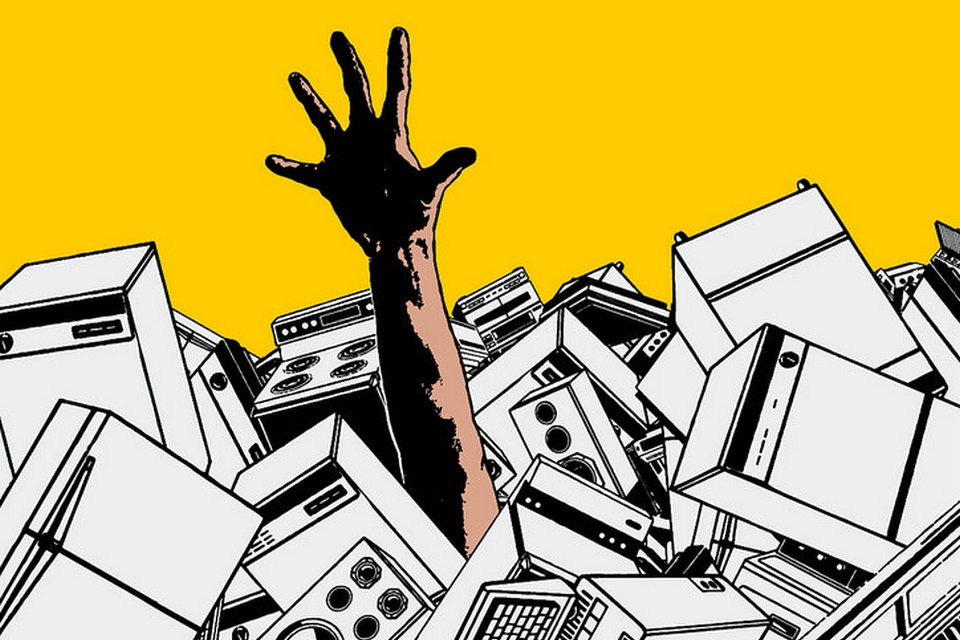
The electronics industry presents a parallel story. Planned obsolescence – the deliberate design of products with limited lifespans to encourage repeat purchasing – is one of the more explicit expressions of consumerism’s logic. Smartphones are updated annually. Software updates are designed to slow older devices. Repair is made deliberately difficult or expensive, nudging consumers toward replacement rather than maintenance. The result is a growing mountain of electronic waste – e-waste – that contains both toxic materials like lead and mercury and valuable metals like gold and lithium. Most of this waste is not properly recycled. Much of it is shipped to developing countries where informal recyclers, often including children, process it in dangerous conditions, exposing themselves to toxic substances in exchange for tiny quantities of recoverable metal.
The broader ecological picture is sobering. Global consumption patterns are currently outpacing the Earth’s regenerative capacity. If everyone on the planet consumed at the rate of an average American, we would need roughly five Earths’ worth of natural resources to sustain it. The carbon emissions associated with the production, transportation, and disposal of consumer goods are a substantial driver of climate change. Deforestation – much of it driven by the expansion of agricultural land to produce food, feed livestock, and grow commodity crops – is accelerating biodiversity loss at a rate not seen since the mass extinction events of geological history. Consumerism is not the only cause of these crises, but it is deeply implicated in all of them.
The Social Fabric Under Strain
Beyond the environment, consumerism exerts profound pressures on social structures, relationships, and the quality of communal life. The relationship between consumer culture and inequality is complex and deeply important.
On one hand, the expansion of mass-market consumer goods has democratized access to comfort and convenience in ways that genuinely matter. The refrigerator, the mobile phone, clean water from a tap – these are not trivial luxuries. They have transformed everyday life for billions of people, reducing physical labor, improving health outcomes, and enabling new forms of communication and opportunity. The spread of consumer culture has, in many contexts, accompanied increases in life expectancy, literacy, and material security.
On the other hand, the logic of consumerism tends to concentrate wealth rather than distribute it. The profits generated by consumer economies flow disproportionately to shareholders, executives, and the owners of capital. Workers in manufacturing and retail – particularly in global supply chains – often earn wages that make the very goods they produce unaffordable to them. The woman stitching garments in a Bangladesh factory earns a fraction of the retail price of the jacket she makes. The miner extracting cobalt for electric vehicle batteries in the Democratic Republic of Congo lives in poverty in one of the most resource-rich countries on earth. Consumerism, in its current form, does not merely reflect inequality – it often perpetuates and deepens it.
Consumer culture also shapes the nature of social relationships in ways that are not always obvious. When identity is constructed primarily through consumption – when who you are is expressed by what you own, wear, drive, and display – relationships can become transactional. People are valued as audiences for one’s consumption, or as competitors in a status game. The communal, non-commercial dimensions of life – shared public spaces, civic participation, religious community, neighborhood solidarity – can be crowded out by the imperatives of work and shopping. Time spent earning to buy is time not spent connecting, creating, or being present.
The phenomenon of consumer debt deserves particular attention in any analysis of consumerism’s social effects. When consumption is financed by borrowing, the future is mortgaged to fund the present. Household debt in many countries has reached historic levels. Credit card debt, personal loans, and buy-now-pay-later schemes keep millions of people in a state of permanent financial anxiety. This anxiety is not merely a personal burden – it has systemic effects on public health, family stability, and social cohesion. Financial stress is one of the leading causes of depression, relationship breakdown, and reduced civic participation. A society in which a large portion of the population is struggling with debt is a society in which consumer culture has extracted a heavy toll.
Identity, Meaning, and the Emptiness Within
Perhaps the most intimate effect of consumerism is its colonization of identity and meaning. In previous eras, people derived their sense of self from religion, community, craft, family, and place. These sources of identity were, in many ways, more stable and more richly interconnected than consumer identity. They did not require a credit card. They were not subject to seasonal trends. They could not be recalled or made obsolete.
Consumer culture offers a different deal: identity through purchase. You can buy the aesthetic that expresses who you want to be. You can curate your home, your wardrobe, your technology, and your leisure activities to project a particular self to the world. This is not entirely without value – human beings have always used material objects to express identity, and there is something real and meaningful in the craft of choosing objects that resonate with one’s sensibilities. But when identity becomes primarily a matter of consumption, it acquires a disturbing instability. If who you are is defined by what you own, then what happens when you can no longer afford to keep up? What happens when the trends shift and your carefully assembled self-expression becomes dated? What happens when you look inward and find not a person but a collection of purchases?
Psychologists who study wellbeing consistently find that material acquisition, beyond a threshold of basic security and comfort, is a poor predictor of life satisfaction. What actually correlates with deep happiness is the quality of one’s relationships, a sense of purpose and meaning, the experience of autonomy and competence, and connection to something larger than oneself. Consumerism, at its most aggressive, tends to crowd out precisely these conditions. It encourages individualism over community, novelty over depth, display over authenticity.
The concept of “retail therapy” is revealing. The phrase acknowledges, almost casually, that people shop to manage emotional pain – to soothe anxiety, loneliness, boredom, and sadness. And it works, briefly. The surge of dopamine associated with anticipation and acquisition provides genuine short-term relief. But it does not address the underlying emotional need. It provides a behavioral shortcut around the harder, slower work of genuine emotional processing, social connection, and meaning-making. Over time, it can become a compulsive pattern – what researchers call compulsive buying disorder – in which shopping ceases to be a pleasurable choice and becomes an uncontrollable response to negative emotion.
Children, Advertising, and the Early Induction
One of the most ethically troubling dimensions of consumer culture is its targeting of children. Children are among the most vulnerable audiences for advertising because their cognitive defenses against persuasion are not yet fully developed. Young children, particularly below the age of eight, often cannot distinguish between advertising and entertainment content. They absorb brand messages as straightforward truths. They experience desires shaped by marketing without the metacognitive tools to interrogate those desires.
The targeting of children by consumer brands begins remarkably early. Toy advertising, fast food marketing, children’s media saturated with branded characters and merchandise tie-ins – these are not incidental features of childhood in the consumer age. They are deliberate strategies to build brand loyalty from the earliest possible age, knowing that preferences formed in childhood tend to persist into adulthood. Children become vectors for consumer desire in households, nagging parents for products they have seen advertised, translating marketing messages into family purchasing decisions.
The rise of digital platforms and YouTube has created new frontiers for child-directed marketing. Unboxing videos – in which children or adults unwrap and display new toys, games, and products – have become one of the most watched genres on YouTube, with some child influencers accumulating hundreds of millions of views. The line between play and advertising in this content is largely nonexistent. Children watch other children receive and enjoy products, and the desire to have the same experience is direct and powerful.
The long-term effects of early and intensive exposure to consumer culture on children’s values, expectations, and psychological development are a growing area of concern. Research suggests that children who grow up in highly commercialized environments tend to place greater emphasis on material wealth as a source of happiness, show higher levels of materialistic values in adulthood, and report lower levels of life satisfaction than peers who grew up in less commercialized contexts.
Consumerism and the Global South
The story of consumerism cannot be told honestly without grappling with its global dimensions and its profoundly unequal geography. The consumption that drives climate change, resource depletion, and waste generation is overwhelmingly concentrated in wealthy nations. The ecological consequences of that consumption are disproportionately borne by the poorest and most vulnerable nations and communities.
Rising sea levels threaten Pacific island nations that have contributed negligibly to global carbon emissions. Droughts intensified by climate change devastate farmers in Sub-Saharan Africa who own no car, no air conditioner, and no significant accumulation of consumer goods. Toxic waste from wealthy-country electronics is processed in slums in Ghana, India, and China by workers who have no meaningful choice. The supply chains of consumer goods reach into the Global South for raw materials – minerals, agricultural products, textiles – under conditions that are often exploitative and environmentally destructive.
At the same time, consumer aspirations are spreading rapidly in the Global South as incomes rise and the aspirational messaging of global brands penetrates new markets. The middle classes of India, China, Brazil, and many other nations are growing, and with growth comes increased consumption. This is, in human terms, entirely understandable and in many ways a legitimate expression of development and improved living standards. But it raises profound questions about whether the consumer model that wealthy nations have built is scalable to a global population of eight billion people. The mathematics of planetary resources suggest that it is not. If the world’s emerging middle classes consume at anywhere near the rate of their counterparts in Europe or North America, the ecological consequences would be catastrophic.
This creates a deeply uncomfortable ethical dilemma. Wealthy nations built their prosperity on unconstrained consumption and now, having caused the bulk of the ecological damage, find themselves in the position of asking developing nations to constrain their own development in the name of planetary sustainability. The injustice embedded in this position is not lost on leaders and populations in the Global South, and it is a central tension in global climate negotiations.
The Rise of Counter-Movements
Consumerism does not go unchallenged. Across the world, in varying forms and with varying degrees of coherence, people are questioning the assumptions of consumer culture and seeking alternatives. These movements are diverse – sometimes complementary, sometimes contradictory – but together they represent a significant cultural reckoning with the costs of endless consumption.
Minimalism, as a lifestyle philosophy, has gained considerable traction in the past decade. Its core argument is simple: owning fewer things frees you. Fewer possessions mean less financial pressure, less clutter, less maintenance, and paradoxically more clarity and contentment. Books like Marie Kondo’s approach to decluttering and the broader minimalist movement on social media – somewhat ironically promoted through the same platforms that drive consumer desire – have resonated with millions of people who feel overwhelmed by their own accumulations.
The slow food and slow fashion movements advocate for a different relationship with goods: fewer, better, more thoughtfully produced. Where fast fashion encourages disposability, slow fashion encourages quality, durability, ethical production, and conscious consumption. Where industrial food production prioritizes speed and scale, slow food prioritizes taste, tradition, local sourcing, and ecological sustainability. These movements are not anti-consumption per se – they recognize that people will always need food and clothing – but they propose a fundamentally different logic of consumption.
The circular economy is an emerging economic framework that challenges the traditional “take, make, dispose” model of industrial production. In a circular economy, products are designed for longevity, repairability, and recyclability. Waste from one process becomes input for another. Ownership is sometimes replaced by access – car-sharing, tool libraries, clothing rental services. The goal is to decouple economic activity from resource consumption, to grow value without growing the material throughput of the economy. It remains, at present, more aspiration than reality, but it is gaining traction in policy circles and among forward-thinking businesses.
The degrowth movement goes further, arguing that the very goal of perpetual economic growth – the underlying logic that requires ever-increasing consumption – must be abandoned. Degrowth economists argue that wealthy nations should deliberately reduce their material consumption, redistribute wealth, and restructure their economies around wellbeing rather than GDP growth. This is a radical proposition, deeply threatening to the political and economic establishment, and it faces enormous practical and political obstacles. But it is gaining academic and intellectual credibility as the ecological consequences of growth-based economics become increasingly undeniable.
Technology’s Double Role
Technology occupies a paradoxical position in the story of consumerism. On one hand, it is among the most powerful drivers of consumption – the smartphone in your pocket is a portal to an infinite marketplace, available at any moment, calibrated by algorithms to show you what you are most likely to buy. On the other hand, technology offers some of the most promising tools for reducing the ecological footprint of consumption and enabling new, less resource-intensive ways of meeting human needs.
E-commerce has made shopping frictionless to an almost unsettling degree. One-click purchasing, same-day delivery, algorithmically curated recommendations, dynamic pricing that creates a sense of urgency – these are not neutral conveniences. They are deliberately designed features of a system engineered to minimize the psychological resistance to purchasing. The act of spending money, which once required physical presence, tangible cash, and a moment of conscious decision, has been progressively dematerialized into an almost involuntary gesture.
Yet the same digital infrastructure that enables frictionless consumption also enables the sharing economy, peer-to-peer exchange, access models that reduce the need for individual ownership, and platforms for secondhand trade. People can now rent equipment they rarely use, exchange clothing with strangers, share rides, and access libraries of music, film, and books without purchasing individual copies. These models, when genuinely adopted at scale, can reduce the material intensity of consumption without necessarily reducing the experiences and services that consumption was meant to provide.
Artificial intelligence is likely to reshape consumption patterns in ways that are not yet fully visible. On the one hand, AI-driven personalization will make advertising and retail recommendation more precise and more persuasive than ever before. On the other hand, AI tools could help consumers make more informed decisions, compare products more meaningfully, understand supply chains and environmental impacts, and plan purchases more deliberately. The direction of travel will depend heavily on who controls the technology and what incentives govern its deployment.
The Path Forward
The question that hangs over all analysis of consumerism is whether change is possible – whether human societies can reconfigure their relationship with consumption without sacrificing the genuine goods that material progress has delivered, and whether they can do so at the speed that ecological reality demands.
The honest answer is that nobody knows. The forces driving consumerism are powerful, deeply institutionalized, and globally distributed. The advertising industry spends trillions of dollars annually persuading people to consume more. The financial system is structured around growth, and growth requires consumption. Political leaders in most countries are evaluated primarily on their success in expanding GDP, which is itself largely a measure of consumer spending. The entire architecture of modern life – urban design, work culture, social norms – is organized around consumption.
And yet the evidence is accumulating that the consumer model is unsustainable – ecologically, psychologically, and socially. The ecological limits are the most urgent and the least negotiable. The planet will not adjust its physics to accommodate an infinite growth model. At some point, consumption must be brought into alignment with planetary boundaries, whether by choice or by the far more painful mechanism of ecological collapse.
The more hopeful scenario involves a genuine cultural shift – a broad renegotiation of what prosperity means, what success looks like, and where satisfaction is sought. There are tentative signs that such a shift is underway, particularly among younger generations who report greater skepticism about consumer culture, greater concern for environmental sustainability, and greater emphasis on experience, community, and purpose over material accumulation. Whether these inclinations survive the pressures of debt, aspiration, and advertising as these generations age into full economic participation remains to be seen.
What is clear is that the conversation matters. Awareness of the mechanisms of consumerism – its psychological architecture, its environmental costs, its social consequences – is a necessary first step toward any meaningful change. You cannot critique a system you cannot see. And consumer culture, with considerable sophistication and at enormous expense, works hard to remain invisible – to feel not like a system at all but like common sense, like freedom, like the natural expression of human desire.
Understanding that it is a constructed system, one that serves particular interests and produces particular consequences, is the beginning of agency. It does not require renouncing all pleasure in objects, or retreating to a life of ascetic simplicity, or feeling guilty about every purchase. It requires something more modest and more sustainable: a willingness to examine what you want, why you want it, and whether having it will deliver what you actually seek.
The hunger that consumerism cultivates is real. But it is often hunger for something that objects cannot provide – for connection, for meaning, for the quiet satisfaction of a life lived in accordance with one’s actual values. Recognizing this does not end the hunger. But it begins the search for a more nourishing answer.