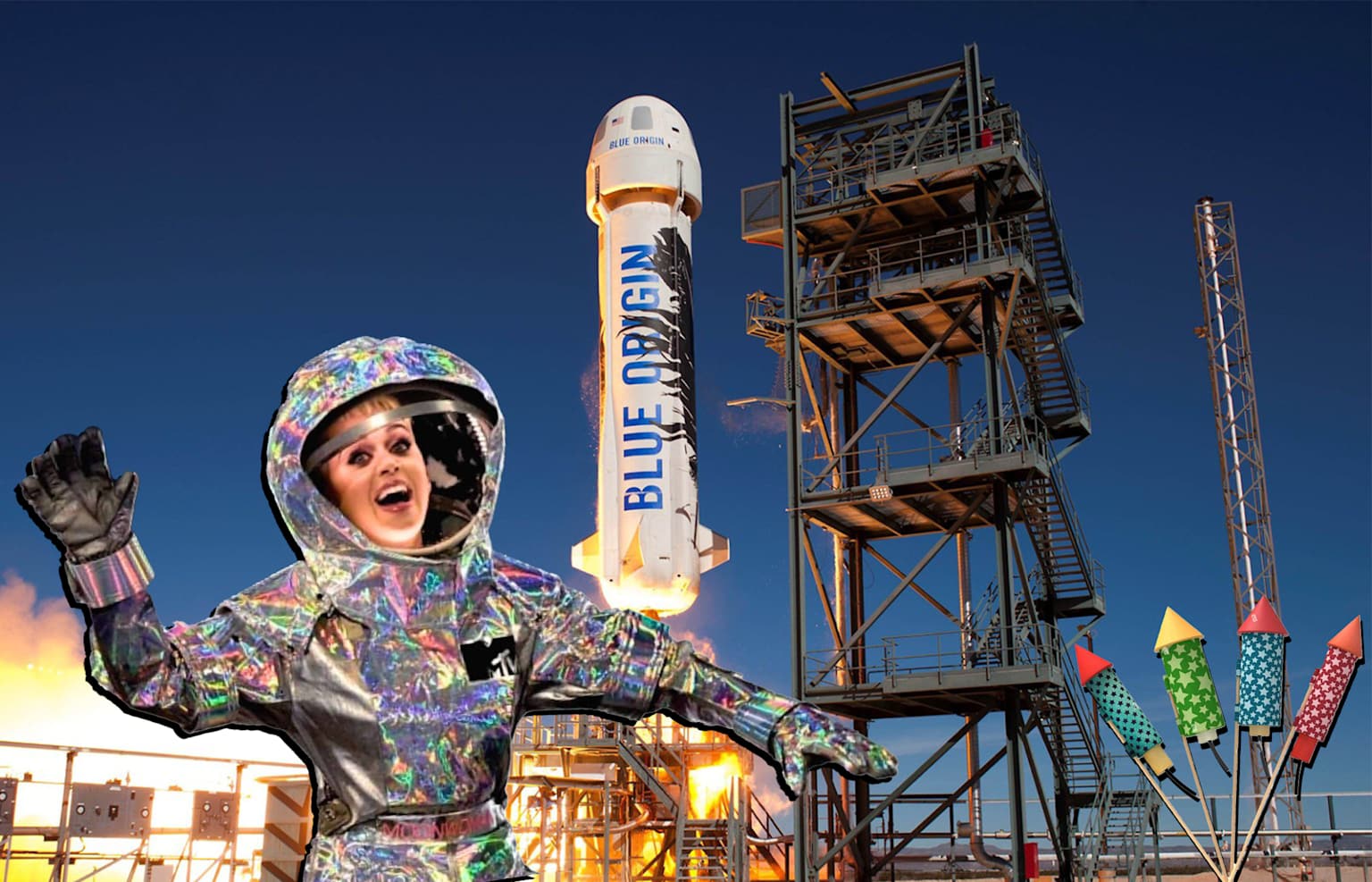
On the morning of April 14, 2025, six women strapped themselves into a capsule atop a Blue Origin New Shepard rocket in the West Texas desert, and for approximately eleven minutes, they left the Earth behind. They crossed the Kármán line – the internationally recognized boundary of space, sitting 62 miles above sea level – experienced three minutes of weightlessness, saw the curvature of the planet below them, and came back down in a capsule slowed by parachutes, landing in the scrubby expanse of the Chihuahuan Desert. It was, by any objective measure, an extraordinary physical experience.
Among the six women was Katy Perry, one of the best-selling pop artists of the 21st century, whose anthems like “Roar,” “Firework,” and “Teenage Dream” once made her virtually untouchable in mainstream culture. There was also Gayle King, the CBS Mornings anchor who has long been one of America’s most trusted broadcasters. There was Lauren Sánchez, former television journalist, helicopter pilot, and the fiancée of Jeff Bezos himself – the man who owns Blue Origin and who personally walked the crew to the launch pad. Rounding out the crew were three women with substantive professional credentials: Aisha Bowe, a former NASA rocket scientist and STEM entrepreneur; Amanda Nguyen, a bioastronautics researcher, Nobel Peace Prize nominee, and civil rights activist who became the first Vietnamese woman in space; and Kerianne Flynn, a film producer.
The mission was called NS-31. It was Blue Origin’s 11th crewed spaceflight. And within hours of those six women returning to Earth, it had become the most mocked, dissected, celebrated, condemned, and meme-ified event in recent pop-cultural memory.
This is the full story of what happened, why it happened, who it actually served, and what it reveals about the strange, complicated, and often uncomfortable intersection of celebrity, billionaire wealth, feminism, and the final frontier.
The Mission: What Actually Happened Up There
Let’s start with the facts, because they matter before the commentary begins.
Blue Origin’s New Shepard is a fully automated, suborbital rocket system. There is no pilot, no manual controls, and no real “astronaut” in the traditional sense – the capsule is a passenger vehicle that launches, separates from its booster, coasts to the edge of space, and returns to Earth entirely under computer control. The booster itself lands vertically after separation, a reusable marvel of modern aerospace engineering. The passengers sit in a ring of large windows designed to maximize their view of the planet below.
The NS-31 mission lifted off at 9:30 a.m. EDT on April 14, 2025, from Blue Origin’s Launch Site One near Van Horn, Texas. The total flight duration was approximately 10 to 11 minutes. The capsule crossed the Kármán line – the 62-mile altitude boundary recognized as the edge of outer space – and the crew experienced roughly three minutes of weightlessness before the capsule began its descent. They landed safely in West Texas, and the crowd of spectators, which included Oprah Winfrey, Kris Jenner, Khloé Kardashian, former astronauts Mae Jemison and Jeanette Epps, erupted in celebration.
Katy Perry’s behavior during and after the flight became iconic almost immediately – and not entirely in a positive way. She sang Louis Armstrong’s “What a Wonderful World” in zero gravity. She held up the setlist for her upcoming Lifetimes Tour to a camera while floating weightless. She kissed a daisy she had brought on board as a symbol of life and Earth’s beauty. And when she landed, she got down on her knees and kissed the ground.
These were genuine, emotional moments. They were also moments that would be clipped, replayed, and torn apart on social media for weeks.
The Crew: Beyond the Headlines
Before diving into the firestorm, it’s worth understanding who actually flew on NS-31, because the conversation around this mission often flattened six distinct individuals into a monolith.
Lauren Sánchez organized the flight herself. She is the one who personally invited each crew member, curated the group, and brought this specific mission into existence. As Bezos’s fiancée and a helicopter pilot, her connection to both the private space industry and aviation is not merely decorative. She has described her vision for the mission as one of inspiration – a desire to show women and girls that space was accessible and achievable.
Aisha Bowe is arguably the most credentialed person on the flight from a pure aerospace standpoint. She worked at NASA and later founded STEMBoard, a technology company focused on building pathways for underrepresented communities in STEM fields. Her presence on the flight was not a vanity exercise – she has spent her career working to make science and engineering more accessible to people who have historically been excluded.
Amanda Nguyen is equally formidable. She is a bioastronautics researcher and a Nobel Peace Prize nominee who became famous for her relentless advocacy for sexual assault survivors, which led to the passing of the Sexual Assault Survivors’ Rights Act in the United States. She became the first Vietnamese woman in space on this flight, a milestone that carries genuine historical weight.
Gayle King is one of America’s most respected broadcast journalists. In the days before the launch, her close friend Oprah Winfrey told reporters that for King, this trip “meant much more than just a trip to space” – it represented a conquest of personal fear and a commitment to continued growth.
Kerianne Flynn is a film producer. Her inclusion was less immediately obvious to the public, but she brings a background in storytelling and visual narrative to the mission.
And then there is Katy Perry, the pop star, whose presence was the most celebrity-driven of the group but whose enthusiasm for the mission was unambiguous. “I’ve dreamt of going to space for 15 years and tomorrow that dream becomes a reality,” she wrote on social media the night before the launch.
The Symbolism They Were Selling
Blue Origin, and more specifically Lauren Sánchez, framed NS-31 as something beyond a tourist flight. The company and its PR apparatus leaned into the language of empowerment, historic firsts, and female representation. And there were legitimate firsts to claim.
The mission was billed as the first all-female spaceflight since 1963, when Soviet cosmonaut Valentina Tereshkova became the first woman in space – a solo flight that, ironically, was not followed by another female Soviet cosmonaut for nearly two decades. The comparison was significant. More than sixty years had passed without an all-female space crew of any kind, private or government-funded. In that context, NS-31 was genuinely unprecedented.
The crew represented a range of achievements: a civil rights activist, a rocket scientist, a journalist, an entertainer, a filmmaker, and a pilot. The mission was designed to send a message: space is not just for white male test pilots and government-selected astronauts. Space, in the language of Blue Origin’s marketing, is “for everyone.”
That phrase – and the entire visual and narrative vocabulary of the mission – was constructed carefully. The crew wore matching flight suits. There were custom patches. There was careful attention to the optics of diversity (the crew was multiracial, spanning different professional backgrounds and age groups). There was the daisy motif that Katy Perry introduced as a symbol of Earth’s fragility and beauty. There was, in every conceivable way, an intention to make this look and feel like something more than a joyride.
The question the internet immediately – and furiously – asked: was it?
The Backlash: When the Rocket Landed, the Mockery Took Off
The online reaction to NS-31 was ferocious and multifaceted. It came from the left, from environmental activists, from feminist critics, from pop culture commentators, from comedians, and even from fellow celebrities.
The first wave was environmental. Activists pointed out the carbon footprint of a rocket launch for eleven minutes of tourism while the planet faces an accelerating climate crisis. The optics of burning rocket fuel so six wealthy women could experience weightlessness for three minutes, at a time when communities around the world are facing floods, droughts, and displacement, struck many observers as obscene.
The second wave was economic. With inflation still biting, with wages stagnant for millions of workers, with the cost of housing and healthcare pushing ordinary people to the brink, the spectacle of billionaire-funded celebrity tourism was read as an act of staggering insensitivity. The fact that Blue Origin declined to disclose how much the flight cost – or who exactly paid for it – only fueled speculation and resentment.
The third wave was feminist. This was perhaps the most interesting and philosophically rich line of criticism, and it came not just from random social media users but from respected cultural commentators. The core argument was that framing an experience available only to people with connections to one of the world’s wealthiest men as a feminist milestone was not just hollow – it was actively harmful to real feminist causes.
Sarah Manavis, writing in The Guardian, described the mission as “one small step for feminism and one giant leap for self-publicity,” arguing that Bezos’s branding of the flight as a “#girlbosswin” was “disturbingly dystopian” against a backdrop of rising wealth inequality and global backlash against feminist progress. She drew a direct line between the spectacle of the flight and the labor practices of Amazon, the company that made Bezos’s fortune – and pointed out the contradiction of using that fortune to fund a feminist PR moment.
The New Feminist called it “space feminism” – a term deployed with corrosive irony. The argument: empowerment becomes performance when it is funded by a male billionaire whose primary business is notorious for brutal working conditions. “What we saw wasn’t feminist advancement,” the publication argued. “It was a spectacle. A celestial girlboss moment, dressed up in custom suits, funded by a male billionaire.”
Al Jazeera’s opinion section was even blunter, headlining its piece: “Faux feminism has left the planet.” The subheading made the point with elegant cruelty: “As the planet burns and women struggle to survive, a billionaire’s fiancée claims inspiration from the edge of space.”
The Futurism headline captured the broader cultural mood: “Zillionaire Girlbosses Astonished by Backlash to Their Frivolous Trip to Space.”
Celebrity Pile-On: When Hollywood Turned on Katy Perry
What made the backlash particularly brutal for Katy Perry specifically was that it came not just from anonymous internet trolls, but from people within her own cultural world.
Actress and model Olivia Munn publicly labeled Perry and her crewmates “gluttonous” for the brief space excursion. This was a pointed, personal attack – not a critique of the system that enabled the flight, but a direct moral judgment of the women who took it.
Amy Schumer weighed in with mockery. Wendy’s – the fast-food chain that has built a brand identity around savage social media commentary – tweeted “Can we send her back?” upon Perry’s return to Earth. It was the kind of pile-on that, in previous years, Perry’s cultural armor might have deflected. But in 2025, she was already vulnerable.
The context of Perry’s declining popularity made the space trip land far harder than it might have otherwise. She had released a new album that was widely panned. Her lead single, “Woman’s World,” had been criticized in nearly all quarters for its reportedly regressive visual presentation – a music video that critics argued undermined the feminist message its title implied. The song was meant to be an anthem; it became a punchline.
Lily Allen went further. On her podcast “Miss Me?”, Allen called the flight “out of touch” in terms that were explicit and personal. She later walked back these comments, issuing an apology to Perry and acknowledging that while she stood by her critique of the flight’s optics, there was no justification for the personal pile-on. But the damage had been done.
Emily Ratajkowski called the celebrity joyride “wasteful and performative.” The internet served up a buffet of memes: Perry floating weightlessly singing “What a Wonderful World” while holding a daisy became a visual shorthand for a very specific kind of tone-deaf celebrity excess.
Slate compared the entire event to the “Imagine” video from 2020 – that infamous pandemic-era moment when a group of celebrities filmed themselves singing John Lennon’s anthem from their mansions, apparently genuinely believing they were offering comfort to a suffering world. “Far from uniting the world in love for our pale-blue dot,” Slate wrote, the Blue Origin flight was “a maddening reminder” of the distance between the ultra-rich and everyone else.
Katy Perry’s Response: Battered, Bruised, and Still Standing
Two weeks after the flight, Katy Perry broke her silence.
In an extensive message shared through a fan page, she addressed the criticism directly and emotionally. She described feeling “battered and bruised” by the response. She told her fans that “the online world” had attempted to turn her into a “human piñata.” She acknowledged that the internet had been ruthless – “a dumping ground for the unhinged and unhealed,” in her words – but she refused to collapse under it.
“Please know I am OK,” she wrote. “I have done a lot of work in understanding who I am and what truly matters.” She described her life as a “human experience” navigated with an audience, sometimes stumbling, sometimes falling, but always rising. “I keep looking to the light,” she said, “and in that light, new opportunities arise.”
Her fans rallied around her. They erected a temporary billboard in Times Square that read: “Know that you are safe, seen and celebrated.” Her Lifetimes Tour, which had launched on April 23 in New Mexico – just nine days after the flight – was surrounded by a cloud of controversy, but her fanbase showed up.
Perry’s response was notable for what it didn’t do: she didn’t apologize for going to space. She didn’t express regret for the trip itself. She acknowledged the pain of the backlash without conceding the premise that she had done something wrong by participating. In that sense, it was an emotionally honest rather than strategically managed response.
The Bigger Picture: What Billionaire Space Tourism Is Really About
To understand what NS-31 actually means, you have to understand what Blue Origin actually is – and who it serves.
Jeff Bezos founded Blue Origin in 2000, making it one of the oldest of the new generation of private space companies. For years it operated in relative obscurity while Elon Musk’s SpaceX grabbed the headlines. Blue Origin’s New Shepard rocket is a suborbital system, meaning it doesn’t achieve orbit – it goes straight up, crosses the Kármán line, comes straight back down. It cannot put satellites in orbit, cannot reach the International Space Station, cannot fly to the Moon. It is, in the language of the industry, a space tourism vehicle.
Bezos flew on the first crewed New Shepard flight in July 2021, alongside his brother Mark and two other passengers. Since then, Blue Origin has carried 58 people into space, including YouTubers, business leaders, celebrities, and scientists. The company has never disclosed a price list for its flights, though early tickets were reported to have sold in the millions of dollars range. The business model is clear: sell access to the experience of space to wealthy individuals and organizations, use that revenue to fund more ambitious aerospace goals, and build a brand narrative around the democratization of space.
The “democratization” framing is where it gets complicated. Space tourism, as currently constituted, is not democratic in any meaningful sense of the word. It is available to the extremely wealthy. The idea that Katy Perry’s eleven-minute flight “proves space is for everyone,” as she wrote on Instagram, is empirically false: space, under the current commercial model, is for people who can afford it or who are selected by people who can afford it. The vast majority of humanity has no more realistic access to a Blue Origin flight than they do to a private island.
This is not a criticism unique to Blue Origin. SpaceX’s tourist missions, Virgin Galactic’s flights, all of them operate on the same basic premise: wealthy people pay to have a transformative experience, and the industry frames this as progress toward a future in which space is more broadly accessible. The argument is that this is how most transformative technologies develop – expensive at first, gradually cheaper, eventually mass-market. That argument is not without merit. But it requires a certain tolerance for the fact that, in the meantime, space is exclusively for the rich.
What NS-31 added to this mix was the feminist branding – the specific claim that sending six women, even wealthy and well-connected women, was a statement about gender equality. And it was that framing, more than the flight itself, that triggered the most substantive criticism.
The “Girlboss” Problem: When Feminism Becomes a Marketing Strategy
The term “girlboss” has had a fascinating and troubled arc in modern culture. Coined as a term of empowerment for women who hustle, achieve, and break barriers, it has been progressively hollowed out until it became, in many circles, a term of mockery – shorthand for a specific kind of surface-level feminist aesthetics that prioritizes the advancement of individual wealthy women over structural change that benefits all women.
The girlboss is someone who “leans in” to a system designed to exploit the majority of workers, celebrates her own achievement as a feminist milestone, and packages individual success as collective liberation. She is not wrong to succeed. She is wrong to call her success a victory for women as a class.
NS-31 fit this template almost perfectly. Here were six accomplished women – genuinely accomplished, in most cases – doing something no all-female group had done since 1963. And yet the conditions under which they did it, and the entity that funded it, raised serious questions about what “progress” actually looked like here.
The women on the flight did not fight for greater access to space. They did not campaign for a government program to send more women to the ISS. They did not advocate for changes to NASA’s selection criteria or training programs. They were selected by one woman – Lauren Sánchez – who is in a relationship with one man – Jeff Bezos – who owns the rocket. The “access” being demonstrated was not structural. It was personal. It was, at its core, an exercise in who you know.
This is not to say that the women themselves are bad people or that their experiences were not genuine. Aisha Bowe’s work in STEM advocacy is real and valuable. Amanda Nguyen’s civil rights work is extraordinary. The fact that Amanda Nguyen became the first Vietnamese woman in space is a historical fact that cannot be taken away by the surrounding spectacle.
But the framing – the deliberate, calculated, PR-crafted framing of this flight as a feminist milestone – was something separate from the individual women and their individual merits. That framing was a product, manufactured for consumption, designed to make Jeff Bezos and Blue Origin look like agents of social progress at a moment when Bezos’s business practices, his treatment of Amazon workers, and his broader role in the growing wealth inequality crisis were under more scrutiny than ever.
The Environmental Reckoning
No honest accounting of commercial space tourism can avoid its environmental dimension, and NS-31 did not escape scrutiny on this front.
The New Shepard rocket uses a BE-3 engine powered by liquid hydrogen and liquid oxygen. Unlike the kerosene-burning rockets that produce black carbon soot directly into the upper atmosphere, New Shepard’s combustion produces primarily water vapor. Blue Origin has argued this makes its rocket more environmentally benign than competitors.
But this is a relative claim, not an absolute one. Any rocket launch releases significant energy, requires the production of industrial gases, and carries an environmental cost in its manufacture, transportation, and operation. More broadly, the normalization of suborbital tourism – the idea that the ultra-wealthy should routinely launch themselves above the atmosphere for personal entertainment – sets a precedent with environmental implications that extend beyond any single launch.
At a time when climate science is more urgent than ever, when extreme weather events are displacing millions, when global leaders are locked in difficult negotiations over carbon emissions, the sight of celebrities floating weightlessly for three minutes before landing back in the desert does not read as climate leadership. It reads as the opposite.
The environmental criticism was not about this one flight’s specific emissions – it was about the cultural signal. If space tourism is normalized, scaled up, and sold as aspirational, the aggregate environmental cost grows. And if the people most visible in space tourism are pop stars and billionaires, rather than scientists and engineers with clear research objectives, the message it sends about whose comfort and whose experiences are prioritized in the contest for atmospheric access is troubling.
The Historical Context: Women and Space
The comparison Blue Origin made to Valentina Tereshkova’s 1963 flight deserves examination, because it was both accurate and, in some ways, misleading.
Tereshkova was not a wealthy tourist. She was a Soviet textile factory worker who applied to the cosmonaut program and was selected in a class of five women – the only one of that group to actually fly. Her flight aboard Vostok 6 lasted nearly three days, not eleven minutes. She orbited the Earth 48 times. She performed experiments. She was, by any definition, a working astronaut.
The gap between Tereshkova’s flight and NS-31 is not just chronological. It is qualitative. And the fact that more than sixty years passed between the first all-female spaceflight and the second is itself an indictment of how slowly the established space agencies have prioritized female representation – a legitimate grievance that does not, however, transform a suborbital tourist hop into an equivalent achievement.
Women have been going to space in growing numbers since Sally Ride flew on the Space Shuttle Challenger in 1983. Women have served on the International Space Station. Women have conducted spacewalks. Christina Koch set the record for the longest single spaceflight by a woman. The story of women in space is long and rich and full of genuine heroism – heroism that is served poorly by being compared to an eleven-minute tourist flight.
Whose Dream, Exactly?
One of the most repeated phrases around NS-31 was Katy Perry’s Instagram declaration: “I’ve dreamt of going to space for 15 years.” It is a genuine expression of a genuine dream, and there is something moving about that. Dreams are not invalid because they are privately held. The desire to see the Earth from above, to experience weightlessness, to stand – however briefly – at the boundary of the known world: these are profound human aspirations.
But there is a difference between a dream and a right. And there is a difference between the fulfillment of one person’s dream and the advancement of a cause.
The framing of NS-31 as a feminist milestone asked the public to accept that Katy Perry’s dream coming true was, in some meaningful sense, a victory for all women. That is the logic of celebrity feminism at its most stretched. It asks us to feel collectively uplifted by the individual achievements of women who are already among the most privileged people on Earth.
This does not mean we cannot celebrate those achievements at all. But it does mean we should be clear-eyed about what is actually being achieved, and what is not.
The Post-Trip Reality: A Changed Landscape?
What actually changed after NS-31? In the weeks following the flight, several things happened.
The flight was certified as a historical first. The Blue Origin brand got significant international media coverage. Lauren Sánchez’s profile rose considerably. Amanda Nguyen’s milestone as the first Vietnamese woman in space was widely reported. Katy Perry’s Lifetimes Tour launched, and despite the surrounding controversy, she performed to crowds of fans who showed up to celebrate her.
What did not happen: there was no increase in government funding for gender-inclusive space programs. There was no policy announcement from NASA or any space agency about accelerated efforts to send all-female crews to the ISS or the Moon. There was no Amazon labor reform. There was no structural change to who gets to go to space and under what conditions.
Blue Origin continued its business. Jeff Bezos and Lauren Sánchez proceeded with their plans to marry in Venice. The New Shepard rocket stood ready for its next mission. And the internet moved on to the next controversy.
The Real Legacy: Spectacle in the Age of Inequality
The story of NS-31 is ultimately a story about spectacle – about the way powerful, wealthy interests have learned to dress themselves in the language of social progress without actually delivering the substance of it.
This is not a new phenomenon. Corporate Pride events have been selling rainbow merchandise since the 1990s while lobbying against LGBTQ+ rights in other arenas. Corporate diversity initiatives have been filling boardrooms with women and minorities while wages for the majority of female and minority workers remain suppressed. The machinery of representation has become extraordinarily sophisticated at identifying which images to project without changing the underlying structures those images are meant to represent.
Space, in this context, is simply the latest frontier – literally – for this kind of optics-driven “progress.” The message is powerful: even the cosmos can be gender-inclusive. The stars are accessible to women. The horizon is limitless.
The reality is more mundane: the horizon, for now, is accessible to women who know Jeff Bezos’s fiancée.
None of this changes the fact that Aisha Bowe floated above the Earth. None of it takes away from Amanda Nguyen’s historical milestone. None of it invalidates the genuine emotion on Katy Perry’s face when she kissed the ground upon landing. Individual experiences are not erased by systemic critique.
But systemic critique matters. It matters because the language of progress, deployed without the substance of progress, actively makes things worse. It tells people who are struggling that the fight has already been won – that women have made it to space, that barriers are falling, that things are improving – when the material conditions of most women’s lives remain unchanged or are actively worsening.
The backlash to NS-31 was not irrational. It was not simply the product of internet cynicism or celebrity schadenfreude. It was, at its core, an expression of exhaustion – exhaustion with being told that a billionaire’s vanity project is a feminist victory, that celebrity tourism is scientific progress, that girlboss moments constitute structural change.
Katy Perry kissed the ground when she landed. The internet kissed her career in a rather different way.
And somewhere in between those two kisses lies the truth about where we actually stand – as a culture, as a civilization, as a species trying to figure out who space belongs to, and at what cost, and in service of what values.
The stars are still up there. The questions are still down here.