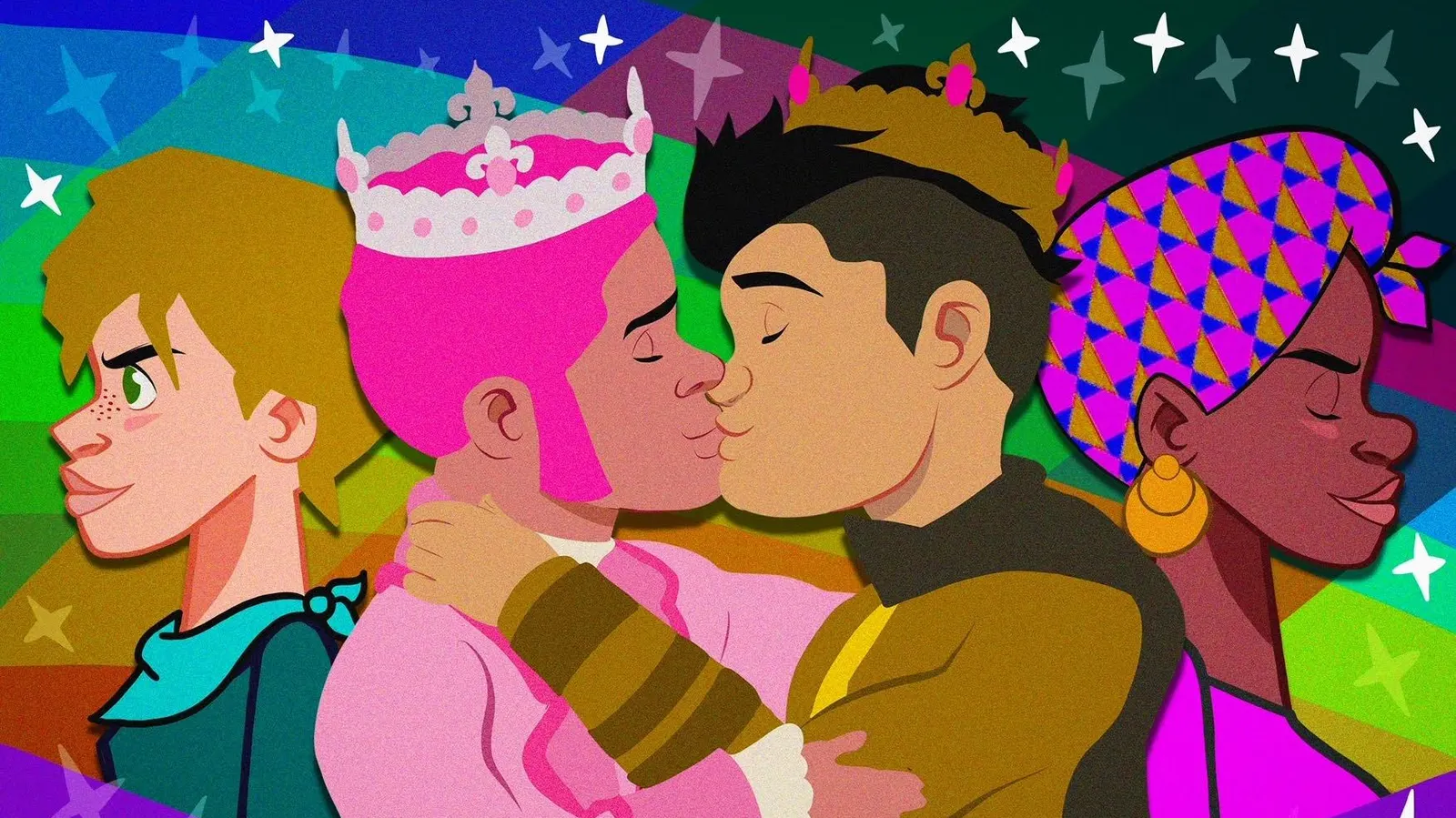
Once Upon a Different Time
Fairy tales have always been strange creatures. They shift and change depending on who tells them. The version your grandmother whispered to you at bedtime was probably nothing like what the Brothers Grimm scribbled down in their notebooks, and their version bore only passing resemblance to the oral traditions that came centuries before. Stories are living things. They breathe and grow and sometimes they need to be set free from the cages we have built around them.
For queer readers, those cages have felt particularly confining. Growing up on a steady diet of princesses kissing princes and heroes winning the hands of beautiful maidens leaves you with a peculiar kind of hunger. You search for yourself in these stories and come up empty. Maybe you learn to read between the lines. Maybe you convince yourself that the evil queen was just misunderstood, or that the two knights who traveled together shared more than just a horse. But it shouldn’t take that much work to find yourself in a story.
That is changing now. Writers across the world are picking up these ancient tales and asking what happens when we let them breathe. What happens when Cinderella falls for her fairy godmother instead? What happens when Achilles and Patroclus are allowed to love each other openly on the page? What happens when the beast is a woman and so is the beauty who learns to see past the curse?
The answers have been extraordinary.
Why Retelling Matters
There is something radical about taking a story everyone knows and making it new. Myths and fairy tales sit deep in our collective unconscious. They shape how we think about love, about heroism, about what makes someone worthy of a happy ending. When those stories only show one kind of love, they quietly teach us that other kinds do not deserve the same narrative weight.
Queer retellings push back against that silence. They are not just adding representation for the sake of it. They are arguing that queer love has always been epic, always been magical, always been worthy of the grandest stages our imaginations can build. When Madeline Miller writes Achilles and Patroclus as lovers in The Song of Achilles, she is not inventing something from nothing. She is drawing on centuries of scholarly debate and textual evidence that suggests their bond was more than friendship. She is saying out loud what readers have whispered for generations.
This matters because visibility changes things. A queer teenager picking up a retelling of Beauty and the Beast where both leads are women does not just get an entertaining story. They get permission. Permission to see themselves as the hero. Permission to believe their love story could be worth telling too.
The Mythology Renaissance
Greek and Roman myths have proven especially fertile ground for queer retellings. This makes a certain kind of sense. The ancient world had complicated relationships with sexuality and gender that do not map neatly onto modern categories. Zeus transformed into various creatures to pursue his desires. Dionysus blurred lines between masculine and feminine. Apollo loved Hyacinthus with a grief that still echoes through the pages of Ovid.
Writers today are reclaiming these stories with fresh eyes. Circe by Madeline Miller gives us a goddess who has been sidelined by history and lets her tell her own story. While the novel is not explicitly a queer retelling, it opens doors. It shows that these ancient women had interior lives far richer than the few lines they were given in the original texts.
Other authors have been more direct. There are retellings of Persephone and Hades that explore what happens when Persephone chooses the underworld, when she finds freedom in the dark rather than captivity. Some versions cast Persephone’s relationship with other goddesses as central to her journey. The pomegranate seeds become symbols of chosen desire rather than trickery.
The Medusa myth has attracted particular attention. Here is a woman punished for being assaulted, transformed into a monster, and then killed by a hero who never bothered to learn her name. Modern retellings ask what happens if we center her perspective. What if her gaze that turns men to stone is not a curse but a defense? What if her isolation on that island was also a kind of sanctuary? These versions often explore Medusa’s relationships with her sisters, the other Gorgons, finding queer possibility in that community of outcast women.
Fairy Tales Reimagined
If mythology gives us gods and monsters, fairy tales give us the architecture of romantic love itself. The castle, the ball, the midnight transformation, the kiss that breaks the curse. These elements have been repeated so many times that they feel inevitable. That is what makes it so satisfying when someone rearranges them into new configurations.
Ash by Malinda Lo was groundbreaking when it appeared in 2009. A lesbian Cinderella story that treated its romance with the same seriousness and beauty as any straight version. The slipper still fits. The ball still matters. But the hand reaching out at the end belongs to a huntress, not a prince.
Since then, the genre has exploded. Snow White stories where the princess and the queen are not enemies but lovers separated by circumstances. Sleeping Beauty tales where the curse of sleep is actually a refuge from a world that refused to accept who she was, and the awakening comes from finally finding someone who understands. Red Riding Hood narratives that lean into the wolfish, where the girl and the beast are not so different after all.
These stories often find queer possibility in elements that were always a little strange. Fairy tales are full of transformations. Frogs become princes. Beasts become men. Swans become maidens. If the genre already accepts that bodies can change through magic, then it becomes easier to explore what that might mean for characters whose bodies have always felt like cages. Transgender retellings of these transformation narratives have found particularly powerful resonance.
The Villain Question
One of the most interesting developments in queer retellings is the rehabilitation of villains. For decades, queer audiences have noticed that the most memorable characters in fairy tales were often the antagonists. The flamboyant sea witch. The dramatic evil queen. The stylish villain in the purple suit. It was not an accident. Coding characters as queer without explicitly naming them was a common technique, and villains offered more freedom for gender nonconformity and excess.
Modern retellings reckon with this legacy in different ways. Some authors give these characters their own stories, exploring what made them who they are. The sea witch was not born cruel. She was betrayed. The evil queen was not jealous of beauty. She was trapped in a system that pitted women against each other for male approval.
Other retellings refuse the villain designation entirely. They ask why we should accept the original framing. Maybe the stepmother is trying to protect her daughters from a system that will destroy them. Maybe the witch in the woods is simply living outside the rules of a kingdom that would burn her otherwise.
This villain reclamation is not about excusing bad behavior. It is about recognizing that queerness has often been cast as monstrous and asking what happens if we refuse that narrative. What if the monster is the hero of her own story?
Beyond the Binary
Some of the most exciting queer retellings are those that push beyond simple gender swaps. Switching a prince for a princess is meaningful, but it only scratches the surface of possibility. What about stories that question the binary entirely?
There are retellings now featuring nonbinary characters who find themselves in fairy tale landscapes that have no space for them and who must carve out that space through their own magic. There are stories where the transformation curse is not something to be broken but something to be embraced. The character does not want to return to their original form. They want to be something new.
Indigenous and non Western mythologies are also entering the conversation. Queer retellings of stories from cultures that historically recognized more than two genders offer something different from European fairy tales. They suggest that the narrowness of the stories we inherited was never universal. Other traditions had room for people who moved between categories, who embodied multiple truths at once.
The Future of Once Upon a Time
The boom in queer retellings shows no signs of slowing. Publishers have recognized the appetite for these stories. Readers keep buying them. Awards keep recognizing them. More importantly, writers keep finding new angles, new myths, new tales to transform.
What strikes me most about this movement is its generosity. These books are not trying to destroy the stories we grew up with. They are trying to make room at the table. You can still have your prince charming if you want him. But now you can also have your princess charming, your nonbinary sovereign, your hero who does not need anyone to complete them.
The best retellings understand that fairy tales were never really about the specific details. They were about longing and transformation and the hope that somewhere out there is a place where we finally belong. Queer readers have always felt that longing perhaps more sharply than most.
Now they are writing their own endings. And honestly? Those endings feel truer somehow. They feel earned. They feel like the stories were always reaching toward these versions and just needed someone brave enough to write them down.
Once upon a time, the stories did not include us. But stories can change. That is sort of the point of magic.