A Night That Refused to Play It Safe
The 98th Academy Awards, held on Sunday, March 15, 2026, at the Dolby Theatre in Hollywood, was one of the most electric, tense, and politically charged Oscar ceremonies in recent memory. From the moment Conan O’Brien stepped onto the stage with a sharp monologue that spared no one – not Hollywood, not streaming executives, not even the President of the United States – to the climactic announcement of Best Picture by Nicole Kidman, the night pulsed with an energy that felt deeply connected to the turbulent world outside the theater. This was not an Oscars night that shied away from its moment. It leaned into it.
Paul Thomas Anderson’s One Battle After Another emerged as the dominant force of the evening, claiming six Academy Awards including Best Picture, Best Director, Best Adapted Screenplay, Best Supporting Actor, Best Film Editing, and the newly inaugurated Best Casting award. It was a sweep that cemented Anderson’s legacy and placed the film firmly in the conversation of the great American political cinema. But it was not a night that belonged to one film alone. Ryan Coogler’s Sinners, a vampire thriller set against the backdrop of Jim Crow-era America, fought hard to the last, capturing four Oscars including Best Actor for Michael B. Jordan and Best Original Screenplay. Between these two Warner Bros. films – yes, both produced under the same studio banner – the night became a battle within a battle, a contest between two visions of American cinema that were equally urgent and equally magnificent.
The evening also bore witness to history-making firsts, deeply moving In Memoriam tributes, a rare tie in the Best Live Action Short category, the introduction of the first new Oscar category in over two decades, and a string of political acceptance speeches that echoed long after the applause faded. The 2026 Oscars was not merely a celebration. It was a statement.
Paul Thomas Anderson’s Triumph
There are filmmakers who wait their entire careers for a film like One Battle After Another. Paul Thomas Anderson, the genius behind Boogie Nights, Magnolia, There Will Be Blood, The Master, and Phantom Thread, did not wait. He earned it, film by film, decade by decade, until the Academy could no longer look away.
One Battle After Another is an adaptation of Thomas Pynchon’s novel Vineland, a book long considered unfilmable. Anderson took that challenge and transformed it into a satirical action-thriller that explores American extremism with a ferocity and wit that left critics breathless. The film stars Leonardo DiCaprio as a retired revolutionary who is dragged back into action against his will, forced to confront a nation that has lost its moral footing. It is a film that feels urgent, alive, and unsettling – the kind of cinema that does not ask you to sit comfortably.
Entering the night with 13 nominations, One Battle After Another had been the frontrunner for much of the awards season. It had swept major industry prizes, including the Producers Guild of America Award, which is historically one of the most reliable predictors of Best Picture. But the late surge of Sinners made the final hours of campaigning breathless and uncertain, and when Nicole Kidman finally stepped to the microphone to announce the winner, the room was as tense as the final scene of any thriller.
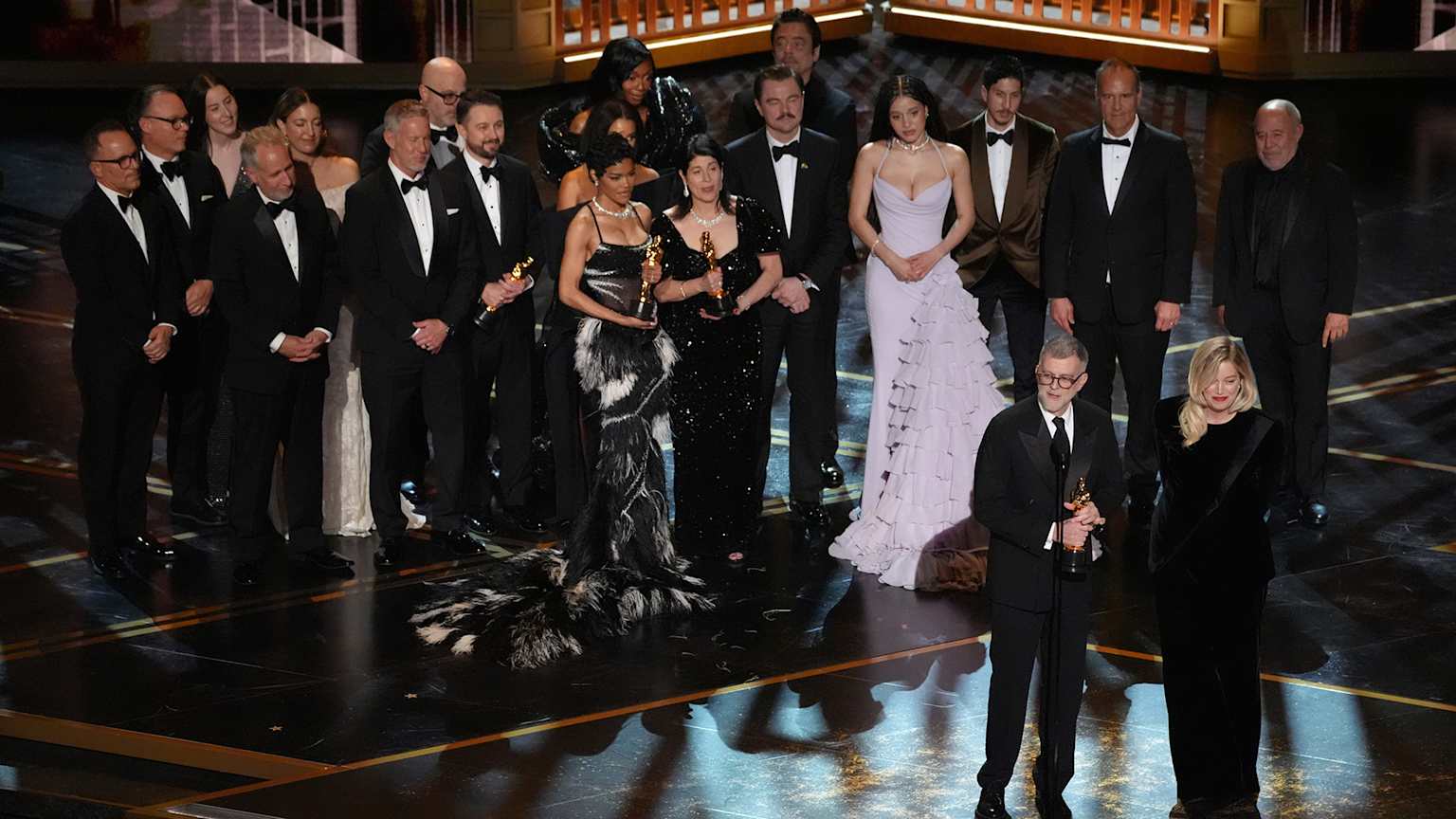
When the film’s name was called, the eruption in the Dolby Theatre was immediate. Anderson’s longtime partner, comedian and actress Maya Rudolph, had been holding onto his directing award, and the two embraced in a moment that was as warm as it was earned. Chase Infiniti, the film’s breakout star, jumped and screamed with uninhibited joy. Teyana Taylor, visibly moved, stood with tears in her eyes. And Anderson himself, breathless and beaming, held the Best Picture statuette with Leonardo DiCaprio beside him.
In his acceptance speech, Anderson showed both humor and humility. He began by recalling the 1975 Oscar race, a legendary year in which Dog Day Afternoon, One Flew Over the Cuckoo’s Nest, and Jaws competed against each other. “There is no best among them,” he said, “there is just what that mood might be that day.” He acknowledged falling short in his previous directing win by forgetting to recognize his cast. This time, he made it right. He turned to Chase Infiniti, and in a moment that silenced the room, said: “Chase, my American girl, Chase, you are the heart of this movie.” The young actress’s eyes filled with tears as the crowd erupted once more.
Producer Sara Murphy was equally emotional, calling the win the culmination of a “wonderful journey.” The award was also accepted in memory of the late Adam Somner, a beloved figure in the film’s production. Anderson’s six-Oscar haul was a testament not just to the film’s quality, but to its resonance in a moment when American cinema is grappling with the same questions the film asks: What does it mean to fight for something? What does it mean to lose your country, piece by piece?
Sinners: The Film That Almost Stole Everything
If there was a film that came closest to pulling off an upset, it was Sinners. Ryan Coogler’s supernatural thriller, set in the American Deep South of the 1930s, was a genre masterpiece – a film that used the trappings of vampire mythology to explore the violence, beauty, and spiritual weight of Black American life. It was bold, gorgeous, and deeply felt, and the Academy recognized it with four major awards.
The most celebrated of those wins was Michael B. Jordan’s Best Actor award. Jordan, 39, has been one of the most gifted actors of his generation, and his work in Sinners – playing twin brothers Smoke and Stack, men caught between the brutality of Jim Crow and the supernatural horror of immortal evil – was widely regarded as the performance of his career. His victory was emotionally charged. “God is good,” he said onstage, echoing a line from the film. He thanked Warner Bros. for “betting on culture and original ideas,” and his speech was a tribute to Coogler, his longtime collaborator and friend.
Their partnership began with Fruitvale Station in 2013, and over more than a decade, Coogler and Jordan have built something rare in Hollywood: a relationship defined by artistic trust, cultural integrity, and a shared belief that stories about Black American life are stories about all of American life. Sinners was their most ambitious collaboration yet, and the Best Actor win felt like a coronation.
Coogler himself received the Best Original Screenplay award, the story of which is deeply personal. Sinners was inspired by his uncle’s passion for blues music, and the script weaves the mythology of the Delta blues into its supernatural narrative with extraordinary care. Coogler’s speech was direct and powerful, and it stood as a reminder that the most enduring movies are often the most personal ones.
Sinners also made history through one of its technical wins. In the Best Cinematography category, Autumn Durald Arkapaw made history as the first woman ever to win in that category. In her first nomination, she defeated seasoned veterans including Darius Khondji and Dan Laustsen, both of whom carry decades of celebrated work. Her win was a landmark moment for women in film, and the standing ovation she received was long and heartfelt. The images she captured in Sinners – the smoky, amber-lit juke joints, the moonlit fields, the visceral confrontations between the living and the undead – were a visual poem of the American South.
The Battle for Best Actor: Jordan vs. Chalamet
The Best Actor race was one of the most closely watched contests of the season. On one side stood Michael B. Jordan, 39, powerful and seasoned, with a career defined by integrity and collaboration. On the other stood Timothée Chalamet, 30, electric and ambitious, earning recognition for his role in Marty Supreme, a 1950s ping-pong drama that was as unexpected as it was critically lauded.
The contest became newsworthy beyond the films themselves when Chalamet made comments in an interview dismissing opera and ballet as irrelevant. “Nobody cares anymore,” he said, in remarks that quickly spread across social media and generated considerable backlash from the arts community. Whether intentional provocation or careless dismissal, the comments became a recurring theme throughout the night.
Director Alexandre Singh, accepting the award for Best Live Action Short Film, used his speech to rebuke the sentiment directly. “We can change society through art, creativity, theatre, ballet, and cinema,” Singh said from the stage, and the applause that followed made clear where the room stood. Host Conan O’Brien, never one to let a good tension pass by unexplored, addressed it with characteristic wit, joking about increased security measures at the ceremony and adding with a glance at Chalamet, “They’re just upset you overlooked jazz.” The audience roared.
In the end, Jordan prevailed. His win was not just personal – it was a statement by the Academy that the performance with the most depth, the most emotional truth, and the most cultural weight had been recognized. Jordan’s journey from Fruitvale Station to an Oscar stage is one of Hollywood’s most meaningful arcs, and his acceptance speech, filled with genuine gratitude and love for his collaborators, was everything an Oscar moment should be.
Conan O’Brien: The Host Hollywood Needed
Hosting the Oscars is widely considered one of the most thankless jobs in entertainment. The audience is enormous, the stakes are high, the live television format is unforgiving, and the history of hosts who have stumbled is long. Conan O’Brien, however, did not stumble. He soared.
O’Brien came prepared with sharp, self-aware humor that balanced political commentary with genuine warmth. In his opening monologue, he flagged that he would be getting political, daring anyone who objected to watch an alternative show hosted by Kid Rock – the American singer who, in February 2026, staged a competing halftime show to Bad Bunny’s Super Bowl performance. It was a joke that landed perfectly, acknowledging the culture wars with a wink rather than a lecture.
He took aim at the streaming industry with a joke about Netflix CEO Ted Sarandos: “Netflix CEO Ted Sarandos is here and this is exciting: This is his first time in a theater.” The bit played on the long-running tension between streaming platforms and the theatrical experience, and it got a huge laugh. O’Brien’s comedy is the rare kind that can skewer everyone in the room while making them feel included in the joke.
Previous Oscars host Jimmy Kimmel also appeared during the ceremony and took his own swipes, noting the importance of documentary filmmakers who work in countries that “don’t believe in free speech,” and joking that he wasn’t able to say which ones – before landing on North Korea and CBS. He also referenced President Donald Trump’s wife Melania, whose documentary, released in 2026, did not qualify for the awards cycle, quipping that Trump would be upset about the oversight. The moment was sharp and brief, landing without overstaying its welcome.
By the end of the night, Esquire had already declared O’Brien “one of the greatest hosts in the ceremony’s storied history.” It was a title well earned.
Resistance Takes the Stage
The 2026 Oscars was not an evening that kept politics in the green room. From documentary speeches to hosting jokes to brief remarks by presenters, the political world outside Hollywood found its way inside the Dolby Theatre repeatedly, and the audience largely welcomed it.
The most striking political moment came during the acceptance speech for Best Documentary Feature, which went to Mr. Nobody Against Putin. Directed by David Borenstein, the film follows a young Russian schoolteacher who wages quiet, personal resistance against Russia’s war on Ukraine. The film is not about heroism in the grand, cinematic sense. It is about the small moral choices that accumulate into complicity or courage.
Borenstein’s speech was measured but pointed. “When we act complicit, when a government murders people on the streets of our major cities, when we don’t say anything, when oligarchs take over media and control how we produce it,” he said, his words falling into an increasingly quiet room. The speech came in the immediate aftermath of the killing of two Americans in Minneapolis by immigration agents, and the connection – unspoken but understood – was unmistakable.
The film’s subject matter, the erosion of civil society through small surrenders of principle, resonated far beyond the context of Ukraine. It was the kind of documentary that the Academy recognized not just as excellent filmmaking but as necessary art.
Co-presenter Javier Bardem, who appeared alongside Priyanka Chopra Jonas during one segment of the evening, demanded a “Free Palestine” from the stage, another moment that drew significant attention. The Oscars stage has long served as a platform for political expression, and in 2026, that tradition showed no signs of fading.
A Moment of Grief: The In Memoriam
Every year, the Academy’s In Memoriam segment serves as a pause – a collective breath of remembrance in the middle of a long, glamorous evening. In 2026, the segment was particularly extended, reflecting a year of significant losses in Hollywood.
Among those honored was director Rob Reiner, the legendary filmmaker behind When Harry Met Sally, A Few Good Men, and Stand by Me, who died alongside his wife Michele on December 14, 2025, at their home in the upscale Brentwood neighborhood of Los Angeles. Reiner was remembered by his close friend Billy Crystal, whose tribute was tender and personal.
Robert Redford was also honored. Barbra Streisand, who starred opposite Redford in The Way We Were, delivered a heartfelt tribute, calling him “a brilliant, subtle actor” and “an intellectual cowboy.” She concluded her remarks by singing a few lines from the film’s iconic title song – a spontaneous, quietly devastating moment that drew a long silence followed by sustained applause. It was one of the most purely emotional moments of the evening, a reminder that Hollywood’s greatest power is its capacity for memory.
History Is Made: New Category, Historic Tie
The 2026 ceremony made history in two specific and fascinating ways, both of which deserve their own recognition.
First, the Academy introduced the Best Casting award, the first new category to be established since Best Animated Feature Film was added in 2001. The award formally acknowledges the often invisible but critically important work of casting directors, whose decisions shape the entire creative identity of a film. Cassandra Kulukundis received the inaugural award for her work on One Battle After Another, and her emotional acceptance speech was a recognition not just for herself but for an entire discipline that has long been overlooked by the industry’s official awards structure.
Second, in the Best Live Action Short Film category, there was a tie – only the seventh in Oscars history and the first since 2013. The Singers and Two People Exchanging Saliva shared the honor, both called to the stage in a moment of rare, delighted symmetry. Ties at the Oscars are so uncommon that they have the quality of a small miracle, and the room received this one with genuine warmth.
Jessie Buckley Claims Best Actress
The Best Actress race had been one of the most hotly discussed of the season. Five extraordinary women competed: Jessie Buckley for Hamnet, Rose Byrne for If I Had Legs I’d Kick You, Kate Hudson for Song Sung Blue, Renate Reinsve for Sentimental Value, and Emma Stone for Bugonia.
Jessie Buckley won for her performance in Hamnet, a film directed by Chloé Zhao and based on Maggie O’Farrell’s novel about the son of William Shakespeare and the grief-stricken parents who survive him. Buckley, the Irish-British actress known for her extraordinary range in Wild Rose, I’m Thinking of Ending Things, and Women Talking, delivered what many critics called a career-defining performance, capturing grief, love, and defiance in equal measure.
Her win was not only a personal triumph but a recognition of a film – and a director – that brought literary, feminine, emotionally complex storytelling to the biggest stage in cinema. Chloé Zhao, nominated for Best Director for Hamnet, did not take home the directing award, losing to Anderson. But the film’s Actress win ensured that its voice was heard on the night’s biggest stage.
Supporting Performances That Stole the Night
Sean Penn won Best Supporting Actor for his role in One Battle After Another, adding another Oscar to a career that has already produced two wins. Penn, however, was absent from the ceremony, and the award was accepted on his behalf. His absence drew attention but not surprise – Penn has never been defined by his comfort with ceremony. His performance in the film, described by critics as ferocious and self-lacerating, was considered one of the most committed supporting turns of the year.
Amy Madigan won Best Supporting Actress for her portrayal of Aunt Gladys in Weapons, a film that generated significant conversation during the awards season. Madigan, a veteran of stage and screen whose work spans decades, was overwhelmed at the podium. Her thank-you to her fellow nominees was genuine, emotional, and without affectation. The win was a reminder that the Oscars, at their best, reward persistence and craft over youth and profile.
The Technical Awards: Craft in Full Bloom
Beyond the headline categories, the 2026 Oscars honored an extraordinary range of technical achievement. Frankenstein, Guillermo del Toro’s gothic reimagining of Mary Shelley’s classic, swept the craft categories, winning Best Production Design, Best Costume Design, and Best Makeup and Hairstyling. Del Toro’s film was a visual feast, and these wins affirmed that great genre filmmaking, when executed at the highest level, deserves recognition alongside more conventionally prestige-minded fare.
The racing drama F1 won Best Sound, a testament to the film’s immersive, thunderous sonic design. Avatar: Fire and Ash claimed Best Visual Effects, continuing the franchise’s tradition of pushing the technological frontier of cinema forward. Best Film Editing went to Andy Jurgensen for One Battle After Another, further cementing the film’s technical dominance.
The Best Original Score award went to Sinners, and Best International Feature Film was awarded to Norway’s Sentimental Value, directed by Joachim Trier. Trier had been nominated for Best Director as well, and the international win was a meaningful recognition of a film that moved audiences and critics deeply.
KPop Demon Hunters: Animation’s Big Night
One of the more surprising and delightful stories of the 2026 Oscars was the success of KPop Demon Hunters, an animated feature that charmed its way into the Academy’s heart and walked away with two awards: Best Animated Feature Film and Best Original Song for the track Golden.
Director Chris Appelhans used his Best Animated Film acceptance speech to deliver one of the most memorable lines of the night. “Keep telling your story,” he told viewers. “The world is waiting.” It was a simple message, but it landed with the force of a full-throated manifesto – a reminder that animation is not a lesser form of cinema, but a distinct and powerful language for storytelling.
The film’s dual wins made it the surprise champion of its particular corner of the evening, and the enthusiasm of its creators was infectious. In a night marked by intensity and political weight, KPop Demon Hunters brought genuine joy.
Warner Bros.: A Studio’s Remarkable Night
Behind the scenes of all the glamour and competition, there was a corporate narrative of unusual interest. Both One Battle After Another and Sinners – the two dominant films of the evening, combining for ten Oscars between them – were produced by Warner Bros. This made the night a remarkable showcase for a studio that is currently in the midst of a major takeover deal, the outcome of which could fundamentally reshape the Hollywood landscape.
The fact that both Best Picture and Best Actor were swept by Warner Bros. productions gave the studio a rare and enviable triumph at a time of genuine uncertainty about its future. Whatever changes lie ahead in its ownership structure, the studio could head into those negotiations with the knowledge that its creative output in 2025 and 2026 was, by any measure, extraordinary.
What the 2026 Oscars Said About Hollywood
In the end, the 98th Academy Awards told a story. It was a story about two visions of American cinema – one rooted in literary political satire, the other in genre mythology and cultural memory – and it concluded, narrowly, in favor of the former. But the closeness of the contest, the breadth of the winning films, and the political energy of the speeches all pointed toward something larger.
Hollywood in 2026 is not in retreat. It is not playing it safe. It is making films that grapple with who America is, what it has done, and what it might become. It is making films about resistance and complicity, about the violence of history and the power of art. It is honoring the craft of storytelling with new categories and old traditions, in equal measure.
Paul Thomas Anderson walked out of the Dolby Theatre with six Oscars and a smile that said he knew, somewhere deep in himself, that the battle had been worth it. Michael B. Jordan walked out as the finest actor of his year. Autumn Durald Arkapaw walked out as a pioneer. And Conan O’Brien walked out having given Hollywood the night it deserved – sharp, funny, honest, and alive.
The battle continues. It always does. And if the 2026 Oscars proved anything, it is that cinema is still one of the places where it matters most.