The Night Hip-Hop Claimed Its Throne
There are moments in pop culture history so undeniable, so seismically significant, that they rewrite the rules of what’s possible on a public stage. February 9, 2025, was one of those moments. At the Caesars Superdome in New Orleans, Louisiana, in front of a live crowd numbering in the tens of thousands and a global audience of 133.5 million viewers, Kendrick Lamar stepped onto the most watched stage in American entertainment and did something no solo rap artist had ever done before: he headlined the Super Bowl halftime show. Alone. On his own terms. And he made it look effortless.
The Apple Music Super Bowl LIX Halftime Show was not just a concert. It was a statement, a coronation, a cultural reckoning, and – perhaps most memorably – one of the greatest troll jobs in the history of live television. By the time Kendrick locked eyes with the camera, smirked like a man who had already won the war before the battle even began, and rapped the words “Say Drake, I hear you like ’em young,” the internet had already erupted into the kind of collective mania that only happens once in a generation.
But to understand why that smirk meant everything – why it became perhaps the most iconic freeze-frame in Super Bowl history – you have to understand the full arc of what Kendrick Lamar had been building toward, not just for the months leading up to this moment, but for the entirety of his extraordinary career.
A Long Road to the Biggest Stage
Kendrick Lamar did not arrive at Super Bowl LIX as a newcomer. He had already been on that stage before. In February 2022, at Super Bowl LVI in Los Angeles, Lamar headlined alongside Dr. Dre, Snoop Dogg, Eminem, and Mary J. Blige in what was widely celebrated as the first halftime show centered entirely around hip-hop music. His performance during that show was singled out by critics as the standout moment of the night. Jon Caramanica of The New York Times called it “stunning – ecstatically liquid in flow, moving his body with jagged vigor.” Rolling Stone’s Rob Sheffield went further, suggesting that Lamar deserved an entire slot to himself. Three years later, he would get exactly that.
On September 8, 2024, the NFL and Apple Music announced that Kendrick Lamar would headline the Super Bowl LIX halftime show as a solo act. The announcement itself was a cultural event. Lamar’s promotional trailer, directed by his long-time creative partner Dave Free, showed him on a football field in front of a giant American flag, throwing footballs through a passing machine while delivering motivational remarks. His statement to the press was brief and characteristically sharp: “Rap music is still the most impactful genre to date. And I’ll be there to remind the world why. They got the right one.”
The timing of the announcement was not incidental. Just weeks earlier, Kendrick Lamar had emerged victorious from one of the most explosive rap feuds in modern history, a months-long public battle with Drake that had produced a string of diss tracks and culminated in Lamar’s “Not Like Us” becoming one of the biggest songs of 2024. The song won a Grammy for Song of the Year and Record of the Year. It had dominated radio, streaming platforms, and social media for months. And now, its creator was going to perform it – potentially – on the Super Bowl stage, in front of 130 million people.
The internet was already buzzing. Speculation ran rampant. Would he actually perform “Not Like Us” at the Super Bowl? Would the NFL allow it? Would Drake’s legal team intervene? The FCC concerns, the copyright questions, the whispers and rumors – all of it built toward a single night that felt inevitable and electric before a single note had been played.
The Controversy Before the Show
The road to the halftime stage was not without turbulence. When Lamar was announced as the headliner, the hip-hop community reacted with a complicated mixture of celebration and outrage. The controversy centered largely on the perceived snubbing of Lil Wayne, the New Orleans native who had publicly campaigned for years to headline a Super Bowl halftime show, particularly one held in his hometown.
Wayne did not hide his devastation. He admitted the announcement “broke” him. His record label, Young Money Entertainment, mobilized in his defense. Birdman and Nicki Minaj condemned Jay-Z – who co-produced the halftime show through his company Roc Nation – for what they called an “egregious” selection. Louisiana rappers Master P and Boosie Badazz joined the chorus of criticism. Even Cam’ron and Mase, figures from the East Coast hip-hop world, voiced their displeasure.
Jay-Z’s defenders responded by noting that he was not the sole decision-maker in the selection process. The NFL’s own selection process, industry figures like Charlamagne tha God, Fat Joe, and Fabolous, all defended the pick and defended Jay-Z’s role as a legitimate advocate for Black artistry within the league’s enormous cultural apparatus.
Lamar himself acknowledged the controversy with characteristic indirection. On his sixth studio album GNX, released in November 2024, the song “Wacced Out Murals” referenced Wayne’s reaction, with Lamar saying that his hard work had let Wayne down, and that Nas was the only major rap artist who had openly praised him for accepting the invitation. It was a moment of rare vulnerability from an artist who typically deals in allegorical layers rather than direct confessions.
And beyond the Wayne controversy, there were deeper philosophical questions being raised about Lamar’s participation. Given his history as one of rap’s most socially conscious voices – a Pulitzer Prize winner who had spent his career critiquing systemic racism, police brutality, and economic inequality – was it hypocritical for him to take the field for the NFL, an organization with its own troubled history regarding social justice, particularly its fraught relationship with Colin Kaepernick and the kneeling protests of the late 2010s? It was a genuine tension, and it added another layer of anticipation to an already heavily loaded event.
The Performance: A 13-Minute Cultural Statement
When the moment finally arrived, Kendrick Lamar did not disappoint. He exceeded every expectation in ways that were simultaneously spectacular and deeply unconventional.
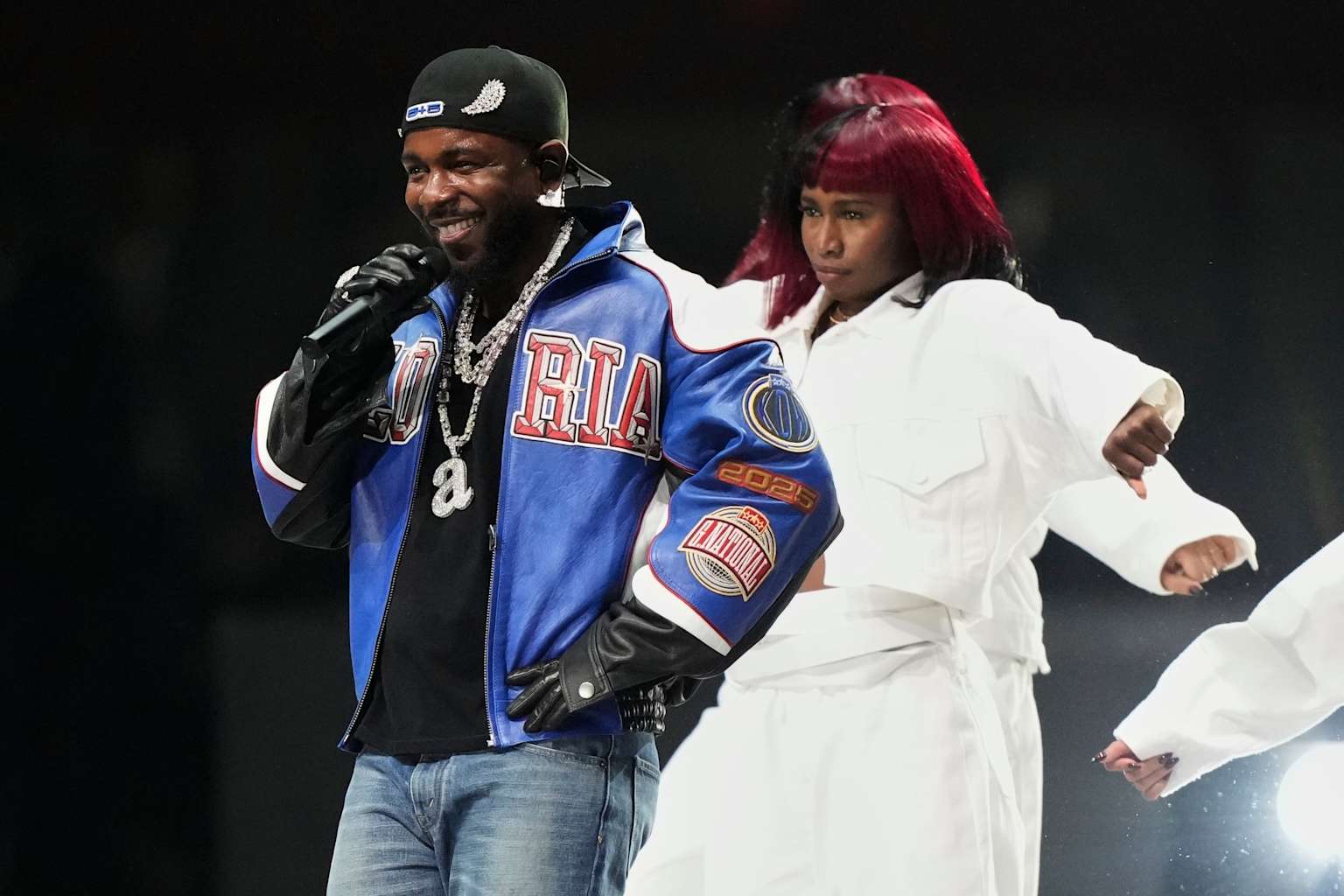
The show opened with an instrumental version of Ghais Guevara’s “The Old Guard is Dead” – a title that functioned less as a song choice and more as a thesis statement. Then, a 1980s Buick GNX pulled up to a stage that had been constructed to resemble a portion of a PlayStation controller, a visual motif that would recur throughout the performance. Lamar and his backup dancers stepped out of the car, and the show began with a portion of “Bodies,” an unreleased track, before moving into “Squabble Up.”
What followed was a meticulously choreographed journey through Lamar’s catalog and cultural identity. “Humble.” “DNA.” “Euphoria.” “Man at the Garden.” “Peekaboo.” Each song was a thread in a larger tapestry, a narrative about identity, race, ambition, and the American dream – or its failure. The stage design incorporated both football and video game references, which art director Shelley Rodgers described as symbolic of Lamar’s journey through the mythology of American success.
Between songs, Samuel L. Jackson appeared in a recurring role as a modernized, satirical Uncle Sam, dressed in a reimagined version of the iconic patriotic costume. Jackson’s Uncle Sam provided sardonic commentary on each segment of the performance, serving as a kind of chorus figure – the voice of institutional America, alternately praising and questioning Lamar’s choices. Jackson’s presence carried an obvious symbolism: a Black man inhabiting the role of Uncle Sam, the ultimate symbol of American nationalism. It was provocative, layered, and impossible to ignore.
Lamar performed “Luther” and “All the Stars” with SZA, whose guest appearance had been announced in the weeks leading up to the show. Their chemistry was electric, and the softer emotional register of these songs provided a necessary counterpoint to the harder-edged material that surrounded them.
But everything – every song, every visual, every moment of the show – was building toward the inevitable: “Not Like Us.”
“Not Like Us”: The Moment That Broke the Internet
Lamar had been teasing the performance of “Not Like Us” throughout the show, breaking the fourth wall at one point to smirk at the audience and say, “I wanna play their favorite song, but you know they love to sue.” The crowd erupted. The joke landed perfectly, simultaneously acknowledging the very real legal uncertainty around the song and demonstrating Lamar’s supreme confidence that he would perform it regardless.
When the beat finally dropped, the Caesars Superdome transformed into something that can only be described as a collective detonation of joy. 133.5 million people were watching. The entire stadium was screaming. And then came the line.
Lamar strutted across the stage with the energy of a man who had planned every single step of this moment for months. He turned directly toward the camera. He locked eyes with the lens. And he rapped:
“Say Drake…”
The smirk that followed was not a grin. It was not a smile. It was something more specific and more devastating than either of those words can capture. It was the expression of a man who has already won – who knows he has already won – and who is savoring every single millisecond of the victory with maximum, unapologetic relish. It was the face of someone who had been told “no” by an industry for years, who had fought for his artistic legitimacy on every front, and who was now saying, wordlessly, to the entire world: I told you so.
The line that followed – “I hear you like ’em young” – was censored in part, but the audience in the stadium knew every word. They chanted it back. The lyric “tryna strike a chord and it’s probably A minor” filled the Superdome in a way that made it impossible to pretend the moment was anything other than what it was: the final, definitive, most public possible humiliation of Drake in the history of their feud.
And then Serena Williams walked onstage.
Serena Williams and the Crip Walk That Said Everything
The appearance of tennis legend Serena Williams – one of the greatest athletes in the history of American sport, and a fellow native of Compton – was the kind of surprise that the internet genuinely did not see coming. She walked onstage during “Not Like Us” and performed the Crip Walk, a dance style originating from Compton street culture that Williams herself had famously performed after her 2012 Olympic gold medal victory, an act for which she faced considerable criticism at the time.
The Crip Walk’s reappearance here was loaded with meaning. On one level, it was a celebration of Compton, a shared cultural identity between two of the city’s most famous exports. On another level, it was deeply personal: Williams had been rumored at various points to have had a relationship with Drake, and her enthusiastic participation in a performance explicitly designed as a victory lap over him was read by virtually everyone watching as a pointed, joyful statement of allegiance.
The moment went viral instantly. Memes flooded every platform within minutes. People who had never followed celebrity gossip suddenly understood exactly what was happening and why it mattered. Williams dancing to a Drake diss track alongside the man who wrote it, in front of 133.5 million people, was the kind of perfect storm of pop culture, personal history, and athletic legacy that the internet simply could not process fast enough.
The Smirk That Launched a Thousand Memes
If the performance itself was historic, its aftermath in internet culture was a phenomenon entirely unto itself. Within minutes of the broadcast, the freeze-frame of Kendrick Lamar’s mischievous smirk during the “Say Drake” line had become the defining image of the entire event – and arguably one of the most memed photographs in recent memory.
The image was simple: Kendrick mid-verse, microphone in hand, eyes directed straight into the camera, wearing an expression that somehow combined supreme confidence, barely suppressed laughter, cold-blooded calculated petty, and genuine delight all at once. It was the grin of a man who has been cooking something in secret for months and is watching you take the first bite.
People used it to describe every conceivable situation of quiet triumph. “Writing ‘gg’ in chat and waiting for them to resign.” “This is how I wanna grin at my enemies’ downfalls.” “If I text you this, just know you’re cooked.” “The grin of a true hater, this man Kendrick is a supervillain.” The comments were relentless, hilarious, and utterly unanimous in their interpretation: this was the face of someone who had won so completely that gloating felt like an understatement.
Sports Illustrated noted that the moment was “instantly celebrated on social media, where it didn’t take long for the clip to become a meme.” Pleated-Jeans.com described the single frozen frame as “a viral meme for the ages” and called for someone to “hang it in the Louvre.” The breadth of the meme’s application was staggering – it was used in gaming contexts, relationship contexts, workplace humor, sports, politics, and everywhere in between.
The “Say Drake” smirk joined a very short list of Super Bowl images that transcend the sport and the moment entirely to become permanent fixtures of popular culture: the wardrobe malfunction of 2004, Beyoncé’s Blue Ivy bump reveal, Lady Gaga’s drone show, and now Kendrick Lamar’s four-second stare into the camera that somehow said more than an entire album could have.
The Flared Jeans and the Fashion Memes
In the cascade of viral content generated by the show, one of the more delightfully absurd subsets of memes focused not on the music, the feud, or the political commentary – but on Kendrick Lamar’s pants.
Lamar performed the entire show in flared jeans. Not slightly wide-leg jeans. Full, unmistakable, unironic flared jeans. And the internet lost its collective mind.
The combination of flared jeans and world-class Drake obliteration became its own comedic genre. “He’s dissing Drake in flared jeans and I’ve never respected anyone more.” “The flared jeans are the real diss track.” “Your mother loved those jeans,” read one caption accompanying a photo of a visibly delighted older woman watching the show. The fashion commentary spiraled further with people speculating about the jeans being a deliberate choice, an ironic fashion statement, or simply evidence that Kendrick Lamar is so confident in his own identity that he performs the biggest show of his career in whatever he feels like wearing, Drake’s opinion be damned.
That last interpretation, of course, was the point. Whether or not the jeans were intentional commentary, they functioned as such. Here was a man at the absolute peak of his cultural power, wearing flared jeans, smirking directly at a camera, and performing a diss track for the largest television audience in Super Bowl halftime history. The jeans were, in a way, the perfect visual encapsulation of Kendrick Lamar’s entire ethos: I do not perform for you. I perform for me. And if you’re watching, that’s on you.
The Political and Social Commentary: Deeper Than the Music
While the Drake feud and its attendant meme-storm dominated the casual conversation around the show, critics and cultural observers were quick to note that Lamar’s performance operated on multiple levels simultaneously, many of which had nothing to do with rap beef.
The show was saturated with political and social imagery. During “Humble,” backup dancers dressed in red, white, and blue arranged themselves to form the shape of a divided American flag. Lamar chanted “the revolution ’bout to be televised, you picked the right time but the wrong guy” – a direct inversion of the Gil Scott-Heron classic “The Revolution Will Not Be Televised.” He declared “forty acres and a mule, this is bigger than the music,” invoking one of the most significant unfulfilled promises of post-Civil War Reconstruction.
Samuel L. Jackson’s Uncle Sam character was read by analysts at The Root as a representation of a “sanitized” America attempting to control the free expression of Black artists – a reading reinforced when Jackson’s Uncle Sam criticized “Squabble Up” for being “too ghetto” earlier in the performance. Writing for The New York Times, cultural critic Tiana Clark described the performance as representing “the gamification of the elusive American dream,” with its PlayStation controller stage design and apparent visual references to Squid Game creating a framework in which the pursuit of American success is portrayed as a rigged game.
Historian Anita L. Wills wrote in the San Francisco Bay View that Lamar’s performance “reignited the Civil Rights Movement’s spirit on a global scale.” USA Today’s Nancy Armour suggested the performance constituted a direct rejection of President Donald Trump’s vision for America. Duquesne University’s law journal published an analysis noting that Lamar’s finale – “TV Off,” performed with Mustard, featuring themes of police brutality and racial stereotyping – urged the audience to break free from the distractions of entertainment and take concrete action.
These were not subtle points. They were made in the most public forum in American life, to the largest audience in halftime show history, with no apology and no softening. This was Kendrick Lamar saying, without equivocation: I was given this platform and I will use it exactly as I see fit. You gave me the biggest stage in the country. Here is what I have to say.
The Flag Protest: An Unscripted Moment of History
The show also produced one of the more unexpected moments in Super Bowl history when a cast member named Zul-Qarnain Nantambu – who had concealed a Sudanese flag and a Palestinian flag bearing the words “Sudan” and “Gaza” beneath his costume – unfurled them during the performance while standing atop Lamar’s black Buick GNX and ran across the field before being tackled by security.
Roc Nation issued a statement clarifying that the protest “was neither planned nor part of the production and was never in any rehearsal.” The NFL banned Nantambu for life from all NFL stadiums and events. The New Orleans Police initially investigated possible charges before ultimately declining to file any.
The incident added yet another layer to an already densely layered performance. In a show filled with deliberate commentary on race, power, and justice in America, the appearance of flags representing two of the world’s most prominent ongoing humanitarian crises created an unscripted collision between Lamar’s intentional political art and the raw urgency of real-world geopolitical suffering. Whether it complicated or deepened the performance’s message was a matter of considerable debate – but it was impossible to ignore, and it became another dimension of the cultural conversation that the show had ignited.
Records, Awards, and the Numbers That Define History
By every measurable standard, the Apple Music Super Bowl LIX Halftime Show was the most successful halftime performance in the event’s history.
The show attracted an average of 133.5 million viewers across broadcast television and all streaming platforms during its 15-minute runtime, surpassing Michael Jackson’s legendary performance at Super Bowl XXVII in 1993, which had long been considered the gold standard of halftime entertainment. The viewership peak reached 137.7 million during the segment immediately preceding the halftime show, with the numbers beginning to climb back down only as the game resumed – a testament to how many viewers tuned in specifically to watch Lamar perform.
The show was nominated for multiple Primetime Emmy Awards, including Outstanding Variety Special (Live) and Outstanding Directing for a Variety Special. It won the Emmy for Outstanding Music Direction, awarded to Kendrick Lamar and Tony Russell. It also won the NAACP Image Award for Outstanding Short-Form Series or Special. The show’s choreography, by Charm La’Donna, was also recognized with an Emmy nomination.
The performance of “Not Like Us” at the Super Bowl generated enormous streaming numbers in the days following the show, further cementing a song that had already won two Grammys as one of the defining cultural artifacts of the mid-2020s. Apple Music, which sponsored the show, reported record engagement on its platform in the 24 hours following the broadcast.
Why This Halftime Show Matters Beyond Music
It is tempting to reduce the legacy of Kendrick Lamar’s Super Bowl LIX halftime show to its most meme-able moments – the smirk, the flared jeans, the Crip Walk – because those moments were genuinely hilarious and genuinely historic in their own right. But to do so would be to miss the forest for the very entertaining trees.
What Lamar did on February 9, 2025, was demonstrate that hip-hop had arrived – not as a guest at the table of American mainstream culture, but as its rightful host. For decades, rap music was systematically excluded from the Super Bowl halftime stage, even as it became the dominant genre in American music. When hip-hop artists did appear, it was often as supporting acts, costumed in respectability politics, told to soften their edges and play it safe for the family audience.
Lamar did none of that. He performed a song with a lyric directly accusing his rival of being a pedophile, to the largest television audience in halftime history, wearing flared jeans, with a grin that suggested he had considered every possible consequence and decided he did not care about any of them. He hired a Black cast. He built a stage shaped like a PlayStation controller. He put a Black man in an Uncle Sam costume and used him to satirize American nationalism. He ended his set by telling the audience to turn the television off and do something.
This was not assimilation. It was occupation. And the 133.5 million people who watched it – whether they agreed with the politics, whether they loved the music, whether they were laughing at the memes or crying at the symbolism – all witnessed something that could not be undone. Hip-hop had claimed its moment on the biggest stage in American sports, on its own terms, without apology.
The Meme Legacy: When Culture Becomes Internet History
In the weeks and months following the show, the meme ecosystem that had erupted around it showed no signs of slowing down. The “Say Drake” smirk became a reaction image used across every conceivable context. “A minor” jokes proliferated in gaming communities, sports forums, and workplace humor accounts. Serena Williams’ Crip Walk was stitched into sports highlight compilations, dance challenge videos, and retrospective compilations of the show’s greatest moments.
Lamar himself became something of a meme archetype – the composed, scheming mastermind who executes his plan perfectly and lets his expression do the gloating for him. Fan accounts began cataloging his micro-expressions throughout the performance, frame by frame, identifying moments where the mask slipped just enough to reveal the sheer satisfaction of a man who had engineered every second of his revenge with surgical precision.
The flared jeans sparked a genuine fashion discourse, with some commentators praising Lamar for refusing to conform to typical rapper aesthetics and others simply enjoying the comedy of the juxtaposition. Mustard’s appearance during “TV Off” generated its own wave of reaction content, with fans celebrating the producer’s moment in the spotlight and drawing attention to the song’s underrated intensity.
Perhaps most remarkably, the memes were not merely funny – they were culturally coherent. They required knowledge of the Drake feud, of Serena Williams’ history, of the Crip Walk, of the legal concerns around “Not Like Us.” The jokes worked because the culture had done its homework. The show had rewarded attention, rewarded fandom, rewarded the years of investment that rap listeners had put into understanding the context. The memes were not just entertainment; they were proof of comprehension.
The Dissenting Voices: Not Everyone Was Amused
No cultural moment of this magnitude passes without controversy, and the Super Bowl LIX halftime show was no exception. A significant contingent of viewers – particularly among conservative commentators and politicians – reacted to the show with confusion, dismissal, or outright hostility.
Some called Lamar’s lyrics “gibberish.” Others argued that the songs were unrecognizable to mainstream audiences and accused the show of being exclusionary. The decision to feature an entirely Black cast of dancers was criticized in some quarters as divisive. The political imagery – the divided flag, the Uncle Sam commentary, the “forty acres and a mule” reference – was dismissed by some as heavy-handed or inappropriate for the Super Bowl’s family audience.
Social media users who felt the show focused too heavily on the Drake feud also voiced their dissatisfaction, arguing that Lamar had used the world’s biggest stage for what amounted to a personal grudge match rather than a celebration of music. Audio complaints were raised, particularly regarding SZA’s performance portions. And the broader philosophical question – whether a Pulitzer Prize-winning social critic could perform at a Super Bowl without compromising his integrity – was never fully resolved, even for Lamar’s most devoted fans.
But these dissenting voices, while real, were vastly outnumbered. The critical consensus was overwhelming in its acclaim. The New York Times called it “perhaps the peak of any rap battle, ever.” The Independent declared it “one of the most important halftime shows in the history of the event, if not the most significant mass-televised rap performance of all time.” The Guardian praised his choice of “artistry over more obvious showmanship.” NPR wrote that Lamar had made it clear “he would not soften his contempt or his approach for the mass audience.”
The Verdict: An Unmistakable Place in History
History will record February 9, 2025, as the night that Kendrick Lamar stood alone at the center of American culture and stared it down without blinking. It will record the 133.5 million viewers, the record-breaking ratings, the Emmy wins, and the NAACP Image Award. It will record the political commentary, the social symbolism, the brave choices and the deliberate provocations.
But it will also record the smirk. That specific, precise, perfectly timed smirk that Kendrick Lamar directed at a camera, at Drake, at the entire entertainment establishment, and at history itself, while wearing flared jeans and performing a Grammy-winning diss track to the largest halftime audience ever assembled.
There have been many great Super Bowl halftime shows. There have been Michael Jackson and Prince and Beyoncé and Bruno Mars, spectacles of choreography and production and stagecraft that defined their eras. But none of them were quite like this – none combined the personal and the political, the petty and the profound, the deeply local (Compton, New Orleans, Black American history) and the universally legible (a man winning a fight and knowing it) in quite the way Kendrick Lamar did on that February night.
He told us he had one opportunity to win a championship. No round twos. He was right. And he took his shot with everything he had, in flared jeans, with a grin on his face, staring directly into the camera.
Game over.