What Is Pop Culture, Really?
Before we trace its journey through time, it’s worth pausing on what “pop culture” actually means. Short for “popular culture,” it is the collection of ideas, images, attitudes, sounds, and phenomena that permeate the lives of the majority within any given society at any given moment. It is the music blasting from a teenager’s bedroom window, the movie everyone is talking about at the office, the meme that makes a billion people laugh on the same Tuesday morning, and the fashion trend that sweeps from a runway in Paris to a street corner in Mumbai within a season.
Pop culture is not trivial. It is, in fact, one of the most powerful forces in human civilization. It shapes identity, drives commerce, reflects political tensions, and documents the emotional pulse of entire generations. Historians often turn to pop culture to understand eras more vividly than any policy paper or economic report could convey. What did people fear? What did they dream of? What made them laugh, cry, or rebel? The answers are almost always embedded in the pop culture of their time.
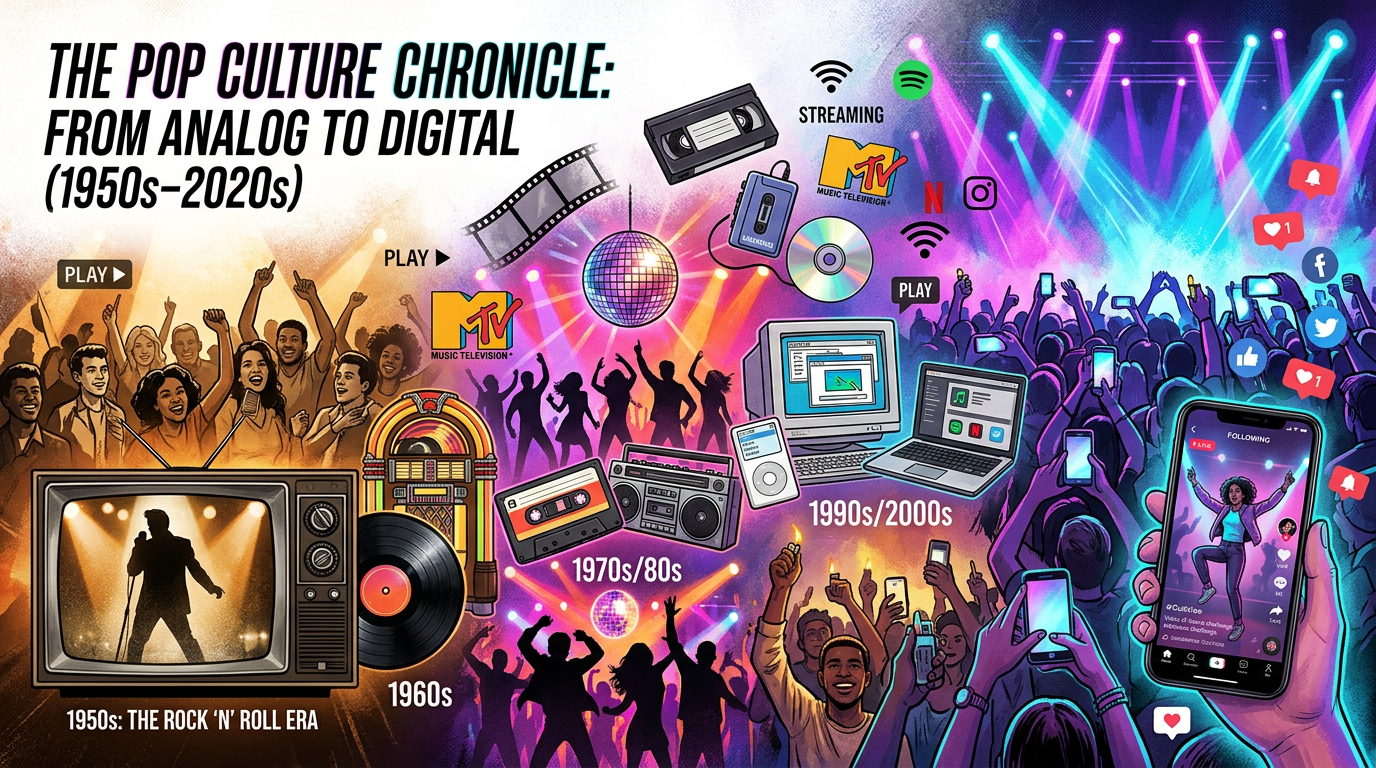
Crucially, pop culture does not exist in a vacuum. It is born from and feeds back into technology, politics, social movements, and economics. Each decade’s dominant cultural output is inseparable from the conditions that produced it. The 1950s couldn’t have had rock and roll without post-war prosperity. The 1980s couldn’t have had MTV without cable television. The 2020s couldn’t have had TikTok without smartphones and 5G networks. This article traces that extraordinary arc , decade by decade , exploring how pop culture has changed, why it changed, and what it reveals about us as a society.[popologist]
The 1950s: The Birth of a New Sound and a New Youth
No decade is more foundational to the story of modern pop culture than the 1950s. World War II had ended, and the Western world , particularly the United States , was experiencing an economic boom unlike anything it had seen before. A new middle class emerged, disposable income increased, and, crucially, a new demographic asserted itself for the first time in history: the teenager.[popologist]
Before the 1950s, there was no real concept of a distinct “youth culture.” Children grew up and became adults. But the postwar generation had leisure time, pocket money, and a hunger for something that felt like their own. They found it in rock and roll.
Elvis Presley, Chuck Berry, Little Richard, and Buddy Holly didn’t just create new music , they ignited a cultural revolution. Rock and roll was loud, it was sensual, it was rooted in African American blues and gospel traditions, and it terrified older generations while electrifying young ones. Elvis’s gyrating hips on television caused moral panic. Disc jockeys like Alan Freed popularized the term “rock and roll” and helped broadcast these sounds to white suburban audiences who had never heard anything like it.[popculturefest.com]
Television was the other transformative force of the 1950s. Sets began appearing in living rooms across America and Europe, and suddenly a single broadcast could reach millions of viewers simultaneously. Shows like I Love Lucy became cultural phenomena, with entire neighborhoods organizing their evenings around their TV schedules. The power of a shared national viewing experience , everyone watching the same thing at the same time , was born in this decade and would define pop culture’s relationship with audiences for generations to come.[popculturefest.com]
Fashion, too, was shifting. James Dean’s blue jeans and leather jackets in Rebel Without a Cause (1955) made casual dressing a statement of youthful defiance. Hollywood was producing stars with an almost mythological aura , Marilyn Monroe, Marlon Brando, Audrey Hepburn , who set the aesthetic standards of the era. Pop culture in the 1950s was brand new, electric, and unapologetically exciting.
The 1960s: Revolution, Rebellion, and Beatlemania
If the 1950s lit the fuse, the 1960s were the explosion. No decade in the twentieth century was more socially turbulent or culturally consequential. The civil rights movement, the anti-Vietnam War protests, the feminist movement, the sexual revolution, and the counterculture movement all erupted simultaneously, and pop culture both reflected and accelerated every one of them.[popologist]
The Beatles landed in America in February 1964, and nothing was ever the same again. “Beatlemania” , a word invented to describe the hysteria their arrival provoked , was genuinely unprecedented. Thousands of screaming fans, newspaper front pages, television appearances, and a level of celebrity that transcended geography and language. The Beatles didn’t just sell records; they rewrote the rules of what popular music could aspire to. Their evolution across the decade , from the cheerful pop of “Love Me Do” to the psychedelic complexity of Sgt. Pepper’s Lonely Hearts Club Band , mirrored the decade’s own transformation from optimism to disillusionment.[popologist]
The British Invasion they led brought dozens of acts , the Rolling Stones, The Who, The Kinks , crashing into American charts, challenging the dominance of homegrown pop and creating a transatlantic cultural conversation that has never really ended.
Music was the era’s most potent political weapon. Bob Dylan and Joan Baez turned folk music into protest art. Marvin Gaye, Nina Simone, and James Brown used soul and R&B to give voice to Black American experience during the civil rights struggle. Jimi Hendrix’s performance at Woodstock in 1969 , particularly his incendiary deconstruction of “The Star-Spangled Banner” , was a statement about war, race, and freedom that no speech could have matched.
Cinema was equally radical. The French New Wave influenced Hollywood filmmakers to break traditional narrative conventions. The Graduate (1967), Bonnie and Clyde (1967), and Easy Rider (1969) all challenged the sanitized storytelling of earlier Hollywood, embracing moral ambiguity, youth disillusionment, and the growing gap between generations. Fashion became a battleground of ideology: miniskirts, tie-dye, bell-bottoms, and peace signs weren’t just clothes , they were declarations of values.[popologist]
The 1960s proved something essential about pop culture: it doesn’t just entertain. At its most powerful, it organizes, inspires, and transforms society.
The 1970s: Disco, Punk, and the Culture Wars
The idealism of the 1960s didn’t survive the decade it was born in. By 1970, Martin Luther King Jr. and Robert Kennedy were dead, the Vietnam War was still grinding on, Woodstock had been followed by the disastrous Altamont festival, and the counterculture was fracturing. The 1970s inherited a world disillusioned with grand narratives, and pop culture reflected that complexity beautifully.
Two opposing musical movements defined the decade. Disco was the sound of escapism , glamorous, hedonistic, and dance-floor-obsessed. Studio 54 in New York City became the symbolic heart of disco culture, a velvet-rope paradise where celebrities, artists, and ordinary people mixed under a mirror ball. Donna Summer, the Bee Gees, Gloria Gaynor, and KC and the Sunshine Band provided the anthems. Disco was also notable for being one of the first mainstream pop movements embraced prominently by gay communities and people of color, giving it a cultural significance beyond its sound.[popologist]
Punk rock emerged as disco’s furious antithesis. Bands like the Sex Pistols, The Clash, and the Ramones were angry, loud, and deliberately anti-commercial. Punk rejected musical virtuosity in favor of raw energy and stripped-back aggression. It was a working-class roar against a music industry that had, in the eyes of punks, become bloated and complacent. Punk’s ethos of “do it yourself” , making your own zines, recording your own cassettes, organizing your own shows , planted seeds that would bear fruit decades later in the internet era.[popologist]
Film also came of age in the 1970s. The decade produced some of the most celebrated movies in cinema history: The Godfather (1972), Chinatown (1974), Apocalypse Now (1979). But it was also the decade that invented the blockbuster. Jaws (1975) by Steven Spielberg was the first film to be released on thousands of screens simultaneously with a massive marketing campaign , a model that Hollywood has followed ever since. Star Wars (1977) followed, creating a franchise phenomenon that extended beyond the cinema into toys, comics, television, and eventually a cultural mythology of its own.[popculturefest.com]
Television was maturing too. All in the Family, MASH*, and Saturday Night Live pushed comedy and social commentary into new territory, addressing race, war, and sexuality with a directness that earlier television had carefully avoided.
The 1980s: MTV, Blockbusters, and the Age of Image
The 1980s were, above all, the decade of visual spectacle. Ronald Reagan’s America was defined by optimism (at least on the surface), conspicuous consumption, and the primacy of image , and pop culture was perfectly calibrated to match.[popculturefest.com]
MTV launched on August 1, 1981, with the almost prophetically titled “Video Killed the Radio Star” by The Buggles, and promptly changed everything. Suddenly, how an artist looked was as important as how they sounded. Music videos became elaborate short films, and artists who could command the visual medium , Michael Jackson, Madonna, Prince, David Bowie , became the defining stars of the era.[popculturefest.com]
Michael Jackson’s Thriller (1982) was more than a music video. It was a cinematic event, a 14-minute mini-horror film directed by John Landis that set a new standard for what the medium could achieve. The accompanying album became , and remains , the best-selling album of all time. Jackson’s fusion of extraordinary dance, cinematic storytelling, and musical genius made him pop culture’s most complete icon of the decade.[popculturefest.com]
Madonna, meanwhile, demonstrated that pop could be deliberately provocative and commercially savvy simultaneously. She played with religious iconography, sexuality, and gender norms in ways that generated both controversy and massive record sales. Her ability to reinvent herself , a trait that would become a benchmark for pop stardom , influenced every major artist who followed her.
The 1980s also cemented the blockbuster franchise as pop culture’s dominant economic model. Indiana Jones, Ghostbusters, Back to the Future, Ferris Bueller’s Day Off , these films weren’t just entertainment; they were cultural events that generated merchandise, theme park rides, sequels, and lasting nostalgic attachment. The concept of the “tie-in” , where a film’s commercial ecosystem extended far beyond the cinema , was perfected in this decade.[popculturefest.com]
Hip-hop, born in the Bronx in the mid-1970s, exploded into mainstream consciousness during the 1980s. Run-D.M.C., LL Cool J, and N.W.A brought a raw, urban storytelling voice to pop music, while the Beastie Boys proved that hip-hop could cross racial lines. By the decade’s end, hip-hop was no longer a subculture , it was one of the most commercially and creatively vital forces in popular music.[popologist]
The 1990s: Grunge, Hip-Hop’s Golden Age, and the Internet’s Dawn
The 1990s arrived with a cultural hangover. The Reagan-era optimism had faded, the Cold War had ended with a whimper rather than a bang, and Generation X , the first generation raised in front of televisions and saturated with marketing , was profoundly, defiantly unimpressed. Their soundtrack was grunge.[popologist]
Nirvana’s Nevermind (1991), with its opening track “Smells Like Teen Spirit,” was a cultural thunderbolt. Kurt Cobain’s raw, anguished vocals and the album’s deliberately unpolished production were a rejection of the glossy pop and hair metal that had defined the previous decade. Pearl Jam, Soundgarden, and Alice in Chains followed, and Seattle became the unlikely capital of global youth culture for a moment. Grunge wasn’t just music , it was flannel shirts, ripped jeans, and a studied indifference to beauty standards that felt, for its fans, like authentic self-expression.
Hip-hop, meanwhile, was entering what many consider its golden age. Tupac Shakur and The Notorious B.I.G. elevated rap lyricism to poetic heights, while simultaneously embodying a deadly coast-to-coast rivalry that ended both their lives tragically young. Jay-Z, Nas, Wu-Tang Clan, and Outkast were exploring the possibilities of the form with extraordinary creativity. Hip-hop was becoming the dominant language of youth culture globally , a process that would only accelerate in the decades to come.[popologist]
Television underwent its own revolution. The rise of cable gave audiences choice, and networks responded with increasingly ambitious programming. The Simpsons redefined what animated television could achieve. Friends and Seinfeld became cultural touchstones, their catchphrases and scenarios entering everyday conversation. The 1990s also saw the birth of reality television: The Real World on MTV (1992) placed cameras in a house with strangers and let the drama unfold, pioneering a format that would dominate the next decade.
And then there was the internet. AOL, Yahoo!, and early websites were still clunky and slow by today’s standards, but the infrastructure of a new cultural universe was being laid. Online forums allowed fans to connect and obsess over shared interests regardless of geography. Fan fiction, fan art, and early meme culture began to gestify in these digital spaces, quietly preparing the ground for the revolution that was coming.[popologist]
The 2000s: Reality TV, Social Media’s Birth, and the Digital Download
The 2000s arrived with anxiety , the Y2K panic turned out to be a false alarm, but the September 11, 2001 attacks genuinely fractured the cultural confidence of the Western world and cast a long shadow over the decade’s entertainment. Pop culture oscillated between escapism and engagement with a newly frightening reality.
Reality television dominated the early 2000s with an almost overwhelming force. Survivor, Big Brother, American Idol, The Bachelor, and Keeping Up with the Kardashians all launched within a few years of each other, transforming how audiences related to fame. You didn’t need talent , or at least, not conventional talent , to become a celebrity anymore. The appeal was raw, unscripted human drama, and audiences responded voraciously. American Idol in particular democratized the process of becoming a pop star, turning audition and voting into a national participatory event and launching careers that would define the decade.[popologist]
Music was undergoing a seismic technological disruption. Napster arrived in 1999 and effectively told the music industry that its business model was obsolete. The free peer-to-peer sharing of music files sent record label revenues into freefall and forced an industry reckoning. Apple’s iTunes Store (2003) offered a legal digital alternative, and its iPod made personal digital music libraries portable and fashionable. The album as a commercial unit began its long decline; the single was reasserting itself, this time in digital form.[popologist]
Social media was beginning to emerge from its chrysalis. MySpace (2003) gave millions of people their first taste of personal online profiles, and it was particularly transformative for independent musicians who could upload their songs directly to fans without a record label intermediary. Facebook launched in 2004, initially restricted to college campuses, and within years it was reshaping how the entire world communicated, organized, and shared. YouTube launched in 2005, and within months it was clear that something profound was happening: ordinary people could now broadcast themselves to a global audience for free.[popculturefest.com]
In cinema, the 2000s saw the franchise model go into overdrive. The Lord of the Rings trilogy, the Harry Potter series, the Spider-Man and X-Men films , these were massive, intricately constructed universes designed to sustain audience investment across multiple films and decades. The concept of fandom deepened and became more organized, with fan conventions growing dramatically in scale and cultural significance.
The 2010s: Streaming, Representation, and the Social Media Takeover
If the 2000s planted the seeds of the digital revolution, the 2010s harvested them spectacularly. Streaming transformed nearly every aspect of cultural consumption, from music to film to television, while social media evolved from a novelty into the central nervous system of pop culture itself.[popologist]
Netflix, which had begun as a DVD-by-mail service, pivoted to streaming in 2007 and by the early 2010s was producing original content that rivaled and then surpassed broadcast television in ambition and quality. House of Cards, Orange Is the New Black, Stranger Things, and The Crown demonstrated that streaming could produce prestige drama, comedy, and nostalgia simultaneously. The concept of “binge-watching” , consuming an entire season in a single sitting , entered the cultural vocabulary and permanently altered the relationship between audiences and stories.[popologist]
Spotify, launched in 2008 and spreading globally through the early 2010s, did for music what Netflix did for video. Streaming eclipsed downloads, which had already eclipsed physical sales, and created an environment where accessibility was total but revenue for artists was fractured. The album as a long-form artistic statement was further challenged by a playlist culture that prized individual songs.[popologist]
The social media landscape consolidated around a few dominant platforms. Twitter became the town square of pop culture commentary, generating real-time collective reactions to events with unprecedented speed and scale. Instagram, launched in 2010, transformed visual culture , photography, fashion, food, and travel were aestheticized and commodified simultaneously. The influencer emerged as a new category of celebrity: people who had built audiences not through traditional entertainment pathways but through cultivating compelling personal brands online.[popculturefest.com]
Representation became one of the decade’s defining cultural conversations. Films like Black Panther (2018), Crazy Rich Asians (2018), and Moonlight (2016) demonstrated both the artistic richness and the commercial viability of stories centered on non-white protagonists. Audiences , and increasingly, studios , recognized that the old Hollywood default of the white male hero was leaving enormous creative and commercial potential on the table. Television similarly expanded its storytelling range, with shows like Pose, Master of None, and Transparent exploring identities and experiences that had been largely invisible to mainstream audiences.[popologist]
The Marvel Cinematic Universe became the defining entertainment franchise of the decade. Beginning with Iron Man in 2008, the MCU built an intricate interconnected universe across more than 20 films, culminating in Avengers: Endgame (2019), which grossed over $2.79 billion worldwide and became the highest-grossing film of all time for a period. The MCU model , shared universe storytelling across multiple titles and media formats , became the template that every other studio attempted (with varying success) to replicate.[popculturefest.com]
K-pop, the South Korean pop music phenomenon, began its conquest of global markets in the 2010s. BTS and Blackpink became genuine worldwide superstars, their fanbases , organized, passionate, and digitally sophisticated , demonstrating that pop music’s geography had permanently expanded. The era of Anglo-American cultural dominance was giving way to something more genuinely global.[popculturefest.com]
The 2020s: Fragmentation, TikTok, and the End of Monoculture
The 2020s began under circumstances no one had planned for. The COVID-19 pandemic arrived in early 2020 and forced billions of people indoors, with screens as their primary window to the world. The cultural consequences were immediate and profound.[youtube]
Streaming surged. Netflix gained nearly 16 million subscribers in the first quarter of 2020 alone. Disney+, launched in 2019, grew with astonishing speed. The concept of “appointment viewing” , of gathering around a shared broadcast at a shared moment , was essentially finished. Audiences were now fragmented across dozens of platforms, each with its own exclusive content, each competing for the same finite hours of human attention.
TikTok emerged as the decade’s defining platform. Unlike Facebook or Instagram, which were built around existing social networks, TikTok’s algorithm was purely content-driven: it showed you not what your friends liked, but what you specifically would engage with, based on your own viewing behavior. This created a radicalized form of personalization that was extraordinarily effective and deeply transformative for how trends formed and spread. A song could become a global hit not because a label had promoted it to radio stations, but because a TikTok trend used it as a soundtrack and the algorithm amplified it to millions of users. Artists like Olivia Rodrigo, Doja Cat, Lil Nas X, and Chappell Roan saw their careers launched or supercharged by TikTok virality.reddit+1
The most significant cultural shift of the 2020s, however, may be the collapse of monoculture itself. In the 1980s, if you wanted to talk about pop culture with a stranger, you could be reasonably certain you’d share reference points , certain TV shows, certain films, certain songs , because the gatekeepers of cultural distribution (record labels, TV networks, film studios) were few enough in number that their choices shaped a broadly shared cultural landscape. Today, with thousands of streaming shows, millions of podcasts, and a TikTok algorithm that serves each user a personalized cultural diet, there is increasingly no common text. The teenager next door may have never seen a single show or heard a single song that you consider culturally central. This is both liberating and disorienting.[reddit]
Taylor Swift became the decade’s dominant pop culture figure , and arguably its most dominant cultural figure full stop. Her Eras Tour grossed an astonishing $2.07 billion, becoming the highest-grossing concert tour in history. Her album re-recordings, designed to reclaim ownership of her masters, became cultural events in themselves. The Swiftie fandom demonstrated a new model of fan engagement , intensely loyal, communally organized, and economically powerful , that had no real precedent in pop history.[buzzfeed]
Podcasts and long-form online video emerged as major cultural forces in the 2020s. Creators on YouTube and Spotify were building audiences of millions, generating cultural conversations and influencing opinions on topics from true crime to politics to self-improvement, often without the involvement of any traditional media institution. The podcast, in particular, became a space where nuanced, long-form discussion flourished in a media environment that often rewarded brevity and shock value.[youtube]
The globalization of pop culture accelerated dramatically. K-pop maintained its global dominance. Afrobeats, led by artists like Burna Boy, Wizkid, and Tems, broke into international markets. Latin music , propelled by artists like Bad Bunny, J Balvin, and Rosalía , dominated global streaming charts. The idea that “pop culture” meant primarily American and British output was comprehensively dismantled. The world’s cultural production had genuinely globalized, and audiences were richer for it.[creativeldn]
Technology as the Engine of Cultural Change
Looking across the decades, one truth stands out above all others: technology has been the single most consistent driver of pop culture transformation. Each major technological shift , the television, the transistor radio, the cassette tape, the VCR, MTV, the internet, the smartphone, the streaming service, the social media algorithm , has restructured not just how culture is distributed but how it is created, who gets to create it, and who can access it.
The printing press democratized the written word. Radio democratized music. Television created a shared national experience. The internet democratized publication. Social media democratized broadcasting. Each democratization wave has been simultaneously celebrated as empowering and criticized as destabilizing , and each has been both.[popologist]
The most profound current technological shift is artificial intelligence. AI tools are already being used in music production, visual art creation, film post-production, and content writing. The implications for pop culture are enormous and still unfolding. Who owns a piece of music if it was partially composed by an algorithm? What does celebrity mean when an AI can generate a convincing deepfake of any public figure? These questions are not hypothetical , they are live debates in boardrooms, courtrooms, and creative communities right now.[youtube]
Pop Culture and Social Movements
Pop culture has never been purely escapist. Throughout its history, it has served as a vehicle for social movements, a platform for marginalized voices, and a battleground for competing visions of society.
The civil rights movement found expression in the soul and R&B of the 1960s. Second-wave feminism was reflected in , and reinforced by , the emergence of powerful female artists and complex female characters in film and television. The LGBTQ+ rights movement gained cultural oxygen through the visibility of queer artists, characters, and stories in mainstream entertainment.[popculturefest.com]
The #MeToo movement, which exploded in 2017 following reporting on Harvey Weinstein, fundamentally altered the relationship between pop culture and power. Overnight, the entertainment industry confronted decades of institutional abuse and impunity, and the conversation about who gets to tell stories , and under what conditions , was permanently transformed. The Black Lives Matter movement reshaped conversations about representation in Hollywood, music, and television with fresh urgency in 2020 and beyond.[globalmediajournal]
These intersections remind us that pop culture is not separate from the serious business of politics and justice , it is deeply woven into it. The stories we tell, the stars we elevate, the music we amplify: these choices have real consequences for how society understands itself and what it considers possible.
The Economics of Pop Culture
Pop culture is also, inescapably, a business , and the economics of that business have transformed as dramatically as anything else. The mid-twentieth century model was built on scarcity: a limited number of television channels, radio stations, and cinema screens meant that content gatekeepers wielded enormous power and commanded enormous revenues.
The digital era shattered that scarcity model. Music streaming pays artists fractions of a cent per play. YouTube’s advertising revenue model rewards volume and virality over quality. The collapse of physical media sales gutted record label revenues. Traditional broadcast television has been losing viewers steadily for two decades.[ie.nitk.ac]
In their place, new economic models have emerged. The creator economy , in which individual content creators monetize their audiences directly through platform revenue sharing, brand partnerships, merchandise, and subscriptions , has produced a new class of cultural producers who operate entirely outside traditional industry structures. The top YouTubers and TikTokers earn incomes that rival A-list Hollywood actors, without a studio, a label, or an agent.[globalmediajournal]
At the same time, the consolidation of streaming power in the hands of a few technology giants , Netflix, Amazon, Apple, Disney , has created new gatekeepers that are in some ways even more powerful than the old ones, because they operate at global scale and with algorithmic opacity that makes it difficult for creators to understand , let alone game , the systems that determine their visibility.
Fashion, Language, and Everyday Life
Pop culture’s influence extends far beyond formal entertainment. It shapes the clothes we wear, the slang we use, the values we embrace, and the things we find beautiful or ugly. Every generation develops a cultural vocabulary , a set of references, aesthetics, and attitudes , that distinguishes it from those before and after.
The 1960s gave us the miniskirt and “groovy.” The 1970s gave us platform shoes and “far out.” The 1980s gave us power suits and “gnarly.” The 1990s gave us Doc Martens and “whatever.” The 2000s gave us low-rise jeans and “bling.” The 2010s gave us athleisure and “on fleek.” The 2020s have given us… everything simultaneously. The TikTok era has accelerated the cycle of fashion micro-trends so dramatically that styles now rise and fall within months rather than years, and the concept of a single defining aesthetic for a generation may be permanently obsolete.[hercampus]
Language is similarly accelerated. Internet slang moves from niche online communities to mainstream usage within weeks. Words like “slay,” “no cap,” “vibe,” “ghosting,” “gaslighting,” and “main character energy” have migrated from specific cultural contexts into everyday speech across demographics and geographies with unprecedented speed. Pop culture is now the primary engine of linguistic evolution, operating far faster than any academic dictionary can track.
The Future of Pop Culture
Pop culture has always been a moving target, and attempting to predict its trajectory is a fool’s errand. But certain tendencies seem likely to define its near-future shape.
The fragmentation of audiences will continue. The era of a single cultural event , a TV broadcast, a film release, a chart-topping album , commanding the attention of an entire society is probably never coming back. Culture will become more niche, more personalized, and more globally diverse.[reddit]
AI will reshape creation at every level. Musicians, filmmakers, visual artists, and writers will increasingly work with AI as a collaborative tool, raising profound questions about authorship, originality, and the nature of creativity. The cultural industries will spend years , perhaps decades , negotiating the legal and ethical frameworks for how AI-generated or AI-assisted content should be classified and compensated.
Virtual and augmented reality promise to create new forms of cultural experience. Concerts, sports events, and entertainment experiences in fully immersive virtual environments are no longer science fiction , they are early-stage commercial realities. The metaverse, whatever form it ultimately takes, will likely host significant portions of cultural life within the next generation.
And the globalization of cultural production will deepen. The stories, music, and aesthetics of Africa, Asia, Latin America, and the Middle East will continue their transformation from regional to global, enriching a cultural conversation that was, for too long, dominated by too few voices.[popculturefest.com]
A Mirror That Never Stops Moving
Pop culture is the most honest mirror that any society holds up to itself. It reveals what we desire and what we fear, what we celebrate and what we suppress, who we elevate and who we ignore. Looking across the arc from Elvis Presley’s debut on The Ed Sullivan Show to Kendrick Lamar’s historic Super Bowl Halftime Show in 2025 , rapping “Not Like Us” to 130 million viewers , is to observe more than seven decades of human aspiration, conflict, creativity, and transformation.[buzzfeed]
Each era produced its own genius , its Beethovens in denim, its Shakespeares with microphones, its Rembrandts with cameras. Each era was also shaped by forces larger than any individual artist: the technologies that delivered culture, the political systems that constrained or enabled it, the economic structures that determined who could create and who could profit.
The one constant is change itself. Pop culture has always evolved, always absorbed, always reinvented. The kids who were scandalized by Elvis grew up to be scandalized by rap, then by TikTok dances, and so the wheel turns. What remains , what has always remained , is the fundamental human need for stories, music, images, and shared experiences that make us feel less alone in the universe.[popologist]
Pop culture, for all its commercial machinery and algorithmic manipulation and manufactured controversy, is ultimately in the business of meeting that need. And in that sense , whatever technologies emerge, whatever platforms rise and fall, whatever trends sweep through and vanish , it will always matter. Because people will always matter. And pop culture, at its best, is simply people telling the truth about what it feels like to be alive.