The toys are back. The lights are flickering. And the internet is absolutely losing its mind over what just hit theaters.
Five Nights at Freddy’s 2 arrived in cinemas on December 5, 2025, riding a wave of massive anticipation from fans who made the first film a surprise box office phenomenon in 2023. That movie earned a staggering 297 million dollars globally despite mixed reviews, proving that loyal fanbases can turn niche video game franchises into mainstream theatrical events.
So naturally, Blumhouse and Universal greenlit a sequel faster than you can say Freddy Fazbear. They brought back director Emma Tammi. They reassembled the entire main cast. They doubled down on the animatronic horror that made the original so distinctive. And they prepared for another massive opening weekend.
What they probably didn’t prepare for was the critical reception. Because Five Nights at Freddy’s 2 just debuted with a 13 percent score on Rotten Tomatoes, making it one of the worst reviewed horror films of 2025. That’s less than half the already lukewarm 33 percent the first film received. Critics are using words like inept, shoddily made, and one of the year’s worst to describe it.
But here’s the twist. The box office numbers tell a completely different story. And the divide between what critics think and what audiences want has never been more obvious.
The Numbers Don’t Lie
Let’s talk money first because that’s what Hollywood ultimately cares about most.
Five Nights at Freddy’s 2 crushed industry expectations during its opening weekend. With a production budget estimated between 36 million and 51 million dollars, the film needed to perform well to justify the franchise’s continuation. Early tracking suggested it would open strong but maybe not match its predecessor’s explosive debut.
Wrong. The sequel delivered impressive numbers that have executives celebrating even as critics pan the film. While it might not reach the stratospheric heights of the first movie, earning that kind of box office despite brutal reviews is actually remarkable. It proves the franchise has a dedicated fanbase that doesn’t care what professional film critics think.
For context, the first Five Nights at Freddy’s opened to massive numbers in October 2023, benefiting from Halloween timing and pent up demand from fans of Scott Cawthon’s beloved video game series. That film became a cultural moment, spawning countless memes, TikTok reactions, and watch parties.
The sequel faces tougher competition. It’s opening in early December against major holiday releases. Disney’s Zootopia 2 is currently dominating the box office, having earned 915.8 million dollars worldwide in just two weekends. But FNAF 2 carved out its own audience and delivered returns that make the film profitable almost immediately.
That’s the power of cult franchises. When you build genuine fan loyalty, you can weather critical storms that would sink other projects.
Share this with your horror obsessed friend who’s been counting down to this release.
What The Critics Are Saying
Okay, so the reviews are rough. How rough are we talking?
The Guardian pulled no punches, calling it an inept game based horror that ranks among the year’s worst films. The review describes the animatronic characters as moving with such clumsy heaviness that it raises questions about their ability to navigate swiftly enough for a genuine killing spree. Ouch.
The New York Times wasn’t much kinder, titling their review The Robots Are Malfunctioning Again and describing it as at best marginally scarier than the already abysmal first film. They acknowledge the bigger budget but question whether more money actually improved anything meaningful.
Screen Rant highlighted that at 13 percent on Rotten Tomatoes, FNAF 2 sits alongside some of 2025’s most critically reviled horror offerings. Films like The Ritual at 9 percent, Bloat at 29 percent, and The Woman in the Yard at 41 percent share similar distinction of being commercially released horror movies that critics actively disliked.
The consensus among negative reviews points to several consistent problems. The script feels carelessly written. The film lacks a proper ending, feeling more like setup for a third installment than a complete story. The pacing is awkward, with characters traveling between indistinct locations without clear purpose. And the attempts to blend various influences from 80s nostalgia to 90s horror homages like Jurassic Park and Scream result in a tonal mess.
Multiple critics noted that the film casts both Matthew Lillard and Skeet Ulrich, famous for playing killers together in the original Scream, but never gives them a scene together. That feels like a massive missed opportunity for an Easter egg that fans would have loved.
The Story Behind The Horror
For those unfamiliar with the franchise, Five Nights at Freddy’s started as an indie horror video game released in 2014. Creator Scott Cawthon built something genuinely unsettling, a point and click survival game set in a rundown pizza restaurant where animatronic characters come to life at night and hunt the security guard.
The games became a phenomenon thanks to Let’s Play videos on YouTube and a sprawling lore that expanded across multiple sequels, books, and spin offs. The story involves murdered children whose spirits possess the animatronic characters, a serial killer named William Afton, and layers of mystery that fans obsessively theorize about.
The first film adaptation, released in 2023, followed Mike Schmidt, played by Josh Hutcherson, a troubled security guard taking a job at the abandoned Freddy Fazbear’s Pizza. His younger sister Abby, portrayed by Piper Rubio, becomes connected to the haunted animatronics. Local police officer Vanessa, played by Elizabeth Lail, helps them uncover the dark truth, her father William Afton is the killer who murdered the children and controls their spirits.
Matthew Lillard’s performance as Afton became a highlight, bringing genuine menace to a character that could have been cartoonish. The film balanced kid friendly elements with horror, earning a PG-13 rating that allowed younger fans to see it while still delivering scares.
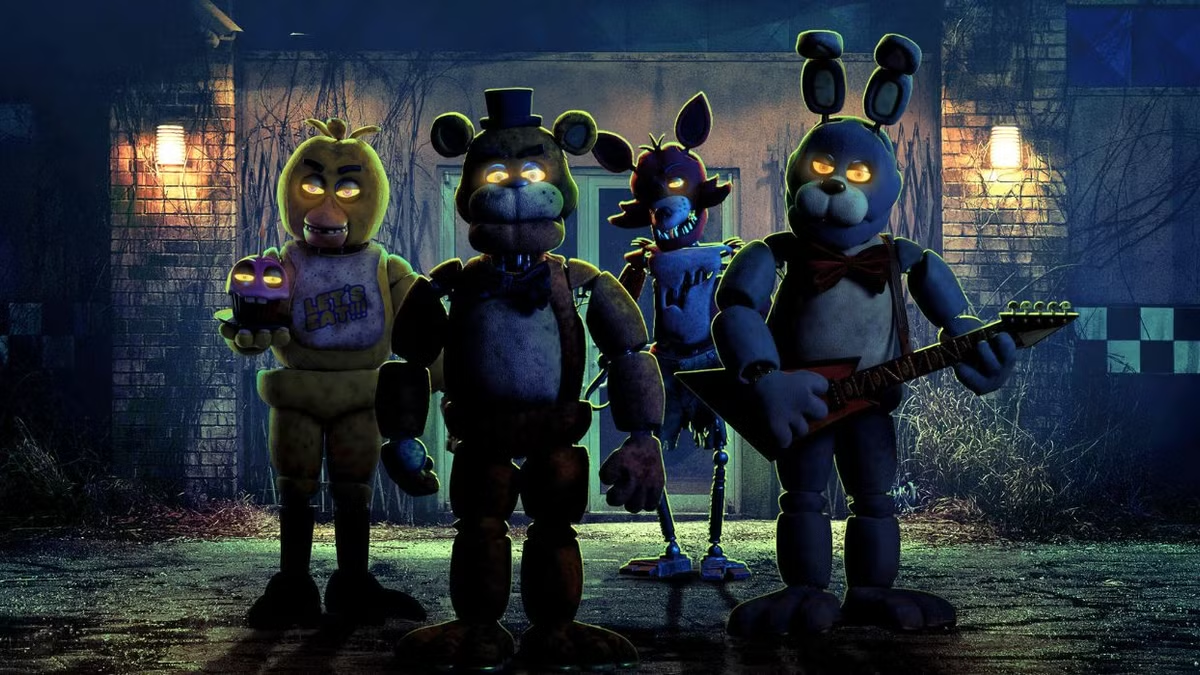
Five Nights at Freddy’s 2 picks up one year later. The events at Freddy’s have been twisted into a campy local legend, inspiring the town’s first Fazfest celebration. Mike and Vanessa have kept the truth from Abby about what really happened to her animatronic friends. But when Abby sneaks out to reconnect with Freddy, Bonnie, Chica, and Foxy, it sets off a terrifying chain of events.
The sequel introduces new characters including The Marionette, a creepy puppet figure from the games who exploits Abby’s loyalty to lure her into danger. The film explores additional locations like a water tunnel ride and brings the animatronics out of their restaurant setting and into the outside world.
Don’t miss out on understanding why this franchise has millions of devoted fans.
The Cast Returns With Reinforcements
One of the sequel’s strengths is bringing back the entire main cast. Josh Hutcherson returns as Mike, now more experienced with the supernatural horrors but still protective of his sister. His performance in the first film earned praise for grounding the story with genuine emotion amid the chaos of killer robots.
Piper Rubio reprises her role as Abby, the young girl whose connection to the animatronics drives the plot. Her character ages from 10 to 11 between films, and her relationship with the haunted creatures becomes more complicated as she learns the truth about what they are.
Elizabeth Lail comes back as Vanessa, the police officer with personal connections to the tragedy. Her father’s crimes complicate her role, and the sequel explores how she processes that trauma while trying to protect Mike and Abby.
Matthew Lillard returns as William Afton despite his character apparently dying in the first film. Horror movie rules apply, nobody stays dead when there’s a sequel to make. Lillard’s scenery chewing performance delighted fans in the original, so bringing him back makes commercial sense even if it requires some narrative gymnastics.
The sequel adds several notable new cast members. Freddy Carter joins the franchise in an undisclosed role that fans are speculating about. Skeet Ulrich, Lillard’s Scream co star, appears in what critics describe as a wasted opportunity since the two actors never share screen time. And Wayne Knight, beloved for his roles in Jurassic Park and Seinfeld, joins the cast, presumably adding both comedy and gravitas.
Director Emma Tammi returns behind the camera. Her first film showed competence with the material even if critics found it lacking. She understands the franchise’s appeal and knows how to stage sequences that satisfy fans even if they don’t impress film reviewers.
Scott Cawthon, the franchise creator, wrote the screenplay based on the second video game in the series. His direct involvement ensures the film stays true to the lore that fans care about, even if it results in a script that prioritizes Easter eggs over narrative coherence.
The Critics Versus Fans Divide
Here’s where things get really interesting. At the time of early reviews, Five Nights at Freddy’s 2 had a dismal 13 percent critics score on Rotten Tomatoes with 46 reviews. But it didn’t yet have an audience score because not enough verified ratings had been submitted.
The first film tells the story of this divide. Critics gave it 33 percent. Audiences gave it 86 percent. That’s a 53 point gap, one of the largest disparities between critical and audience reception in recent horror history.
Why such a massive difference? Because critics and fans are watching these movies for completely different reasons.
Critics evaluate films based on traditional storytelling craft. Is the script well written? Do the characters have compelling arcs? Is the pacing effective? Does the film say something meaningful? By those metrics, the FNAF movies struggle. The plots are convoluted. The dialogue is often clunky. The pacing lurches between exposition dumps and action sequences.
But fans don’t care about any of that. They care about seeing the characters they love on screen. They want Easter eggs referencing obscure game lore. They want to see Freddy, Bonnie, Chica, Foxy, and the rest brought to life with practical effects. They want the experience of being inside the world they’ve been obsessing over for years.
It’s the same phenomenon that makes movies like Venom or Morbius profitable despite terrible reviews. When you build a passionate fanbase through games, comics, or other media, those fans will show up for theatrical adaptations regardless of what critics say.
The FNAF franchise benefits from years of fan engagement. People have spent hundreds of hours playing the games, reading the books, watching theory videos, and participating in the community. They’re invested in a way that casual moviegoers or professional critics can never be.
Tag someone who understands that fan service isn’t always a bad thing.
The Video Game Adaptation Challenge
Five Nights at Freddy’s joins a long line of video game adaptations that struggle to satisfy both critics and general audiences while keeping core fans happy. It’s an incredibly difficult balance.
The best recent examples of successful game adaptations include The Last of Us series on HBO, which earned critical acclaim and fan approval by treating the source material with respect while making changes that work better for television. The Super Mario Bros Movie became a massive hit by leaning fully into fan service and prioritizing fun over narrative sophistication.
But for every success, there are dozens of failures. Movies based on games often feel like they’re checking boxes rather than telling compelling stories. They include references fans recognize but don’t develop them meaningfully. They cast actors who look nothing like beloved characters. They change core elements of the story that fans consider sacred.
The FNAF movies avoid some of these pitfalls by keeping Scott Cawthon directly involved and prioritizing practical effects for the animatronics rather than relying entirely on CGI. The characters look like they do in the games. The restaurant settings feel authentic. The lore is respected even when it makes the plot confusing.
But the films also suffer from trying to compress years of game lore into two hour narratives. The FNAF story is sprawling and complex, with timelines that jump around and reveals that recontextualize everything you thought you knew. Explaining all of that in a movie format while also delivering scares and character development is nearly impossible.
The result is films that feel overstuffed with information but simultaneously incomplete. Critics see messy scripts. Fans see elaborate world building.
The Box Office Reality
Despite the critical drubbing, Five Nights at Freddy’s 2 is succeeding where it matters most to the studio in theaters.
The film’s reported budget of 36 to 51 million dollars is relatively modest for a wide theatrical release. For comparison, big budget blockbusters often cost 200 million or more. Even mid tier studio films typically run 80 to 100 million. Blumhouse built its reputation on producing profitable horror films with lean budgets, and FNAF fits that model perfectly.
With opening weekend numbers that beat industry expectations, the sequel likely already turned a profit before international markets are fully counted. Horror movies typically front load their earnings, making most of their money in the first week or two before word of mouth catches up. But cult franchise films can have longer legs, especially when audiences know critics don’t represent their taste.
The first film’s 297 million dollar global total on a similar budget made it one of 2023’s most profitable films relative to cost. The sequel doesn’t need to match those numbers to be considered a success. If it earns even 150 to 200 million worldwide, that’s a massive return on investment.
And let’s be honest. Universal and Blumhouse are already developing Five Nights at Freddy’s 3. The second film deliberately lacks a proper ending according to critics, setting up future installments. That’s not a bug. That’s a feature. Studios love franchises they can milk for multiple entries.
The strategy is working. Build films cheaply enough that even modest box office returns are profitable. Keep hardcore fans happy with references and lore. Don’t worry about critical reception because the target audience doesn’t care. Repeat every year or two until the well runs dry.
Share this with anyone who thinks box office doesn’t matter anymore.
What Works And What Doesn’t
Even negative reviews acknowledge some elements that work. The practical effects for the animatronics remain impressive. Seeing Freddy, Bonnie, Chica, and Foxy as physical creatures rather than CGI creations gives them weight and presence. The jerky, unnatural way they move is intentionally unsettling.
Josh Hutcherson continues to bring genuine commitment to Mike Schmidt. He’s playing the role seriously, which helps ground the more absurd elements. Piper Rubio as Abby has natural charisma that makes her character more than just a kid in peril. And Matthew Lillard clearly relishes playing a scenery chewing villain.
The film also benefits from lower expectations. Horror sequels are notoriously terrible, so clearing even a low bar can feel like an achievement. And for fans who just want more time in this world, the sequel delivers exactly what they wanted even if it doesn’t add much new.
Where the film struggles is in areas critics consistently point out. The script feels rushed and incomplete, more concerned with setting up future films than telling a satisfying standalone story. The pacing is awkward, with characters moving between locations without clear purpose or logic. And the attempt to expand beyond the restaurant setting dilutes what made the first film’s single location so claustrophobic and tense.
The addition of The Marionette and new animatronics feels obligatory, checking off game elements without developing them meaningfully. Critics note the film rushes through potentially interesting locations like the water tunnel ride without exploration.
And perhaps most frustratingly for reviewers, the film doesn’t commit to being either a fun campy romp or a genuinely frightening horror experience. It exists in an awkward middle ground that satisfies neither approach fully.
The Final Word
Five Nights at Freddy’s 2 is exactly what you expect it to be. If you loved the first film and the games, you’ll probably enjoy this one despite its flaws. If you found the original boring or frustrating, nothing here will change your mind.
The 13 percent Rotten Tomatoes score tells one story. The impressive box office numbers tell another. And the truth exists somewhere between those extremes.
This is a franchise that exists for its fans. It’s not trying to win over skeptics or impress critics. It’s delivering content to a built in audience that’s been waiting for it eagerly. That’s a perfectly valid approach to filmmaking even if it doesn’t result in great art.
Universal and Blumhouse have found a formula that works financially. Make these movies cheaply. Release them regularly. Let fans drive the box office through enthusiasm. Rinse and repeat until the returns diminish.
For now, Five Nights at Freddy’s 2 is doing exactly what it needs to do. Making money. Keeping fans happy. Setting up sequels. Whether that’s enough depends entirely on what you want from horror movies in 2025.
Drop a comment about whether you’re team critics or team fans on this one. Are you seeing it opening weekend or waiting for streaming? Share this with every FNAF fan you know because they’re either already at the theater or planning their viewing party. And let us know if you think critics are completely missing the point or if they’re absolutely right about this one.