When Fear Becomes Fiction
There is something undeniably compelling about watching a teenager navigate a broken world. Maybe its because adolescence itself feels like the end of everything familiar. Maybe its because young people today genuinely face an uncertain future shaped by forces beyond their control. Whatever the reason, climate change has found a comfortable and disturbing home in young adult dystopian fiction. The genre has exploded over the past two decades, giving readers flooded coastlines, scorched deserts, rationed resources, and authoritarian governments that rose from the ashes of ecological collapse.
These stories do more than entertain. They process fear. They make the abstract tangible. A teenager reading about Katniss Everdeen hunting in the woods of District 12 might not immediately think about carbon emissions, but the bones of that world rest on environmental devastation. Panem exists because North America drowned and burned and tore itself apart over what remained. That backstory rarely gets explicit page time, but it haunts every scene. The scarcity. The control. The way nature has become both weapon and prize.
Young adult fiction has always reflected the anxieties of its era. In the 1950s and 60s, nuclear annihilation dominated. The Cold War left its fingerprints on science fiction for decades. Now climate change has taken that role. It seeps into world building and character motivation and plot mechanics. Sometimes its the explicit subject. Other times it lurks beneath the surface, explaining why everything went wrong without ever using the words greenhouse gas.
The Rise of Cli Fi for Younger Readers
Climate fiction, commonly called cli fi, emerged as a recognized genre in the early 2000s. Adult authors like Margaret Atwood and Kim Stanley Robinson had been writing about environmental futures for years, but the label helped crystallize something that had been happening organically. Publishers and readers started seeking out stories that grappled with climate change directly. Young adult fiction followed suit, perhaps inevitably. Teenagers are already inclined toward dramatic stakes and questions about identity and belonging. Add the genuine terror of a warming planet and you have narrative fuel that burns hot.
Not a Drop to Drink by Mindy McGinnis appeared in 2013 and presented a world where water had become the most precious resource. Lynn, the protagonist, guards a pond with her mother. They kill anyone who approaches. Its brutal and sparse and completely believable. The book doesnt lecture about aquifer depletion or corporate water rights. It simply shows what happens when thirst becomes the organizing principle of human society. Readers absorb the environmental message through action and consequence rather than explanation.
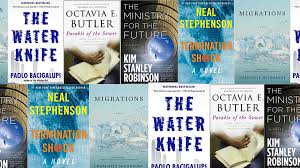
Ship Breaker by Paolo Bacigalupi arrived a few years earlier and won the Printz Award in 2011. Set on the Gulf Coast of a future America, it follows Nailer, a boy who strips copper wiring from beached oil tankers. The storms are worse now. The wealthy have escaped to floating cities. The poor scavenge what remains. Bacigalupi writes with visceral intensity about labor and survival and the terrible choices poverty forces. Climate change created this world, but the story belongs to its characters. Thats the trick. The best cli fi doesnt preach. It immerses.
Environmental Themes in The Hunger Games
Suzanne Collins never explicitly labeled The Hunger Games as climate fiction. But look closer at Panem and the bones of ecological disaster become visible. The series suggests that rising seas and environmental catastrophe reshaped North America before the nation fractured into districts controlled by a glittering, parasitic Capitol. The coal mines of District 12. The agricultural labor of District 11. The fishing economy of District 4. Everything exists to feed resources to those at the center while those on the margins starve.
Katniss herself embodies a kind of environmental literacy. She knows plants and animals. She hunts because her family needs protein and the government rations arent enough. The Meadow where she gathers herbs represents a sliver of wildness in a controlled world. When she enters the arena, her survival depends on reading landscape and weather, understanding how to find water and shelter and food. The Gamemakers manipulate nature as entertainment, creating forest fires and floods and genetically engineered beasts. They have turned ecology into spectacle and punishment.
The deeper environmental message concerns exploitation. The Capitol consumes without replenishing. It extracts coal and crops and fish and children from the districts without giving anything meaningful back. This mirrors real world dynamics where wealthy nations and corporations have historically profited from environmental destruction while vulnerable communities bear the consequences. Katniss cant articulate this in policy terms. She doesnt need to. Her anger at injustice carries the weight of critique.
Some critics have argued that The Hunger Games trilogy functions as environmental justice fiction disguised as political thriller. The revolution ultimately aims to end a system built on unsustainable extraction. Whether Collins intended this reading or whether readers and scholars have retrofitted it onto her work matters less than the resonance. Young readers absorbed a story about fighting power structures that consume everything in their path. Thats a climate narrative even without the label.
Survival Stories and Resource Scarcity
The mechanics of survival drive much dystopian fiction, and climate change provides endless material for desperate circumstances. Drought stories tend toward sparse prose and brutal choices. Flood narratives often emphasize community breakdown and the treachery of those who hoard resources. Fire stories burn fast and leave characters running. Each type of environmental disaster shapes the kind of story that can be told.
Memory of Water by Emmi Itaranta imagines a future where China controls a Scandinavian Union and water rights determine everything. The protagonist, Noria, trains as a tea master, a position that carries secret knowledge about hidden springs. The novel moves slowly and deliberately, building atmosphere rather than action. It earned comparisons to literary fiction more than genre work, and yet its climate premise remains central. Water scarcity has reorganized power. Those who control access to clean water control society. Noria must decide whether to protect her secrets or share them, knowing either choice carries deadly risk.
Breathe by Sarah Crossan presents a different scarcity. After catastrophic oxygen depletion, survivors live in domed cities where air is manufactured and rationed. The wealthy breathe freely. The poor struggle. The environmental message here concerns what happens when even the atmosphere becomes a commodity. Corporations control breath itself. Young revolutionaries believe they can restore natural processes, but the system resists change because too many people profit from the status quo.
These scarcity narratives tap into something visceral. Food, water, air. The necessities of biological existence. When fiction threatens those basics, readers feel the stakes in their bodies. A teenage reader might not worry daily about carbon parts per million, but they understand thirst. They understand hunger. Dystopian fiction translates abstract environmental data into physical experience.
Hope and Despair in Climate Narratives
One tension in climate fiction involves the balance between despair and hope. Too much doom and readers disengage. Too much optimism and the message rings false. Young adult fiction tends toward hope because its audience needs it. Teenagers face enough darkness without literature offering nothing but extinction. But that hope must feel earned rather than tacked on.
The Light Pirate by Lily Brooks Dalton handles this balance beautifully. The novel follows Wanda, born during a hurricane that devastates Florida, across several decades of climate decline. Florida eventually gets closed as a state, abandoned to the elements. But Wanda remains. She learns to survive in a landscape returning to wilderness. The hope isnt political or technological. Its personal and ecological. Wanda finds beauty and meaning in her connection to a changed world. The infrastructure collapses but something endures.
The Great Transition by Nick Fuller Googins takes a different approach by beginning after the climate crisis has been addressed. Sixteen years past Day Zero, when emissions reached zero, a new society has emerged based on mutual aid and collective action. The protagonist Emi grew up in this better world, but she doesnt quite trust it. Her mother, a hero of the transition, remains vigilant against backsliding. The novel alternates between past and present, showing both the struggle to change systems and the difficulty of maintaining change. Hope here is active rather than passive. It requires constant work.
Research suggests that young people experience significant climate anxiety. A global survey found that nearly sixty percent of respondents aged sixteen to twentyfive felt very or extremely worried about the future of the planet. Many reported feeling abandoned by older generations and governments. Dystopian fiction can intensify these feelings, but it can also process them. Reading about characters who face worse circumstances and survive offers a kind of rehearsal. The reader practices resilience through narrative.
The Most Effective Climate Fiction Avoids Lecturing
Nobody wants to read a pamphlet disguised as a novel. The young adult books that succeed in conveying environmental themes tend to prioritize character and story. The world building does the work of argument without ever making arguments explicit. Readers draw their own conclusions from observing how characters live and struggle and choose.
Eleutheria by Allegra Hyde demonstrates this approach. Willa Marks, orphaned at seventeen, eventually finds her way to Camp Hope, a utopian compound in the Bahamas that claims to be living the solution to climate change. But the reality proves more complicated. The charismatic leader has his own agenda. The community operates more like a cult than a movement. Willa keeps striving for her ideals even when the people representing them let her down. The novel explores how hope can be manipulated and how commitment to change can be exploited. Its a warning about false solutions as much as a warning about environmental collapse.
The Marrow Thieves by Cherie Dimaline brings Indigenous perspectives into climate dystopia. Set in a future where most people have lost the ability to dream, the novel follows Frenchie, a young Metis boy, as he and his found family flee government agents who harvest Indigenous bone marrow to restore dreaming capacity to the settler population. Climate change has reshaped the landscape, but the deeper horror involves the continuation of colonial violence. Dimaline connects environmental destruction to the broader history of Indigenous dispossession without ever reducing her characters to symbols. They feel real. Their pain feels specific. The politics emerge from lived experience rather than authorial lecture.
Young protagonists in these novels rarely have all the answers. They make mistakes. They trust the wrong people. They lose hope and find it again. This messiness makes them believable and prevents the fiction from becoming propaganda. A perfect hero with perfect environmental consciousness would bore readers and irritate them. Flawed teenagers navigating impossible situations earn emotional investment.
Technological Solutions and Their Limits
Many climate dystopias interrogate the promise of technological salvation. The idea that innovation will solve environmental problems without requiring fundamental changes to society appears repeatedly, usually with skepticism. Fiction that presents technology as panacea tends toward utopianism. Fiction that presents technology as double edged sword tends toward more interesting complications.
The Ones Were Meant to Find by Joan He offers a vision of eco cities designed to protect committed environmentalists while the rest of the world deteriorates. The protagonist Kasey lives in one of these protected spaces, supposedly devoted to planetary preservation. But the people inside prove willing to do terrible things to maintain their refuge. The eco city becomes a critique of lifestyle environmentalism that protects the privileged while abandoning everyone else. Technology enables this selective protection. It doesnt challenge the underlying injustice.
Breathe similarly presents its domed cities as technological achievement hiding social stratification. The air works. The system delivers breathable atmosphere. But access depends on money and status. Technology solves the immediate survival problem while creating new forms of inequality. Young revolutionaries in the novel believe in different possibilities, in restoring natural processes rather than maintaining artificial ones. Their faith in alternatives represents hope, but the dominant system has immense inertia.
These critiques resonate because young readers have grown up hearing promises about green technology and sustainable innovation while watching emissions continue to rise. The gap between rhetoric and reality breeds skepticism. Fiction that acknowledges this gap feels honest. Fiction that ignores it feels naive.
Found Family and Community Building
Climate dystopia frequently destroys nuclear families. Parents die. Siblings scatter. The survivors must form new bonds. This narrative pattern serves multiple purposes. It creates emotional stakes immediately. It allows diverse groups of characters to come together. And it suggests that existing social structures may not survive environmental transformation. New forms of connection become necessary.
The found family trope appears constantly in young adult dystopian fiction. Katniss allies with Rue and later Johanna and Finnick. Ship Breaker gives Nailer a crew that functions like siblings. The Marrow Thieves organizes its characters into a chosen community moving across the landscape together. These relationships model cooperation and mutual aid. They suggest that survival depends not on isolated individuals but on people caring for each other.
This emphasis on community carries political implications. Individualist responses to climate change, like personal carbon footprint reduction or private bunkers, receive implicit criticism when fiction emphasizes collective action. The heroes succeed because they work together. The villains often hoard resources for themselves. The moral weight falls clearly on solidarity.
Young readers absorbing these patterns learn something about how social change happens. Not through lone heroes but through people organizing and sacrificing and trusting each other. Whether authors consciously intend this lesson or whether it emerges from the logic of storytelling matters less than its presence. The found family structure teaches interdependence.
Gender and Climate Narratives
Young adult dystopian fiction features remarkable numbers of female protagonists. Katniss Everdeen, Tris Prior, June from Legend, Cassia from Matched. The pattern has drawn both praise and analysis. Some critics argue that female protagonists appeal to the target audience of mostly teenage girls. Others suggest that women and girls bear disproportionate impacts from climate change globally and therefore make particularly resonant figures for these narratives.
Environmental justice scholarship documents how climate disasters affect women differently than men in many contexts. Women often have less mobility, less access to resources, and more caregiving responsibilities that constrain their responses to emergencies. Flooding displaces women. Drought increases the labor of water collection that falls primarily on women and girls. Heat waves kill elderly women at higher rates than men. These gendered impacts rarely receive explicit attention in young adult fiction, but the prominence of female protagonists may reflect an intuitive connection between gender and environmental vulnerability.
The female characters in these novels tend toward competence and resilience. They hunt and fight and lead. They refuse traditional constraints. Some critics have celebrated this as feminist empowerment while others have questioned whether these exceptional individuals distract from systemic analysis. A girl with a bow can win games designed to entertain oppressors, but can she change the system that created those games?
Climate fiction that centers female protagonists often pairs environmental themes with critiques of patriarchal control. The Capitol in Panem objectifies female tributes through fashion and spectacle. The domed cities in Breathe police womens reproduction. The breeding programs in various dystopias treat female bodies as resources. These parallels suggest connections between domination of nature and domination of women. Whether readers consciously register this connection or absorb it subliminally, it shapes the political texture of the genre.
Reading Climate Fiction as Preparation
Some educators argue that climate fiction helps young readers prepare emotionally for environmental uncertainty. The psychological concept of exposure suggests that encountering feared scenarios in controlled contexts can reduce anxiety and increase coping capacity. Reading about characters surviving climate disasters might function similarly. Readers practice emotional responses without facing actual danger.
Climate emotions research identifies a range of responses young people experience when confronting environmental crisis. Fear, sadness, anger, guilt, helplessness, and sometimes hope. Fiction allows readers to experience these emotions alongside characters who share them. This can feel validating. Other people, even fictional ones, feel what I feel. The isolation of climate anxiety diminishes when readers find companions in narrative.
Critics of this perspective worry that dystopian fiction might normalize disaster or induce paralysis rather than action. If the future looks inevitably bleak, why bother fighting for change? The hopelessness hypothesis suggests that relentless doom can demobilize rather than motivate. Young adult fiction generally avoids this trap through its emphasis on protagonist agency. Katniss fights. Nailer escapes. Wanda adapts. The characters refuse despair even when circumstances justify it.
The most thoughtful climate fiction acknowledges both the severity of environmental threats and the possibility of meaningful response. It doesnt promise easy solutions or happy endings, but it insists that choices matter. This balance requires considerable narrative skill. Too much hope feels dishonest. Too little feels cruel. The best books in the genre find the space between.
What Comes Next for the Genre
Climate change will continue shaping young adult dystopian fiction because climate change will continue shaping the world young readers inhabit. The material conditions of environmental crisis generate narrative material endlessly. New disasters provide new settings. New scientific understanding provides new speculative possibilities. New political failures provide new villains.
Recent trends suggest growing diversity in climate fiction. Stories centered on Indigenous perspectives, Global South settings, and marginalized communities appear more frequently than a decade ago. This expansion matters because climate impacts fall unevenly. Fiction that only imagines wealthy white characters navigating environmental collapse misses the larger picture. Novels like The Marrow Thieves and How High We Go in the Dark suggest that the genre can embrace broader human experiences.
Another trend involves hybrid genres. Climate romance. Climate horror. Climate mystery. Environmental themes weave into narratives that might not have incorporated them previously. This diffusion means that young readers encounter climate content even when they dont seek it explicitly. The premises of environmental change have become so familiar that authors use them casually. This normalization carries both risks and benefits. Climate change loses some shock value but gains cultural presence.
Publishing continues producing cli fi for young readers at significant volume. Lists of anticipated releases feature multiple environmental titles each year. Whether this reflects genuine reader demand or publisher assumptions about what topics resonate remains unclear. Market dynamics shape what gets published, and trends can shift quickly. But the underlying environmental conditions that generate climate fiction show no signs of improving. The stories will keep coming because the circumstances that inspire them persist.
Young adult dystopian fiction has become one of the primary ways that teenage readers encounter imaginative visions of environmental futures. These books dont substitute for scientific education or political organizing. They cant solve the climate crisis through narrative alone. But they offer something valuable nonetheless. They give fear a shape. They provide rehearsal for difficulty. They suggest that even in broken worlds, young people can matter. And they insist, against considerable evidence, that the story isnt over yet.