The phone rings in an empty room. Dust falls from crumbling ceilings. A voice cuts through static asking the question fans have whispered for three years: “Whatever happened to Tommy Shelby?”
Then Birmingham explodes.
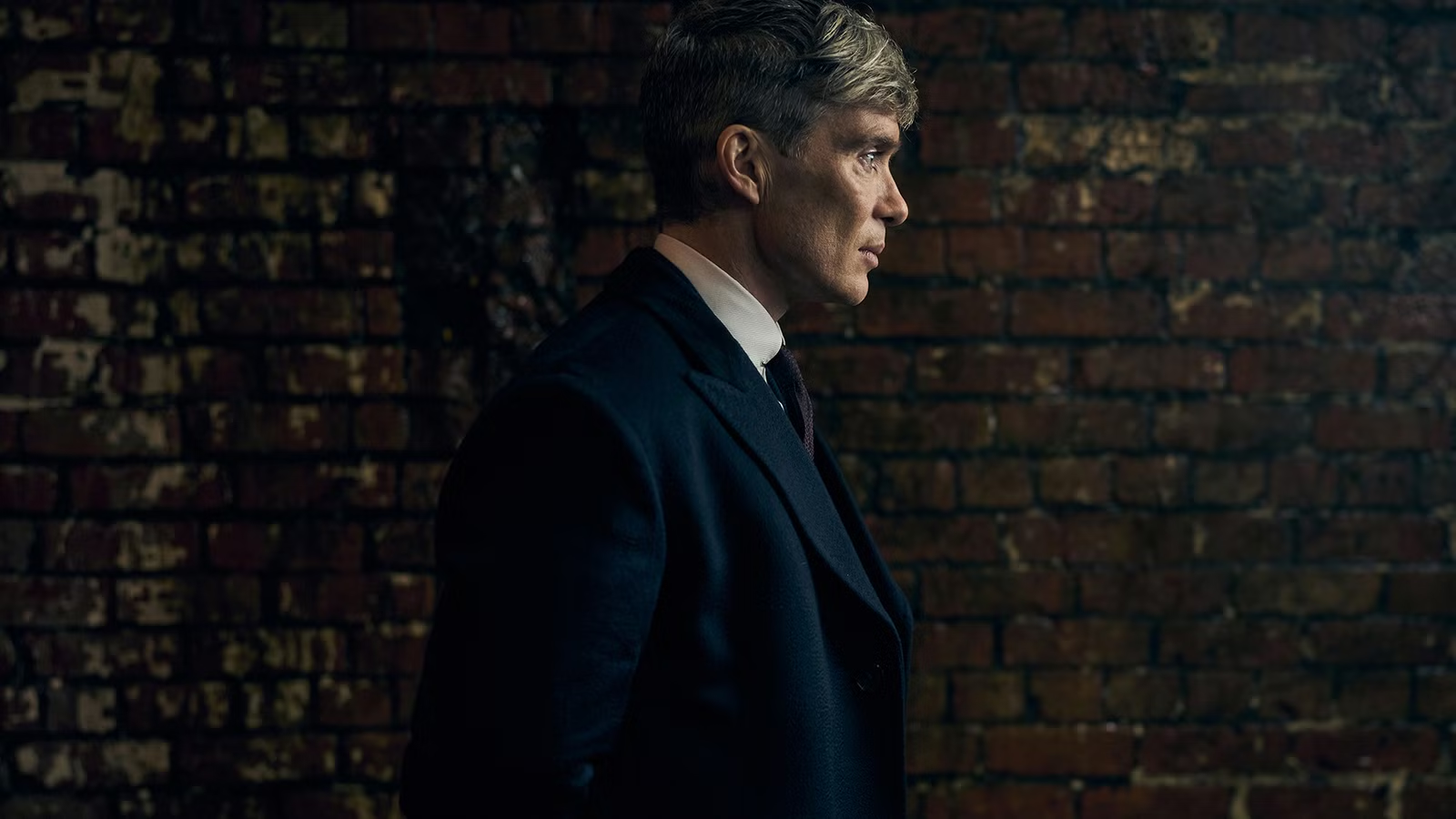
Peaky Blinders: The Immortal Man trailer dropped on December 23, 2025, and the internet hasn’t recovered. Cillian Murphy slides back into that razor lined cap like he never left. But this Tommy looks different. Silver streaks his hair. War haunts those ice blue eyes deeper than ever. The backdrop? Birmingham during the 1940 Blitz, burning under German bombs while Tommy Shelby crawls back from exile to face his darkest reckoning yet.
This isn’t just another gangster movie. This is Tommy confronting whether his legend saves or destroys everything he built. Theaters get first dibs March 6, 2026. Netflix drops it globally March 20. The countdown starts now.
Buckle up. This ride rewrites everything.
The Trailer That Broke Christmas
Netflix knew exactly what they were doing dropping this teaser two days before Christmas. Fans were settling in for holiday mode when boom, Tommy Shelby walks back into their lives looking like a ghost dragged through hell and back.
The one minute teaser packs more punch than most full trailers. Opens with devastation. Birmingham under siege from the Blitz. Buildings collapse. Fire consumes the industrial heart of Britain. Through the smoke and chaos walks Tommy, looking older, harder, impossibly more dangerous.
His voiceover teases impossible choices. “I’m not that man anymore,” he growls, but the cap tilt and razor sharp stare scream the opposite. Tommy Shelby is exactly that man. He’s just evolved into something more terrifying.
Quick cuts flash new faces and familiar ones. Rebecca Ferguson commands the screen with mystery written all over her. Barry Keoghan radiates young hungry violence. Tim Roth lurks like the threat he always is. Stephen Graham, Sophie Rundle, and the loyal Peaky crew return battle hardened.
The score builds dread. No Red Right Hand yet, saving that for later. Instead, atmospheric tension cranks higher until those five words thunder: “By order of the Peaky Blinders.”
Social media detonated instantly. Twitter flooded with “KING TOMMY IS BACK” and crying emojis. TikTok edits racked millions of views within hours. Reddit threads exploded with frame by frame breakdowns and wild theories.
Share this with your Peaky obsessed friend who needs this energy right now.
Story That Pulls Tommy From The Dead
Steven Knight scripts this chapter with the same ruthless precision that built six seasons of addiction. The setup? Birmingham 1940, peak World War II carnage. The Blitz is pounding the city into rubble. Tommy Shelby, believed dead or at least gone for good after walking away in 1934, gets dragged back into the fire.
The official synopsis reveals Tommy faces a choice that could define or destroy the Shelby legacy forever. With the family’s future and the entire country at stake, he must confront his own demons while navigating wartime chaos. Secret missions based on true events pull him deeper into a world where gangster skills meet wartime espionage.
The title “The Immortal Man” cuts several ways. Surface level, it’s about Tommy’s supernatural ability to survive every assassination attempt, political trap, and family betrayal thrown his way. Deeper? It asks whether Tommy has become a legend bigger than the man, whether his myth has trapped him forever.
Knight loves blending historical fact with dramatic fiction. During WWII, British intelligence absolutely recruited criminals for covert operations. The Special Operations Executive used whoever could get the job done, morality optional. Tommy’s skill set of intimidation, strategy, and shadow work makes him perfect for that world.
Theories running wild suggest Tommy works with British intelligence, infiltrates fascist networks, or runs black market operations that secretly supply the war effort. Maybe all three. Knight keeps lips sealed but promises “full throttle Peaky at war with no limits.”
The six year gap between season six’s 1934 ending and the film’s 1940 setting opens narrative possibilities. Where did Tommy go? What broke him enough to stay away? What crisis dragged him back? Those answers will hit hard.
Tag someone who binges shows in one weekend. They need this.
Cast That Stacks Legends With Fresh Blood
Cillian Murphy anchors everything as Tommy Shelby. Fresh off his Oscar win for Oppenheimer, Murphy brings even more gravitas to a character he’s inhabited for over a decade. But this time he’s also producing, giving him creative control beyond performance. Murphy told press he’s “grateful for the collaboration” and “excited” to shoot, but his eyes in the trailer tell the real story. This Tommy has seen things that carved new scars.
Barry Keoghan joining as Duke Shelby is inspired casting. Duke surfaced in season six as Tommy’s illegitimate son, immediately proving he inherited the Shelby ruthlessness. Keoghan, hot off scene stealing performances in The Banshees of Inisherin and Saltburn, brings unpredictable intensity. The father son dynamic between Murphy and Keoghan could explode into the emotional core of the film. Duke wants power. Tommy wants redemption. Those goals might collide violently.
Rebecca Ferguson enters the Birmingham underworld in an undisclosed role, but knowing her track record in Dune and Mission Impossible, expect complexity and danger. She’s not playing anyone’s side character. Ferguson commands attention, and her presence suggests a character operating on Tommy’s level, whether as ally, enemy, or something messier.
Tim Roth signed on in September 2024, and his role remains mysterious. The Pulp Fiction legend brings menace to every frame he inhabits. Whether he’s a wartime profiteer, a government official, or a rival gangster, Roth will steal scenes.
The returning core includes Stephen Graham as union firebrand Hayden Stagg, Sophie Rundle as Ada Shelby Thorne pushing her political rise, Ned Dennehy as Charlie Strong, Packy Lee as the loyal Johnny Dogs, and Ian Peck as Curly. These characters have ridden with Tommy through every storm. Seeing them navigate WWII Birmingham will hit different.
Jay Lycurgo rounds out new additions. The cast list keeps expanding with deeper cuts: Ruby Ashbourne Serkis plays Agnes Shelby, Sam Baker Jones as Jake, Thomas Arnold as Virgil. Background players include punters, tailors, SS guards, airmen, and POWs, suggesting the scope explodes beyond typical Peaky territory.
Behind the scenes, the stunt team stacks heavy. Neil Chapelhow doubles Murphy. Luke Gomes handles Keoghan’s action. Nicholas Daines covers both Roth and Graham. Rob Cooper coordinates fight choreography. This level of stunt preparation hints at action sequences that dwarf anything the series attempted.
Drop your dream casting for future Peaky projects in the comments.
Knight And Harper Dream Team
Steven Knight created Peaky Blinders in 2013 and wrote every episode across six seasons. His voice defines the show: razor sharp dialogue, morally complex characters, historical events twisted with dramatic license, and Tommy Shelby’s internal war between ambition and redemption.
Knight scripting the film guarantees authenticity. This isn’t a Hollywood adaptation that sanitizes or dumbs down the source material. It’s the same mind that crafted “I’m not a traitor to my class, I am just an extreme example of what a working man can achieve” and every other iconic Tommy line.
Tom Harper directing brings the perfect complement. Harper helmed three episodes in season one, including the pilot that established the show’s visual style and narrative tone. He understands the DNA of Peaky Blinders: the balance between stylized violence and emotional vulnerability, the anachronistic music choices, the slow motion walks that feel like opera.
But Harper has evolved as a filmmaker since 2013. Wild Rose showcased his ability to handle intimate character studies with musical elements. The Aeronauts proved he can orchestrate period piece spectacle. The Immortal Man demands both skills: epic wartime scale and the close up vulnerability that makes Tommy Shelby more than a gangster archetype.
Harper recently told press the film allows for “cinematic ambition” the series budget never permitted. Expect wider shots, longer takes, more complex action choreography. But also expect those signature close ups on Murphy’s face where a flicker of expression communicates more than dialogue ever could.
Cillian Murphy producing adds another layer of quality control. He’s not just performing. He’s shaping the project, ensuring it honors what came before while pushing the story forward. Murphy’s dedication to Tommy Shelby borders on method. He’s lived with this character for years, understanding Tommy’s psychology deeper than anyone except maybe Knight himself.
The trio of Knight, Harper, and Murphy as writer, director, and star slash producer creates a power structure focused on one goal: delivering the Peaky Blinders film fans deserve.
Don’t miss out on set photos leaking online. Follow official accounts now.
Birmingham 1940 Setting Burns Real
Birmingham during the Blitz wasn’t just dangerous. It was apocalyptic. The city suffered over 2,000 air raid alerts between 1940 and 1943. German bombers targeted Birmingham’s industrial capacity: the factories producing weapons, vehicles, and materials for the British war effort.
Thousands died. Buildings that survived World War I crumbled under sustained bombing campaigns. The Austin works in Longbridge, the BSA factory in Small Heath, and countless other facilities became priority targets. Civilians huddled in shelters, never knowing if their street would exist in the morning.
This is the Birmingham Tommy Shelby returns to. Not the gritty but functional post WWI city of the series. This is a city literally on fire, fighting for survival, where normal rules evaporate under existential threat.
The chaos creates perfect conditions for Tommy’s skill set. Black markets explode during wartime. Rationing creates demand for illegal goods. Information becomes currency. Someone who can navigate criminal networks, intimidate rivals, and think strategically becomes invaluable to both underworld and overworld operations.
Historical records confirm British intelligence recruited from morally gray areas during WWII. The Special Operations Executive and other agencies used whoever could accomplish missions, criminal background irrelevant. If Tommy Shelby existed in 1940, agencies would absolutely try to recruit him.
The setting also mirrors Tommy’s internal state. Birmingham burning reflects Tommy’s psyche: haunted by WWI trenches, scarred by personal losses, watching everything he built potentially consumed by forces beyond control. The external chaos manifests his internal war.
Knight weaves this historical texture into narrative. The series always grounded dramatic fiction in real events: the real Peaky Blinders gang, Billy Kimber, the 1926 General Strike, Oswald Mosley’s British Union of Fascists. Expect The Immortal Man to continue that tradition, blending real WWII operations with Shelby family drama.
Visually, the Blitz provides stunning cinematic potential. Fire lighting Birmingham’s streets at night, bombers overhead, buildings collapsing in slow motion, Tommy walking through destruction like the immortal man the title suggests. Harper’s expanded budget allows practical effects and set pieces the series could never afford.
The early series famously blew a huge chunk of season one’s budget on the opening shot: horses running down the street with Russian arms dealers. The production had to improvise with rudimentary camera gear for other scenes. The film budget removes those constraints, letting Harper and cinematographer Darren Bird create the Peaky visual style on a grander scale.
Title Meaning Layers Deep
“The Immortal Man” works on multiple levels, classic Knight wordplay.
Literally, Tommy Shelby has survived more death sentences than should be humanly possible. He’s been shot multiple times. Poisoned. Cursed by gypsies. Marked for assassination by rival gangs, politicians, and fascists. Every season ended with Tommy seemingly doomed, and every season he walked out alive.
By 1940, Tommy’s survival streak borders on supernatural. Enemies might genuinely wonder if he can die. The myth of Tommy Shelby has grown larger than the man. He’s become a ghost story gangsters whisper about.
But immortality has costs. Tommy can’t escape his legend. In season six, he tried to walk away, fake his own death, find peace. The film proves that didn’t work. The past won’t stay buried. The Shelby name won’t let him rest. He’s trapped by the empire he built, cursed to keep fighting even when he wants to stop.
The title also questions legacy. Immortality through myth rather than flesh. Tommy’s building something that outlasts him: the Shelby family empire, the political connections, the businesses. That’s a form of immortality. But is it worth the cost? Has he created something meaningful or just another cycle of violence?
Knight loves existential questions buried in gangster drama. The Immortal Man likely asks whether Tommy’s curse is external or self inflicted. Can he ever be just a man again, or has he become the legend permanently? Does he even want to escape anymore, or has he accepted this is who he is?
The film’s climax probably forces Tommy to choose: embrace the immortal legend and all its darkness, or destroy everything and try to be mortal again. Either choice comes with unbearable cost.
These are the kind of questions that made Peaky Blinders more than a period crime show. The gangster stuff is surface. Underneath runs a story about identity, legacy, and whether redemption is possible for someone who’s gone too far.
Share with anyone who loves shows with layers.
Tommy’s Demons Coming Home
Tommy Shelby’s PTSD from WWI trenches has haunted him since episode one. The series never shied from depicting his psychological damage: hallucinations, night terrors, emotional numbness punctuated by explosive rage. He self medicates with opium and whiskey. He buries himself in work and schemes to avoid thinking.
Placing Tommy in 1940 Birmingham during the Blitz deliberately triggers his war trauma. Bomb explosions echo artillery shells. Buildings collapsing recall tunnel collapses in France. Air raid sirens resurrect visceral memories of going over the top into no man’s land.
Tommy’s mental state in the film likely spirals. He’s already carrying guilt over Grace’s death, complicated relationships with his siblings, and the moral weight of everything he’s done to build Shelby Limited. Adding WWII chaos and being pulled back into violence he tried to escape creates a psychological pressure cooker.
Murphy excels at playing Tommy’s internal war. The character rarely breaks down openly, but Murphy communicates volumes through microexpressions: the clench of his jaw, the flicker in his eyes, the way he lights cigarettes with shaking hands. The film gives Murphy room to explore Tommy’s psychological landscape with the depth and time a feature allows.
The synopsis mentions Tommy must “face his own demons.” That’s not generic action movie language. That’s the core of his arc. Tommy’s greatest enemy has always been himself. The voice in his head saying he’s damned, that he destroys everything he touches, that he’s gone too far for redemption.
The film probably climaxes with Tommy making a choice that defines whether he believes his own darkness or fights for something better. Does he sacrifice himself? Does he embrace being the monster? Does he find some middle path?
Expect a performance from Murphy that reminds everyone why he’s one of the best actors working today. The Oscar for Oppenheimer proved his range, but Tommy Shelby remains his most iconic role. He’s had years to live with this character. The film lets him bring everything he’s learned as an actor to his defining role.
Shelby Family Evolution War
Family has always been Peaky Blinders’ beating heart, even when that family is dysfunctional and dangerous. Tommy’s relationships with his siblings, aunt Polly (before Helen McCrory’s tragic passing), and extended family created the emotional stakes that made the gangster plots matter.
The film introduces a generational shift. Barry Keoghan’s Duke Shelby represents the new blood. He appeared briefly in season six as Tommy’s illegitimate son from a wartime romance. Duke immediately proved he inherited his father’s cunning and ruthlessness without the moral complexity that haunts Tommy.
Duke potentially leads the Peaky Blinders in Tommy’s absence. He’s younger, hungrier, less burdened by guilt. That creates natural conflict. Does Duke respect Tommy’s return or resent it? Has Duke taken the organization in directions Tommy opposes? Can they work together or does the throne only fit one Shelby?
Sophie Rundle’s Ada Thorne continues her political rise. Season six saw Ada enter the political arena, using Shelby money and connections for legitimate power. By 1940, Ada could hold significant political position, navigating the wartime government. Her storyline probably explores whether Shelby power can transition from criminal to legitimate, and what compromises that transition demands.
The relationship between Ada and Tommy has always been complicated. She’s the moral conscience of the family, pushing back against violence while still supporting her brother when needed. Ada probably represents the path Tommy wishes he could take: using power for something beyond personal empire building.
Stephen Graham’s Hayden Stagg adds working class politics. He’s the union organizer, representing the people Tommy claims to champion. Their alliance likely faces strain as Tommy’s wartime activities might conflict with worker interests.
The returning crew (Johnny Dogs, Charlie Strong, Curly) represent loyalty tested by time. They’ve followed Tommy through everything. But 1940 is different. The stakes are national survival, not gang territory. How far does their loyalty stretch?
New family members like Agnes Shelby expand the Shelby tree. Every addition creates more people Tommy feels responsible for protecting, more potential victims if he fails, more emotional leverage enemies can exploit.
Knight has always written the Shelbys as tragic family: bound by blood, divided by ambition, united by external threats. The film probably tests those bonds harder than ever. WWII forces choices between family and country, personal loyalty and national duty, saving individuals versus saving England itself.
Fan Reaction Explodes Global
The December 23 trailer drop created instant global conversation. Within 24 hours, the official Netflix teaser on YouTube racked up millions of views. Social media platforms flooded with reactions ranging from ecstatic to emotionally overwhelmed.
Twitter trends included “Tommy Shelby,” “Peaky Blinders,” and “The Immortal Man” in multiple countries simultaneously. Fans posted everything from simple “HE’S BACK” reactions to detailed frame by frame analysis of trailer shots.
TikTok became a breeding ground for creative responses. Editors spliced trailer footage with classic Peaky scenes, creating montages set to show’s iconic music. Cosplayers broke out flat caps and suits for reaction videos. Fan theories proliferated about plot points, character fates, and hidden trailer details.
Reddit communities like r/PeakyBlinders exploded with discussion threads. Users debated everything from whether Tommy faked his death between 1934 and 1940, to whether Alfie Solomons might somehow appear (Tom Hardy is not confirmed for the film, but fans hope eternally).
YouTube reaction channels had a field day. Channels dedicated to trailer breakdowns, British television analysis, and general entertainment all covered the teaser, dissecting every moment.
The common threads? Relief and anticipation. Season six ended satisfyingly but left fans wanting more. The film announcement generated excitement mixed with caution: could it live up to six seasons of excellence? The trailer’s quality eased most concerns. Comments overwhelmingly praise the cinematography, Murphy’s presence, and the epic scale the teaser promises.
Some fans expressed concern about one missing element: Red Right Hand by Nick Cave, the show’s theme song. The trailer uses different atmospheric music. Some worried this signals a departure from what made Peaky special. Others argue the film will have its own identity while honoring the series.
The fan base spans demographics unusually wide for a period crime drama. Peaky Blinders attracts young adults for the style and music, older viewers for the historical setting and complex plotting, international audiences who connect with themes of class struggle and ambition. The film needs to satisfy all these groups.
Early reactions suggest it’s on track. The trailer gives hardcore fans the callbacks and continuity they crave while presenting a story accessible to newcomers. Knight has always been savvy about balancing those audiences.
Comment below with your first reaction to the trailer. Let’s compare notes.
Netflix Viewership Beast Mode
Peaky Blinders isn’t just critically acclaimed. It’s a viewership monster. The series consistently ranks among Netflix’s most watched shows globally.
Season six finale drew massive audiences worldwide. While Netflix guards exact numbers, industry tracking via Nielsen showed Peaky Blinders pulling over 1 billion minutes viewed during peak weeks. That puts it in conversation with giants like Stranger Things and The Crown.
In the UK, the series finale on BBC peaked at 3.8 million viewers live, with consolidated numbers reaching 6.2 million. For a show that started as a modest BBC Two drama, that growth is remarkable.
The show’s audience skews mature. Nielsen demographic data shows Peaky Blinders attracts significant viewership in the 50 to 64 age range (26%) and 35 to 49 range (24%). But it also pulls younger viewers, unusual for a period drama. The 18 to 34 demographic engagement proves the stylized violence, contemporary music, and moral complexity transcends typical period piece audiences.
Globally, Peaky Blinders ranks consistently in Netflix’s top 10 in dozens of countries. The series found particular success in unexpected markets: Argentina, Turkey, India, and throughout Latin America. The themes of class struggle, family loyalty, and ambition translate across cultures.
The film benefits from this massive built in audience. Even with a theatrical release window, the Netflix drop on March 20, 2026 ensures global simultaneous access. Expect launch weekend numbers to potentially break Netflix records for a film release.
Netflix’s dual strategy (select theaters first, streaming two weeks later) serves multiple purposes. Theatrical qualifies the film for awards consideration. It creates scarcity and urgency for hardcore fans wanting the big screen experience. And the short window before streaming prevents piracy while maintaining hype.
For comparison, Netflix’s Red Notice pulled 364 million hours viewed in its first 28 days. The Gray Man hit 253.87 million hours. If The Immortal Man cracks 300 million hours, it’s a smash. Given the fan base and anticipation, that target seems reachable.
Budget Evolution Shows Growth
Early Peaky Blinders operated on shoestring budgets. Season one reportedly had around £7.5 million for six episodes. That’s barely over £1 million per episode, minuscule by modern prestige TV standards.
The famous opening shot of season one exemplifies this: Cillian Murphy and crew riding horses down a street. Knight wanted this striking image. The production spent a large chunk of available budget on that sequence and the Russian arms dealers scene. For weeks afterward, the crew scrambled with limited resources, using borrowed equipment and guerrilla filming tactics.
That budgetary constraint accidentally created the show’s gritty aesthetic. The slightly rough camera work, the close framing, the focus on faces over wide spectacle. It looked nothing like typical period dramas. It felt raw, immediate, dangerous.
As the show’s success grew, so did budgets. By season six, each episode cost significantly more, allowing for bigger set pieces, more extras, more ambitious action sequences. But even late season budgets couldn’t approach feature film scale.
Knight confirmed in interviews the movie budget dwarfs series budgets. Exact figures remain undisclosed, but industry estimates suggest anywhere from £25 to £40 million, potentially higher. That puts The Immortal Man in the range of mid-budget theatrical releases.
What does that money buy? Larger scale destruction for the Blitz sequences. More extras to fill bombed out Birmingham streets. Practical effects for explosions and building collapses. Stunt coordination for complex action. Period accurate vehicles, costumes, props for 1940. Location shooting beyond the usual Birmingham spots. Post production visual effects to enhance practical work.
Knight told press the expanded budget removes all creative limits. If the script calls for an air raid with bombers overhead and fires engulfing city blocks, the production can deliver. The series would have written around those limitations. The film embraces them.
That said, Knight emphasized the film won’t lose the intimate character focus in pursuit of spectacle. The budget serves story, not the reverse. Tommy’s internal struggles, family dynamics, and moral complexity remain central. The Blitz is backdrop, not distraction.
Theories Gripping Hardcore Fans
Peaky fans love theorizing. Reddit, Twitter, and fan forums buzz with speculation based on every trailer frame and interview quote. Here are theories gaining serious traction:
Theory one: Tommy works with British intelligence. The synopsis mentions “secret missions based on true events.” During WWII, the SOE and MI5 recruited criminals for covert work. Tommy’s skills in intimidation, infiltration, and violence make him perfect for wartime black ops. He might assassinate fascist sympathizers, disrupt enemy supply lines, or gather intelligence using underworld connections.
Theory two: Duke stages a power coup. Barry Keoghan’s casting as Duke Shelby fuels speculation about father versus son conflict. Duke took control of the Peaky Blinders during Tommy’s exile. He’s younger, more ruthless, unburdened by Tommy’s guilt. When Tommy returns, Duke resents giving up power. The central conflict becomes whether the Shelby empire has room for both.
Theory three: Rebecca Ferguson plays a government handler or spy. Her undisclosed role drives speculation. Given her action bonafides and commanding presence, many fans guess she’s Tommy’s contact with British intelligence. Their relationship mixes professional respect, romantic tension, and mutual manipulation. She recruits Tommy for missions but has her own agenda.
Theory four: Tim Roth is the main villain. Roth’s unnamed character sparks theories he’s a fascist profiteer, black market king, or corrupt government official. He represents the worst of wartime opportunism: exploiting chaos for profit while people die. His conflict with Tommy becomes ideological. Tommy may be a criminal, but he has lines. Roth’s character has none.
Theory five: Ada brokers peace between family and government. Sophie Rundle’s Ada rising politically creates a bridge between Shelby criminal empire and legitimate power. She might negotiate Tommy’s intelligence work, protecting the family legally while Tommy operates illegally. Her arc explores whether the Shelbys can transition from gangsters to political dynasty.
Theory six: Tommy’s final sacrifice. The darkest theory suggests Tommy dies or disappears permanently, finally free of the immortal man curse. He completes one last mission that saves his family and country, then walks into oblivion. It would be tragic but fitting: Tommy achieving redemption through ultimate sacrifice.
Knight keeps plot details locked tight. Murphy and cast avoid spoilers in interviews. That secrecy fuels fan speculation, keeping conversation alive until release.
Which theory sounds most likely? Drop your vote below.
Visual Style Gets Cinema Treatment
Tom Harper inherits a show with distinctive visual language and gets to expand it cinematically. Peaky Blinders established specific aesthetic choices that defined its look:
Blue tinted color grading creates a cold, haunted atmosphere. The series bathes scenes in blue and gray tones, occasionally broken by warm firelight or blood red. This color palette reinforces the emotional landscape: Tommy’s world is cold, beautiful, dangerous.
Slow motion walks turned gangsters into mythic figures. The series made an art form of the slow motion crew walk: Tommy and the Peaky Blinders striding down streets, fanned out in intimidating formation, often to dramatic music. These moments feel operatic, elevating gangster swagger to legend.
Extreme close ups on Murphy’s face let microexpressions tell stories. Harper and later directors learned Tommy rarely needs dialogue. A shot of Murphy’s eyes communicates volumes: the calculation, the pain, the controlled rage always simmering.
Dynamic editing during violence makes fights feel visceral. The series cuts violence into sharp bursts: quick flashes of razors, punches, blood. It conveys brutality without gratuitous gore.
The film expands this visual language for cinema. Expect wider shots to establish the scale of bombed Birmingham. Longer takes to build tension. More ambitious camera movements now that budgets allows cranes, dollies, drones.
But Harper will maintain the core aesthetic. The blue tint, the slow motion swagger, the close ups on Murphy. These elements define Peaky visually. Abandoning them would feel wrong.
Cinematographer Darren Bird brings experience shooting period pieces and action. His work will balance the intimate character moments with epic set pieces. Imagine Tommy having a quiet conversation with Ada, shot in close framing with that blue tint, then cutting to a wide shot of Birmingham under bomber attack, fire lighting the sky, before returning to Tommy’s face reflecting the flames.
The action choreography under Rob Cooper will likely deliver the series’ best fight sequences times ten. With stunt doubles for all major actors and budget for elaborate set pieces, expect Shelby violence elevated to cinematic scale.
Soundtrack Traditions Continue
One element that made Peaky Blinders iconic is its anachronistic soundtrack. Knight made the bold choice to score a 1920s period drama with contemporary and alternative music: Nick Cave, Arctic Monkeys, PJ Harvey, Radiohead, Anna Calvi, Royal Blood.
This musical choice could have felt gimmicky. Instead, it became signature. The modern music creates emotional resonance modern audiences connect with immediately. It makes a story set 100 years ago feel urgent, timely, dangerous.
Red Right Hand by Nick Cave became the show’s theme. That opening bass line and Cave’s menacing vocals signaled the Peaky Blinders were coming. The song appeared in different versions across seasons, always announcing something major.
The trailer for The Immortal Man doesn’t feature Red Right Hand, sparking fan debate. Some worry this signals the film abandoning musical traditions. More likely, the trailer uses different music to create distinct atmosphere while saving Red Right Hand for the film itself. Imagine that bass line dropping during the opening credits on the big screen. Chills.
Knight confirmed in interviews the film continues the musical approach. Expect carefully curated tracks that blend period and contemporary, creating the emotional landscape. The film might lean into WWII era music more than the series did, reflecting the 1940 setting, while still incorporating modern sounds.
Composer Martin Phipps has scored Peaky since season two. His original compositions blend with the licensed tracks, creating cohesion. Phipps will likely provide an original score for The Immortal Man that echoes series themes while expanding for cinema.
Music licensing costs money, one reason the expanded budget matters. The film can afford more tracks, more expensive licenses, more ambitious musical moments.
Why March 2026 Feels Forever Away
The release date of March 6 (theaters) and March 20 (Netflix) feels agonizingly distant. But the wait serves purposes.
First, it gives marketing time to build. We’ve had one teaser. Expect a full trailer in early 2026. TV spots. Magazine covers. Cast interviews. Behind the scenes featurettes. Clips and teasers. The hype machine will ramp up gradually, keeping conversation alive for months.
Second, it allows fans to rewatch the series. Six seasons, 36 episodes. That’s substantial content to revisit before the film. Newcomers have time to discover the show. Lapsed fans can refresh their memories. Hardcore fans can catch details they missed.
Third, it creates anticipation. Delayed gratification makes the eventual payoff sweeter. By March 2026, fans will be ravenous. Opening weekend (both theatrical and Netflix) will be an event.
Fourth, it avoids competition. March typically has lighter release schedules compared to summer blockbuster season or year-end awards contenders. The Immortal Man gets breathing room to dominate conversation.
The wait also lets post production perfect everything. Visual effects, sound design, color grading, music mixing. All the technical elements that make cinema special. Rushing those processes risks quality. Knight, Harper, and Murphy want this perfect. That takes time.
Patience. By order of the Peaky Blinders, the wait will be worth it.
Set calendar reminders now. Plan viewing parties. Recruit friends who’ve never watched.
Final Verdict: Why This Matters
Peaky Blinders: The Immortal Man is more than a movie. It’s the continuation of a cultural phenomenon that redefined period dramas, made Birmingham cool, turned Cillian Murphy into a global icon, and proved audiences hunger for morally complex antiheroes struggling with identity and legacy.
The film arrives at the perfect moment. Streaming services dominate, but cinematic experiences matter more than ever. The dual release strategy respects both.
Tommy Shelby’s story resonates because it’s universal beneath the period details. Who hasn’t felt trapped by their past? Who hasn’t wondered if redemption is possible after going too far? Who hasn’t built something and questioned whether it was worth the cost?
The creative team delivered excellence for six seasons. They’ve earned trust for the film. Knight’s script, Harper’s direction, Murphy’s performance, the supporting cast, the expanded budget, the commitment to honoring what came before while pushing forward. Everything aligns.
March 2026 might feel distant, but when those opening credits roll and that first “by order of the Peaky Blinders” hits, it’ll feel like Tommy Shelby never left. He’s been waiting in the shadows, preparing for one more war.
Birmingham burns. The Blitz rages. The Shelby empire hangs by a thread. Tommy Shelby walks back into hell one final time.
And we’re all riding with him.
Your Move Now
Theories? Drop them in the comments. Who lives? Who dies? What’s Tommy’s endgame? Start the debate.
Share this article with every Peaky fan in your contacts. Spread the hype. The more people talking, the bigger the event becomes.
Follow official Peaky Blinders and Netflix social accounts for updates. More trailers are coming. Behind the scenes content will leak. Stay plugged in.
Rewatch the series before March. You’ll appreciate the film more with everything fresh. Share favorite episodes and moments.
Most importantly, show up. Buy tickets for March 6 or stream March 20. Vote with viewership for quality storytelling, for risks that pay off, for antiheroes who reflect our complexity.
Tommy Shelby is immortal because we keep his legend alive. By order of the Peaky Blinders, this is the event of 2026.
See you in Birmingham.