Honey Dont wears a flirty grin for a title, but the movie underneath it is closer to a raised eyebrow and an uneasy shrug. Ethan Coen is at the helm again as director and co writer with Tricia Cooke, following last years Drive Away Dolls. You can feel the ambition. You can see the craft. The parts sparkle in the light. The machine they form does not quite run.
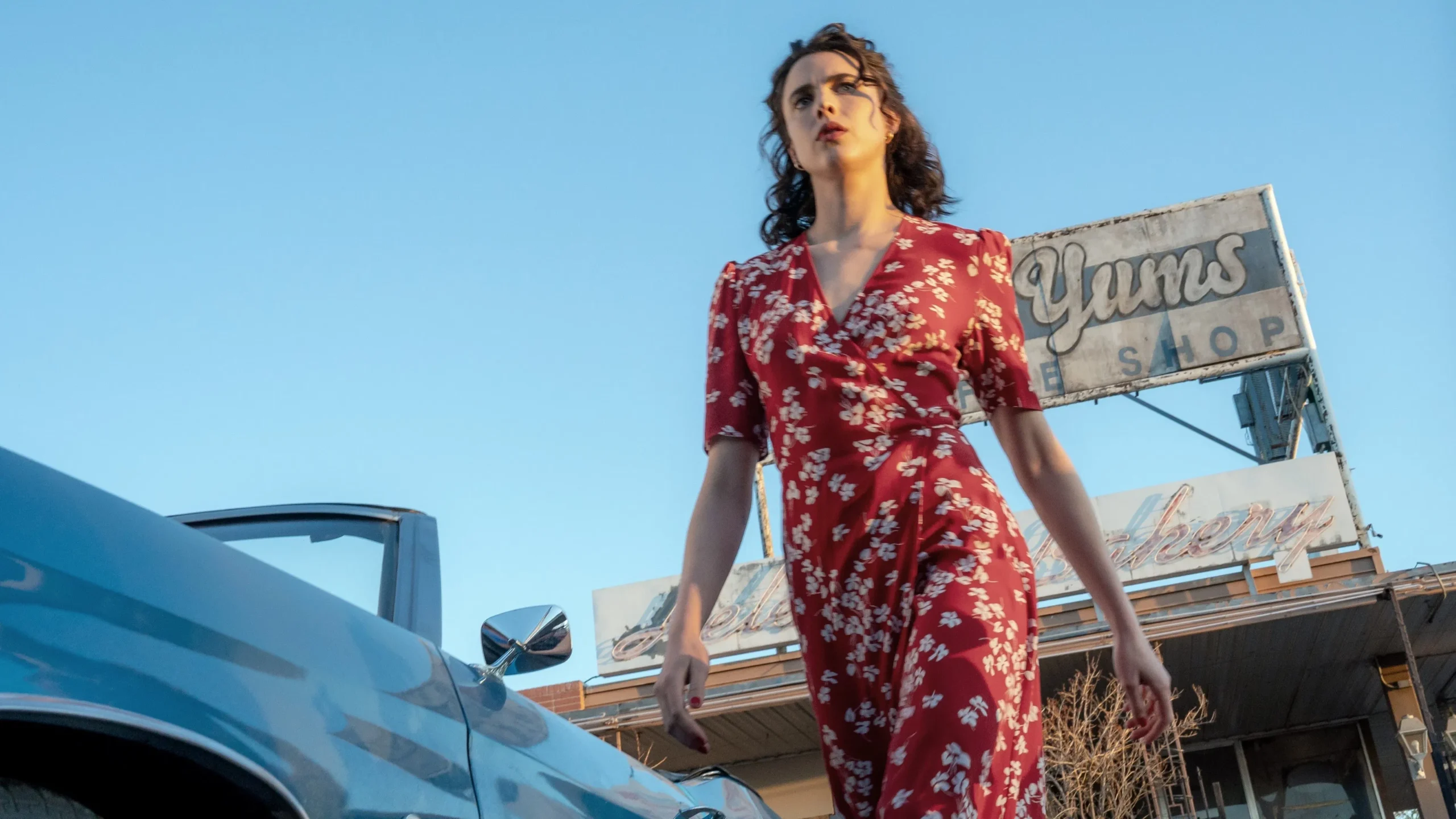
Let me get the good news on the table first, because there is a lot of it. The movie looks beautiful. Cinematographer Ari Wegner gives Bakersfield a sunburned glow that feels like old paper postcards you find in a relatives attic. The light is dusty and forgiving. It turns every alley and parking lot into a diorama from a forgotten roadside America. There is an easy rhythm to the way the camera moves in and out of rooms and streets. You can sense the confidence in the visual language.
The costumes are a joy too. Peggy Schnitzer leans into a crisp retro look that keeps glancing back at earlier noir eras without becoming dress up. Patterns and textures talk to one another. The blouses. The trousers. The heels. The thrift store suits. The small town uniforms and Sunday best. People carry themselves differently because of what they are wearing, which is something you only notice when a movie understands wardrobes as behavior.
And Carter Burwell sets a mood that feels like sun baked melancholy. He is a longtime partner of the Coen world and his Western tinged score curls around scenes like smoke. It hints at menace and then fades into a quiet little grin. He does what he always does so well. He gives a movie a heartbeat that you can feel before you understand it. I liked listening to this one even when it lost me.
The cast is a checkerboard of personalities that ought to make a playful modern noir really sing. Margaret Qualley is front and center as private investigator Honey ODonohue. Aubrey Plaza plays a cop named MG who does not smile so much as look through you. Chris Evans puts on a collar as a preacher with too much charm and a mean streak. Charlie Day shows up as a small city detective who does not quite get it. Billy Eichner pops in and out. Talia Ryder plays a niece with a fragile situation back at home. You hear those names and your head nods. It is a tasty lineup. On paper it is the right movie.
The setup has the snap of an old paperback. Honey arrives at a fatal car crash and something about the scene sets off her instincts. It smells wrong to her. She is not law. She is not official. She is a professional snoop with good shoes and a quicker mind than she lets on. The day before the victim had reached out to hire her. So she pulls the thread. More bodies begin to fall into the case like loose change. A storefront church becomes the center of the map. A man of God is not what he seems. Neither is anyone else.
Qualley has real presence in the lead. She is tall and graceful and moves like someone who knows she can control a room just by choosing when to lean against a doorframe. There is a musicality to the way she trades barbs. She can let a line skim across the surface and then cut three lines later with a dry little aside. She carries that noir posture without slipping into cartoon. You want to follow her. That is a big deal. The movie gives her plenty of swagger. It does not give her a character with much underneath it. There is posture and banter and not enough ache.
Charlie Day plays a local detective who keeps asking Honey out even after she tells him in plain words that she is not interested in men. He is not cruel about it. He is just tuned to the wrong frequency and cannot hear no as a complete sentence. It is meant to be lightly comic and a bit cringey at the same time. The beat plays, we get it, and then it happens again. The script has a habit of circling its own jokes like that. You feel the folksy bounce in the banter, but the scenes do not escalate. They repeat.
On the villain side, Chris Evans dives into a slithery role as Reverend Drew Devlin, the spiritual leader of that little church that sits at the center of the mess. I have enjoyed watching Evans break away from the shiny Marvel hero mold in the past couple of years. He has taken parts that let him be complicated or even nasty. This time he is a swaggering charmer with a taste for control. And yet the movie tips him too early and too broadly. He becomes the obvious snake in the room from his first minutes on screen. There is not much surprise left to squeeze out of him after that. He glowers, he seduces, he threatens, he sins. You already knew he would.
There is a cheeky exchange where he asks Honey if she drinks and she replies that yes she drinks a lot and she is proud of it. That gives you a feel for the tone the movie is chasing. Arch. Dry. A little naughty. The line lands. A lot of lines like that do. The trouble is what comes in between them.
While Honey works the case she also keeps watch over her niece, played with quiet alarm by Talia Ryder. The young woman is stuck in a bad relationship with a guy who telegraphs danger from the first glance. This thread is supposed to add stakes and warmth. It is supposed to show us the version of Honey who is not just a wisecracking sleuth but also a guardian with real responsibilities. You can see the intention. On screen it feels like a side path that pulls us away from the main route and then does not return us with new insight. The niece deserves a better arc than the quick beats she is given.
The story sends Honey into the orbit of MG, a tough cop who carries her silence like a blade. Aubrey Plaza plays her with that cool deadpan she does better than almost anyone. You can feel the static between them from the first time they share the frame. When they begin a sexual relationship the film does not try to soften the edges or turn them into a tender movie couple. It is physical. It is intense. It is complicated. In private there is heat. In public there is a scene in a brightly lit bar that pushes plausibility to the breaking point. Part of me admired the nerve. Part of me thought, come on, someone would have noticed. But the bigger issue comes later, when the relationship takes a hard turn in the final stretch. The tone shifts in a way that feels unearned. It is not clear if the film is reaching for camp or tragedy or something in between. The shift can play as a jolt that knocks the story off balance rather than deepening it.
I kept thinking about how close all of this is to working. You have the bones of a present day noir. A heat soaked California town. A private eye with snap in her voice. A fight between surface righteousness and private depravity. A chorus of eccentrics along the way. It is all here. And yet the actual mystery fades in and out until it is hard to remember what we are chasing. That can be a choice. The Big Lebowski famously uses its plot as a canvas rather than as a straight line to a solution. The tone and the language become the point. The difference is that in Lebowski there is an overall pattern that repeats and reconfigures across the film. The mix of lines and images and situations builds a trance. There is an internal logic even inside the chaos. Here the chaos is looser. The movie gathers characters and subplots and lets them bump into one another. Then it expects a big moment late in the story to land with emotional weight because it says it does. The groundwork is not there.
A long lost relative shows up toward the end. The film wants that to feel like a crack in the tough outer shell. It should be a reaction shot that tells a hidden story all by itself. Instead it feels like something added late in the draft in hopes of adding feeling. Writing can do that. Sometimes you put a new piece into a piece of furniture and the whole thing suddenly makes sense. But you can also feel it when a screw is stripped and the leg will not stay tight. The scene wobbles.
Ethan Coen working without his brother still feels like an experiment that is being tinkered with in public. The films share a sensibility, of course, and Drive Away Dolls had a brisker snap and a more cohesive rhythm than this one. Honey Dont is more scattered. It has the bemused smile of a shaggy dog story but it does not show the discipline that makes shaggy dog stories satisfying. You need a drumbeat of motifs. You need repeating images or phrases that take on fresh meaning. There are flashes of that here. A drink ordered the same way. A gesture with a lighter. A pair of sunglasses passed back and forth. But they do not add up to a pattern that carries the audience through the fog.
Let me go back to the look and sound of the movie because they deserve more credit. Wegners frames find dignity and oddness in Bakersfield in equal measure. A congregation in folding chairs. A row of neon signs that have seen better nights. Sun glancing off the chrome of a car that is a little too clean for the neighborhood. The palette leans toward faded fruit colors. Peach. Dusty teal. A kind of soft lemon. You might watch the film with the volume off and enjoy the compositions as a road trip slide show. It is really that handsome.
Burwells music lopes and twangs. He does not oversell suspense. He gives us the feeling of a horizon rather than a loud directive. It is good storytelling music in that way. It holds its posture even when the narrative posture sags.
Peggy Schnitzers costumes deserve their own paragraph. The way Honey dresses is not a stunt. It is a self portrait. Crisp blouses. Trousers with a sharp line. Heels that announce her arrival and then fall silent. She dresses the way she speaks. Clean lines, but not stiff. You can tell the garments have their own history. The congregation has its own palette. MG dresses like she wants to disappear and also be a little dangerous. The fast food uniforms and the Sunday outfits and the shabby suits feel like they came from real closets. This makes a difference. Costume design shapes performance and this is one of the departments where the movie never stumbles.
I kept wishing the script had more to say once the witty exchanges ran out. There is talk of faith and power and desire. There are glimmers of critique of small time cult figures who know how to make need into currency. There is the classic noir question of how much a person is willing to risk to uncover the truth. The movie touches these ideas but does not hold them for long. It prefers to lean back and watch people be a little awful in entertaining ways. That can be fun. It can also feel thin if you are waiting for a deeper cut.
As a piece of entertainment, Honey Dont is a pleasant enough watch from moment to moment. A line will pop and you grin. A shot lands and you lean forward. Then a scene stretches out without much tension and you look at your watch. Little bursts of energy, then soft patches. The overall flow is not steady. By the time the story reaches the finish line, frustration has crept in. I did not feel angry with it. I felt a bit sad because you can see the fine version of this movie flickering right next to the one we have.
There is one part almost everyone I have spoken with agrees on. The opening title sequence is a gem. It has that crisp confidence you crave, like settling into a good chair. It promises a tone that the rest of the film only fits in pieces. If you like a good title sequence as its own art form you will be happy before the first scene even starts.
Let me circle back to the performances for a second. Qualley is poised for a great run of lead roles. She can be sly without being smug. She can sell a reaction with a tilt of the chin rather than a big face. When the movie gives her something to play beyond cool and clever, she comes to life. The scenes with her niece are the closest the film comes to that, but they are too brief. Evans is obviously having fun, and he brings star wattage to every shot, but the writing gives him so few layers that the performance can only go so deep. Plaza keeps a secret fire burning, and when she is on screen there is a pulse the rest of the film could use more often. Day does a variation on his anxious charm that will appeal to his fans, though the character is mostly there for a running bit. Ryder suggests more pain than the script puts into words, which is a compliment to her and also a sign that the film could have trusted her with more.
Does Honey Dont work as a hangout movie, where the point is to vibe with a set of oddballs and soak in a mood rather than solve a case? Sometimes, yes. The Bakersfield atmosphere is strong. The bench of supporting players is colorful. The soundtrack and the visuals make a comfortable cushion. But most hangout movies are built on an invisible architecture that keeps everything afloat. This one has too many loose boards. You keep falling through.
If you count yourself as a completist for all things Coen, you will want to see it no matter what I say here. There are fingerprints you will recognize. Dry jokes that have the family cadence. Side characters who seem to have walked in from a sharper movie and will probably walk back there after their scene. And if you are all in on the collaborators, the delight remains. Wegner. Burwell. Schnitzer. There is plenty to admire in their work. For everyone else, I cannot quite recommend the trip. Not because it is a disaster. It is not. It is a shrug with expensive taste.
There is a version of this review where I tell you to go anyway because movies like this need our patience and our curiosity. I believe that a lot of the time. I love odd ducks. But patience and curiosity are not the issue here. Clarity is. Shape is. The film meanders without committing to meandering as an ethos. The characters are fun until you lean on them to carry weight, and then you realize they are mostly air. The tone keeps you at a pleasant distance right up until it asks you to care deeply, and then it does not give you enough time to cross that gap.
Maybe the next outing will snap into place. Maybe this process of solo work will keep refining. The raw materials are here. The eye is there. The ear is there. The feel for Americana fogged by corruption is still sharp. Honey Dont is not nothing. It is a tray of good ingredients that never fully make a meal. You can nibble. You might even savor a bite or two. You will leave hungry.
One last thought. Sometimes what we ask of a movie becomes the reason we cannot enjoy the one we are actually watching. I went in hoping for a present day noir that had the velocity of an old pulp novel and the side eye of a Coen comedy. The movie delivers pieces of that and then drifts into its own strange lane. I tried to follow it there. I did. And I found stretches of real pleasure. I just did not find the spine that would hold the pleasures together. If you go for the surface pleasures alone, you might have a good time. If you go looking for a story that sticks, you may walk out thinking what I thought. That the opening titles really were the best part. And that the title that grins at you as you sit down turns out to be a little warning after all.