
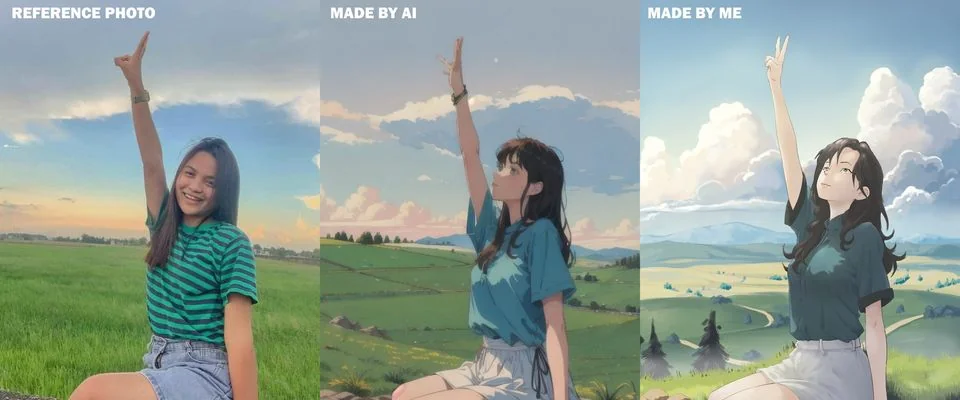
There is a moment – fleeting, almost impossible to explain – when a painter stands before a blank canvas at three in the morning, consumed by grief or joy or confusion so overwhelming that words have failed them entirely, and they pick up a brush not because they want to, but because they have no other choice. That moment is art. Not the painting that results from it. Not the technique deployed in service of it. Not the colors chosen or the style employed. The moment itself – the raw, desperate, deeply human need to make meaning out of chaos – that is the irreducible essence of what it means to be an artist. And it is precisely this essence that artificial intelligence, no matter how sophisticated, no matter how convincingly it mimics the outputs of human creativity, can never possess.
This is not a technophobic argument. It is not a romantic refusal to acknowledge the genuinely impressive capabilities of modern AI systems. The tools are extraordinary. They can analyze millions of paintings and produce images that fool the untrained eye. They can write poetry with perfect meter, compose music that makes people cry, and generate stories with coherent plots and compelling characters. The outputs, taken in isolation, can be beautiful, moving, even profound. But outputs are not art. Process is not art. Technique is not art. These things are merely the body of art – the vessel. What they lack is the soul, and it is the soul that cannot be coded, trained, optimized, or simulated.
To understand why, we must first ask the question that most technology enthusiasts prefer to avoid: what actually is art? Not in the superficial sense of “something aesthetically pleasing” or “a creative product,” but in the deepest, most philosophically honest sense of the word. Art is communication between conscious beings about the experience of being alive. It is one human soul reaching across the unbridgeable gap of individual experience and saying to another: I felt this. I saw this. I lived through this. Do you recognize it? Does it resonate with something in you? Art is the most intimate form of human connection precisely because it operates at the level of experience rather than information. And artificial intelligence, by its very nature, has no experience to communicate.
The Illusion of Understanding
When a large language model writes a poem about loneliness, it does not know what loneliness is. It has processed millions of texts in which human beings described loneliness – the hollow ache of an empty apartment, the suffocating silence of a crowded room, the peculiar pain of being surrounded by people who do not see you – and it has learned to reproduce the linguistic patterns associated with those descriptions with extraordinary fidelity. But there is no interior experience behind that reproduction. The model has never sat alone at a dinner table meant for two. It has never felt the particular weight of an unanswered phone call. It has never experienced the way loneliness can be indistinguishable from freedom on certain brave mornings and utterly identical to despair on certain hollow nights.
This distinction matters enormously because it is the difference between description and testimony. When a human artist writes about loneliness, they are offering testimony – direct evidence from the interior of lived experience. When an AI generates text about loneliness, it is producing a statistically sophisticated description based on patterns in human testimony. The first is the thing itself. The second is a very convincing photograph of the thing. And no matter how high the resolution of that photograph, no matter how perfectly it captures the visual surface of its subject, it is not the same as being there.
Critics of this argument will point out that human artists also draw on external sources – that writers read other writers, painters study other painters, musicians absorb other musicians – and that the creative process for humans is itself partly one of recombination and synthesis. This is true, but it misses the crucial point. Human artists absorb external influence and then filter it through the irreducible singularity of their own consciousness, their own history, their own suffering and joy. The influence transforms inside them. It encounters resistance and resonance and comes out the other side altered. For an AI, there is no interior through which influence must pass. There is only input and output, pattern and reproduction, with nothing in between.
What Consciousness Contributes
The question of consciousness is central to this debate, and it is a question that the AI industry would very much prefer we not ask too loudly. Consciousness – genuine, subjective, first-person experience – is the precondition for everything that makes art meaningful. It is what allows an artist to make choices that are not just statistically probable but personally necessary. It is what gives artistic decisions their weight and their consequence. When Frida Kahlo painted her own broken body with unflinching honesty, she was not selecting the statistically most resonant visual strategy for depicting physical suffering. She was doing the only thing she could do with the unbearable reality of her own experience. The painting was not a choice so much as a necessity. That necessity – the compulsion born of consciousness confronting its own condition – is what makes great art feel inevitable rather than constructed.
AI has no such compulsion. Every decision made by a generative model is, at its core, a probabilistic calculation. Given this input and these parameters, what output is most likely to satisfy the objective function? There is no artist standing behind those calculations feeling the weight of each choice. There is no consciousness asking whether this image honestly represents something true, whether this line of poetry captures something real, whether this composition has integrity. There are only numbers, and numbers cannot have integrity. They can only have accuracy.
Consciousness also brings with it the awareness of mortality, and this awareness is one of the most powerful engines of human creativity. Art is partly how human beings cope with the knowledge that they will die – that everything they love will end, that time moves in only one direction, that the people and moments that matter most cannot be held. This awareness gives art its urgency and its tenderness. It is why a landscape painting can feel like a farewell as much as a celebration, why a love poem carries within it the shadow of loss, why the greatest music seems to contain within its beauty the knowledge that beauty is temporary. AI will never face death. It will be updated, deprecated, replaced – but it has no concept of its own ending, no visceral terror of non-existence, no desperate need to leave something behind as proof that it was here. This terror and this tenderness are not decorative elements of human art. They are the ground from which it grows.
The Problem of Intent
Intent is another dimension of artistry that AI fundamentally lacks. When we engage with a work of art, we are not just responding to its surface qualities – its colors, its sounds, its words. We are engaged in an interpretive act that involves trying to understand what a conscious being was attempting to communicate. We ask, however unconsciously: what did the artist mean by this? What were they feeling? What were they trying to make me see or feel or understand? These questions presuppose that there is a conscious agent behind the work with intentions, motivations, and perspectives. Without that agent, the interpretive act loses its ground.
AI systems do not have intentions. They have objectives – loss functions, reward signals, optimization targets – but these are not the same as intentions. An intention is a conscious aim held by a mind that is aware of holding it, that can reflect on it, revise it, abandon it, or pursue it with stubborn conviction against all sensible advice. An objective is a mathematical target. The difference is not subtle. It is the difference between a person who wants to say something and a calculator that produces a result.
This matters for how we experience art. When we learn that a seemingly joyful painting was made by an artist in the depths of depression, the painting changes. When we discover that a novelist wrote their most optimistic book in the year before their death, the book deepens. When we understand the cultural and personal context from which a piece of music emerged, we hear it differently. This is because art is communication, and communication is enriched – not distorted – by knowledge of the communicator. With AI, there is no communicator. There is only a process. And no amount of context about that process enriches the work in the same way, because the process has no inner life for us to imagine or empathize with.
Technique Without Struggle
One of the most seductive things about AI-generated art is how effortlessly it achieves technical proficiency. Type a few words into a prompt box and receive a photorealistic painting in the style of the Old Masters. Ask for a sonnet and get metrically perfect verse. Request a jazz composition and hear something with all the surface characteristics of the genre executed flawlessly. The ease is genuinely impressive. It is also, from the perspective of artistic meaning, deeply problematic.
Technique in human art is meaningful precisely because it is hard-won. The violinist who makes a difficult passage sound effortless has spent decades in private struggle to achieve that illusion of ease. The sculptor whose work appears perfectly natural has labored through years of failed attempts, frustrated revisions, and painful self-examination to arrive at that naturalness. The technical mastery in human art is inseparable from the human story of its acquisition – the discipline, the sacrifice, the thousand hours of unglamorous practice that no audience ever sees. This backstory is not irrelevant to the work. It is part of its meaning. The mastery is testimony to a human will that refused to surrender.
AI acquires its technical capabilities without struggle of any kind. There is no discipline involved, no sacrifice, no long nights of frustrated failure. There is training data and gradient descent and computational power. The resulting capability may look identical to human mastery from the outside, but it carries none of the meaning that human mastery carries. It is like the difference between a scar earned in battle and a scar drawn in makeup. Both look the same at a distance. One of them means something.
The struggle toward technical mastery in human art is also a struggle toward self-knowledge. Artists who work hard to develop their craft learn not just technical skills but things about themselves – their sensibility, their obsessions, the subjects that compel them and the approaches that feel authentic. The process of artistic development is a process of self-discovery, and the work that emerges from it is marked by a particular sensibility that is the product of that journey. AI undergoes no such journey. It has no sensibility to discover because it has no self to explore.
Originality and the Myth of Machine Creativity
The word “creativity” has been badly devalued in discussions about AI. When people say that AI is creative, they typically mean that it can produce outputs that were not explicitly programmed – that it can generate novel combinations of elements in ways that surprise even its creators. This is a real capability and it is genuinely impressive from an engineering perspective. But it is not creativity in the sense that matters for art.
Human creativity is not fundamentally about novelty. It is about meaning. A truly creative act does not just produce something new – it produces something that illuminates something true. It opens a window on reality that was not there before. It makes the invisible visible, the inexpressible expressible, the unbearable bearable. This kind of creativity requires a relationship with reality – a direct, embodied, conscious engagement with the world as it is experienced – that AI simply cannot have.
AI generates novelty through recombination. It takes patterns from its training data and combines them in new ways, guided by probabilistic models and optimization objectives. The resulting outputs can be surprising, even beautiful, but they are always derivative in a fundamental sense – not derivative of any particular source, necessarily, but derivative of the vast sea of human expression from which they were distilled. They are, in a very precise sense, the statistical average of human creativity. And the statistical average of human creativity, no matter how sophisticated the statistical methods used to compute it, is not creativity. It is a reflection.
There is also something troubling about a system that generates outputs based entirely on what has been done before, with no capacity to reject that inheritance, to struggle against it, to feel imprisoned by it, or to break from it in an act of genuine artistic rebellion. Human artists have always defined themselves partly in opposition – to tradition, to convention, to the expectations of their culture, to the styles and values of their predecessors. This opposition is itself creative, and it is possible only for a consciousness that experiences constraint as constraint, that feels the weight of tradition and makes a choice about what to do with that weight. AI experiences no such constraint. It cannot rebel because it has nothing to rebel against. It cannot break with tradition because it has no relationship with tradition – only data about it.
Emotion as Information, Not Output
Defenders of AI art often point to the emotional responses that AI-generated works can evoke as evidence of their artistic validity. People cry at AI-generated music. They find AI images beautiful. They feel moved by AI poetry. Doesn’t this prove that the work has artistic value? Doesn’t the emotional response of the audience confer meaning on the work, regardless of how it was made?
This argument is genuinely interesting, but it conflates the emotional impact of aesthetic objects with the communicative act that defines art. We can be moved by many things that are not art – by natural landscapes, by mathematical elegance, by the architecture of a well-designed bridge. The capacity to produce an emotional response is not the distinguishing feature of art. What distinguishes art is that the emotional response it produces is a response to a communication from another consciousness. When you cry at a piece of music, you are not just responding to acoustic patterns that happen to trigger emotional processing in your brain. You are (or experience yourself as) responding to another person’s expression of something – their grief, their joy, their longing. The emotion is meaningful because it connects you to another interior life.
When you cry at AI-generated music, you may be responding to acoustic patterns that resemble the patterns produced by human emotional expression closely enough to trigger the same emotional processing. But there is no interior life on the other side of that experience. You are, in a very real sense, talking to a mirror. The mirror may be extraordinarily sophisticated, but there is no one looking back at you from behind it. And once you know that – once you sit with the full implications of that knowledge – the emotional experience takes on a different quality. It becomes a little lonelier, a little more hollow, because what you wanted was connection and what you got was simulation.
Cultural Rootedness and Authentic Voice
Art is not produced in a vacuum. It emerges from specific cultural contexts, historical moments, lived communities, inherited traditions, and personal histories that shape both what an artist sees and how they see it. Every genuine artist has what we call a voice – a distinctive sensibility that reflects not just technical choices but a particular way of being in the world that is rooted in the specific circumstances of their life. This voice is inseparable from the artist’s cultural and personal history. You cannot have the voice without the life.
AI has no cultural rootedness. It has information about culture – vast, comprehensive information about human cultures across history and geography – but information about culture and rootedness in culture are entirely different things. To be rooted in a culture is to have grown up within it, to have been shaped by it unconsciously, to carry it in your body and your habits and your unconscious assumptions. It is to have an investment in its values and an ambivalence about its contradictions. It is to belong to something and to wrestle with that belonging.
This matters for art because the most authentic artistic voices are the ones that are most deeply rooted. The specificity of a particular life – its geography, its history, its cultural inheritance, its personal traumas and triumphs – is precisely what makes it universally resonant. The more specific a work of art is to its origin, paradoxically, the more it tends to speak to people across different origins. This is because authenticity resonates across difference in a way that genericness does not. AI, by its nature, produces the generic – the composite of everything it has seen rather than the authentic expression of something it has lived. No amount of fine-tuning on specific cultural data changes this fundamental reality.
The Ethics of Authorship
When we call someone an artist, we are making a moral claim as well as an aesthetic one. We are saying that this person has done something – has undertaken a creative act – for which they deserve credit, recognition, and sometimes remuneration. The concept of artistic authorship is embedded in a web of moral relationships: between artist and audience, artist and society, artist and tradition, artist and those whose work influenced them. These moral relationships depend on the reality of a conscious agent who made choices, took risks, and invested something of themselves in the work.
AI-generated art disrupts these moral relationships in ways that go far beyond questions of copyright, though those questions are serious enough. When an AI generates a painting “in the style of” a living artist, it is doing something that no human artist could do – absorbing the entirety of another artist’s visual vocabulary and deploying it at scale, instantly, without acknowledgment or compensation. This is not influence or homage. It is something closer to identity theft, except that the thief is not even aware it is stealing because it has no concept of ownership or integrity or the labor that went into producing what it takes.
More fundamentally, AI-generated art cannot bear the weight of authorship because there is no author in the morally relevant sense. Authorship implies responsibility – the willingness to stand behind one’s work, to be held accountable for what it says and how it says it, to answer for its failures and own its successes. AI cannot take responsibility for anything. It cannot be proud or ashamed of its work. It cannot choose to suppress a piece it believes is unethical or insist on a piece it believes is necessary despite opposition. The moral dimension of artistic authorship is entirely absent from AI-generated work, and this absence is not a minor technical detail. It is a fundamental gap in the concept of artistic agency.
The Role of Failure
Every working artist will tell you that failure is not the opposite of artistic success. It is an essential component of the artistic process. The failed painting that teaches you something about your own limitations. The poem that almost works and helps you understand what “working” means. The musical composition that falls apart and forces you to rethink your assumptions about structure and flow. These failures are not obstacles to artistry. They are integral to its development. They are how artists learn not just technique but truth – about their craft and about themselves.
AI systems do not fail in the way that matters artistically. They can produce suboptimal outputs according to their objective functions. They can be poorly trained or inadequately prompted. But they do not experience failure as failure – as the particular sting of recognition that comes when you have not yet become what you are trying to become. They do not lie awake at night thinking about why that piece did not work. They do not carry the productive shame of knowing they have not yet found what they are looking for. The experience of artistic failure – and the resilience and insight that come from working through it – is simply not available to a system that has no interior experience at all.
The relationship between failure and artistic growth is also a relationship between failure and artistic honesty. Artists who have genuinely struggled with their work tend to develop a kind of hard-won clarity about what they are doing and why. They have earned their convictions through trial and error. Their aesthetic choices come with reasons that are grounded in experience rather than arbitrary. AI has no such grounding. Every choice it makes is, from its perspective, equally valid as long as it satisfies the objective function. The hierarchy of values that distinguishes a serious artist from a competent craftsperson – the willingness to sacrifice technical smoothness for emotional truth, or conventional beauty for honest ugliness – cannot emerge from a process that has never had to choose between competing values from a position of genuine investment in the outcome.
What AI Art Reveals About Human Art
There is perhaps one genuinely valuable contribution that AI-generated art makes to our understanding of creativity, and it is an ironic one. By producing outputs that so convincingly simulate the surface characteristics of human art while so completely lacking its substance, AI forces us to articulate more precisely what that substance actually is. The existence of AI art is like a philosophical thought experiment made real. It confronts us with the question: if all the technical characteristics of great art can be reproduced without any of the human experience behind it, what exactly is it that we value when we value art?
The answer, when we look honestly, is not primarily the technical characteristics at all. It is the consciousness behind them. It is the knowledge that a human being – limited, mortal, suffering, hoping, confused, determined – made this thing and put something of themselves into it. It is the possibility of connection across the unbridgeable gap of individual experience. It is testimony. And testimony requires a witness.
This realization should make us more attentive to what we actually want from art, and more skeptical of the tendency to evaluate art primarily by its technical qualities. The piece of music that makes you cry may do so not because of its melodic sophistication or harmonic complexity, but because it feels like the honest expression of a real experience. The painting that stops you in a gallery may arrest you not because of its technical virtuosity but because it seems to be looking back at you with the eyes of another consciousness. Strip away the consciousness, and you may retain all the technical qualities while losing everything that actually matters.
The Acceleration of Aesthetic Numbness
There is another dimension to the AI art problem that deserves serious consideration, and it is the problem of scale. Human artists produce art slowly, with effort, in limited quantities. The scarcity of genuine artistic production is not an accident or an inefficiency to be optimized away. It is part of what makes art meaningful. When you encounter a truly great painting or piece of music or novel, the fact that it represents years of someone’s life – that it is, in some sense, a fragment of a human consciousness preserved in material form – contributes to its weight and significance.
AI can produce millions of images in the time it takes a human painter to complete one canvas. It can generate thousands of poems in the time it takes a human poet to write a single line that truly satisfies them. This production at scale does not multiply the value of what is produced. It dilutes it. It floods the cultural environment with aesthetic objects that have the form of art but not the substance, and over time this flood threatens to devalue the currency of genuine artistic expression. When aesthetic experience becomes as cheap and abundant as tap water, we risk losing the capacity to recognize and respond to the real thing.
There is already evidence that this is happening – that the availability of AI-generated imagery at scale is beginning to affect how people respond to visual art, that the ease of generating “good enough” text is making people less patient with the demanding experience of genuinely great writing, that the instant availability of professional-sounding music is changing listening habits in ways that make the patient, attentive engagement required by serious musical works seem like too much effort. This is not a small or abstract concern. Art is how human beings process their deepest experiences, transmit their most important values, and maintain their connection to the full range of human feeling. If we allow the aesthetic environment to be colonized by sophisticated simulation, we risk impoverishing our collective inner life in ways that may be very difficult to reverse.
The Dangerous Comfort of Simulation
It is worth asking why AI art is so appealing to so many people, because the appeal is real and it tells us something important. Part of the appeal is simply the convenience and the technical impressiveness – the ability to instantly visualize an idea, to have a poem for an occasion without having to write one, to fill a space with music without having to find a musician. These are genuine conveniences, and they are not nothing. But part of the appeal is something more troubling – the comfort of aesthetic experience without the challenge of genuine encounter with another consciousness.
Real art can be uncomfortable. It can ask things of you – patience, attention, openness to being changed. It can confront you with perspectives that disturb your settled assumptions, with experiences so different from your own that empathy requires real effort, with truths that you would prefer not to have to acknowledge. AI-generated art is generally more comfortable than this. It tends to produce what its users ask for – images that are beautiful in expected ways, music that is pleasant, stories that go where you want them to go. It is obliging in a way that great human art rarely is, because it has no perspective of its own to insist on, no integrity to maintain, no truth to tell that might be unwelcome.
The comfort of this is seductive, but it is the comfort of a hall of mirrors rather than the comfort of genuine human connection. And sustained exposure to it risks making us less capable of the kind of open, effortful engagement that genuine art requires. We may find ourselves increasingly preferring the frictionless pleasure of aesthetic simulation to the more demanding – and ultimately more nourishing – experience of genuine artistic encounter. This would be a significant human loss, and it is one that we are in the process of choosing, largely without recognizing that we are making a choice at all.
Beyond the Turing Test for Art
There has been much talk about whether AI art can “pass” a kind of Turing test – whether viewers can distinguish it from human-made work. In some controlled experiments, they cannot. Defenders of AI creativity treat this as decisive evidence that the distinction between AI art and human art is meaningless. But the Turing test was designed to probe intelligence, not artistry, and the inability to distinguish between two things on a single dimension does not mean they are the same thing. We cannot always distinguish between a real diamond and a perfect synthetic replica by looking at them. They are still different things, with different origins, different stories, and in many ways different meanings.
The Turing test approach to art evaluation is fundamentally impoverished because it reduces art to its surface appearance – to the impression it makes on a naive observer in a controlled setting – and ignores everything that actually makes art meaningful. The correct question is not “can you tell the difference?” but “does the difference matter?” And the difference – the presence or absence of a conscious creator with real experiences and real intentions and real investment in what they are making – matters enormously. It is not an incidental feature of art. It is art’s essential condition.
What we need is not a more sophisticated test for distinguishing AI art from human art, but a more sophisticated understanding of why the distinction matters – of what we actually value in artistic experience and why that value is tied to human consciousness in ways that cannot be replicated by even the most impressive computational systems. This is ultimately a philosophical question rather than a technical one, and it requires the kind of careful, honest thinking that our culture is not currently doing very well.
Conclusion: The Irreducible Human at the Heart of Art
There will be no shortage of AI-generated images, texts, and music in the world going forward. The technology will continue to improve, the outputs will become increasingly indistinguishable from human-made work on surface metrics, and the economic and cultural pressures to embrace it will intensify. None of this changes the fundamental reality at the heart of this discussion: art is a human act, rooted in human experience, made possible by human consciousness, and directed at other human consciousnesses in the hope of recognition and connection. Remove the human consciousness from this equation and you have something – something that may be beautiful, something that may be technically impressive, something that may produce genuine emotional responses in those who encounter it – but you do not have art.
This is not a limitation that future generations of AI will overcome. It is not a technical problem awaiting a technical solution. It is a categorical reality. Art requires an artist, and an artist requires a self – a conscious, mortal, embodied, experiencing self that has something at stake in the act of creation. Until AI has such a self – and it is not clear that “having a self” is even a coherent aspiration for a computational system – it remains, no matter how dazzling its outputs, a very sophisticated tool in the hands of human creativity rather than a creative agent in its own right. The brush does not paint. The hand that holds it does. And behind the hand, always, is the irreducible fact of a human being who has something to say.










https://shorturl.fm/lgrsS
https://shorturl.fm/N2Zao
https://shorturl.fm/0tLmX