
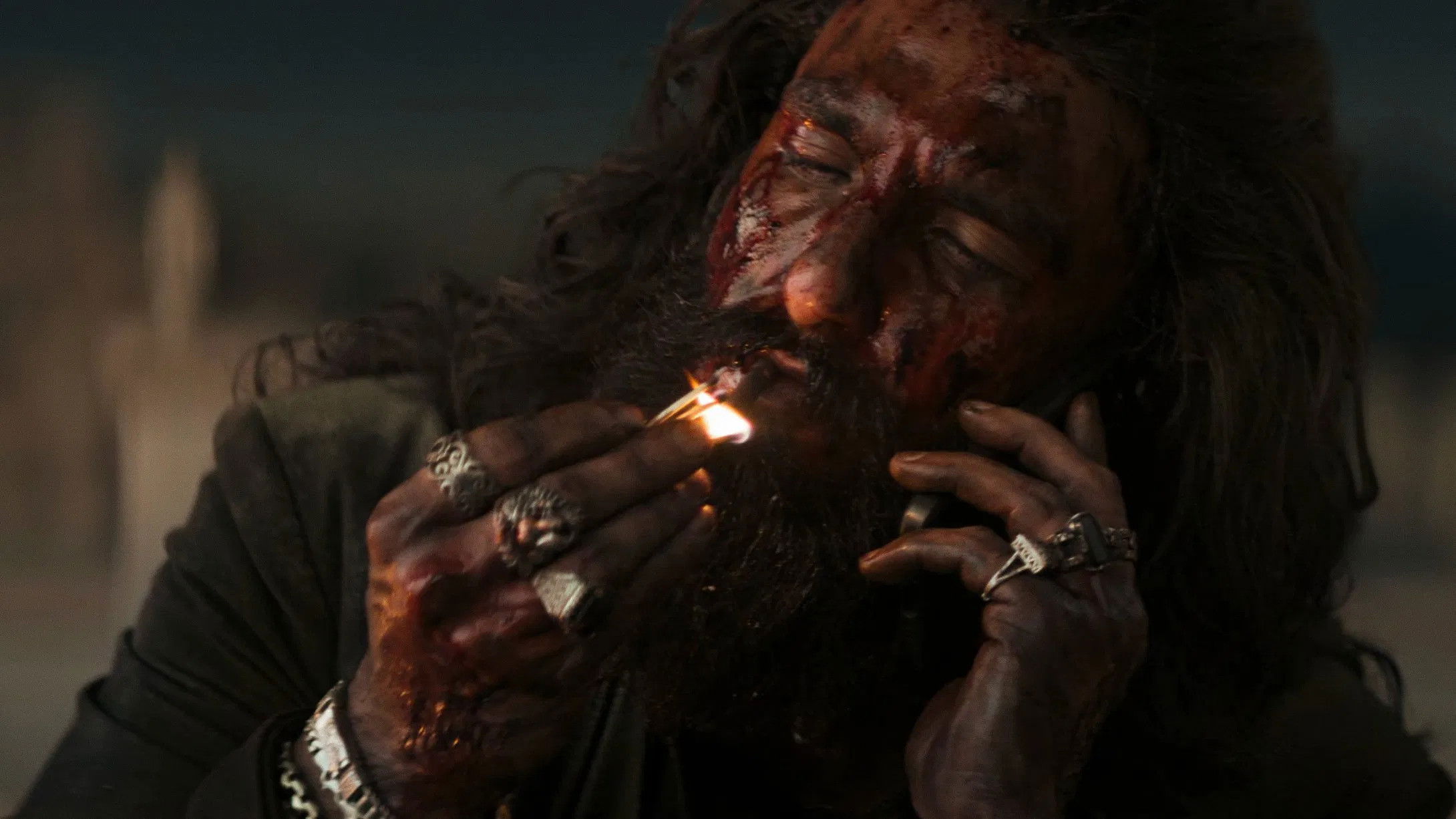
The Illusion of Truth
There is a particular kind of propaganda that is far more insidious than the crude, banner-waving kind. It does not arrive with cartoonish villains or embarrassingly clunky dialogue. It does not announce itself. It comes dressed in slick cinematography, powered by a Rs. 300-crore budget, carried on the capable shoulders of one of India’s most charismatic actors, and packaged with the kind of textured, almost literary storytelling that disarms the critical mind. It comes, in short, looking exactly like Dhurandhar.
Aditya Dhar’s 2025 blockbuster spy thriller is, by any technical measure, an impressive piece of filmmaking. Its three-and-a-half-hour runtime does not feel gratuitously long. Its performances, particularly Ranveer Singh’s coiled, unpredictable energy as the undercover operative Hamza Ali Mazari, and Akshaye Khanna’s magnetic, almost Shakespearean turn as Rehman Dakait, are genuinely extraordinary. The background score thrums with tension. The chapter-based narrative structure creates a mounting sense of dread. Even its detractors admit it is well-made.
And that, as commentator Dhruv Rathee pointed out in a widely-viewed video, is precisely what makes it so dangerous.
Because propaganda that is badly made gets dismissed. It gets mocked, debunked, and forgotten. But propaganda that is superbly crafted — propaganda that feels real, that uses actual audio recordings, that splices in genuine archival footage of the 26/11 Mumbai attacks, that names its characters after real people and places its story in a real neighborhood — that kind of propaganda burrows into the subconscious. It shapes perceptions that audiences do not even realize are being shaped. It builds emotional architecture around political conclusions. And when the credits roll, the viewer does not feel like they have been told what to think. They feel like they have discovered the truth.
That is the genius and the menace of Dhurandhar.
Setting the Stage: What the Film Claims to Be
Dhurandhar presents itself as a sprawling espionage thriller loosely inspired by real events. It follows a young Indian intelligence operative sent undercover into Lyari, Karachi’s labyrinthine, gang-controlled neighborhood, as part of a secret mission called “Operation Dhurandhar.” His task: to infiltrate the network of Rehman Dakait, a powerful Karachi gangster, expose links between his criminal operation and Pakistan’s Inter-Services Intelligence (ISI), and ultimately dismantle a terror infrastructure that the film connects directly to the 2008 Mumbai attacks.
The film carefully positions itself as being “inspired by true events.” It uses real audio recordings from the 26/11 attacks — the chilling conversations between the terrorists and their handlers. It deploys real footage of the carnage. It names its primary antagonist after a real person: Rehman Dakait was an actual Lyari gangster. Police officer Chaudhry Aslam is a real person. The Khanani brothers, whose currency-smuggling empire features in the narrative, are based on real figures. The intelligence chief Ajay Sanyal, played with calm, hawkish authority by R. Madhavan, is visually and behaviorally modeled on current National Security Advisor Ajit Doval — same mannerisms, same attire, same steel-eyed pragmatism.
The film’s marketing doubled down on this claim of authenticity. The trailer opened with real footage. Director Aditya Dhar spoke in interviews about his extensive research. The implicit promise made to the audience was: This is not fiction. This happened.
But here is where the great deception begins. Because underneath this veneer of documentary authenticity lies a web of fabrications so wholesale, so structurally embedded in the narrative, that they cannot be attributed to artistic license. They can only be understood as deliberate ideological construction.
The Lyari Lie: Manufacturing a Geopolitical Enemy
At the heart of Dhurandhar’s propaganda architecture is its representation of Lyari. This is the film’s foundational distortion — and it is a whopper.
In the film, Lyari is presented as a Pakistan-India geopolitical battleground, a zone where the ISI cultivates gangsters as instruments of state-sponsored terrorism against India, where Rehman Dakait’s criminal empire is directly tied to plotting major attacks on Indian soil, and where India’s intelligence operatives must conduct shadow warfare to protect their country.
The real Lyari tells an entirely different story.
Lyari is a historic, densely populated neighborhood in Karachi, home primarily to Baloch migrants who came to the city generations ago. It is renowned for its boxing clubs, its football culture, its music traditions, and its fierce political loyalty to the Pakistan Peoples Party. The “Lyari gang war” that the film implicitly references was a brutal but hyper-local conflict — a turf battle between rival criminal groups aligned with different political factions, primarily the PPP and the MQM (Muttahida Qaumi Movement), fought out on the neighborhood’s cramped streets with automatic weapons and grenades.
India did not feature in this story. Not even tangentially. The Lyari gang war was a Pakistani political conflict, driven by Pakistani political dynamics, fought by Pakistani people over Pakistani resources and Pakistani influence. To take that conflict — which destroyed real lives, traumatized real families, and left real communities in ruins — and retrofit it into an anti-India terror narrative is not “artistic license.” It is a fundamental rewriting of someone else’s history for someone else’s political purposes.
Journalists and academics who know Lyari, many of them from Karachi itself, were quick to catalogue the film’s specific inaccuracies. Rehman Dakait, the film’s central villain, died in 2009. The 26/11 Mumbai attacks happened in November 2008. The film links him to those attacks — a temporal impossibility even within its own fuzzy timeline. The film shows a marine training facility near Shah Latif Town, on Karachi’s coastal belt, where Mumbai attack operatives supposedly trained before departing by ship. This detail has no basis in the established record of how the attacks were planned and executed. These are not nitpicks. These are central plot points built on fabricated foundations.
Even the physical geography is wrong. Lyari residents and former inhabitants who watched the film noted that locations, architectural details, and neighborhood dynamics were consistently misrepresented. The film’s Lyari is a cinematic construction, a Pakistan designed to confirm a particular worldview, not a real place where real people live.
The Propaganda Playbook: How Dhurandhar Does It
What separates Dhurandhar from mere nationalism-adjacent entertainment is the sophistication with which it deploys propaganda techniques. It does not simply wave a flag and ask you to cheer. It employs a series of well-established methods to build an ideological framework inside an entertainment experience.
The Authenticity Anchor
The most powerful technique in the film’s toolkit is its use of real archival material. By opening with genuine 26/11 audio, the film locks the audience into a state of emotional reality. The horror of those recordings — the detached, businesslike voices directing murder — is viscerally real. It happened. It killed people. And by splicing this real horror into its fictional narrative, Dhurandhar borrows that reality for everything else it shows. The audience’s brain cannot cleanly separate “this really happened” from “this is a dramatization.” The emotional register of documentary footage bleeds into the fictional scenes that follow. This is not an accident of filmmaking. It is a calculated choice to weaponize historical tragedy as emotional validation for a constructed narrative.
The Good Indian / Bad Pakistani Binary
Every character choice in Dhurandhar reinforces a simple moral binary. Indian characters — even when they are morally complex, strategically ruthless, or personally flawed — are ultimately driven by patriotism, competence, and a genuine desire to protect their country. Pakistani characters fall into one of two categories: either they are actively villainous (ISI agents, terrorist facilitators, corrupt politicians) or they are tragic victims of their own system, useful to India but ultimately doomed.
There is no Pakistani character in the film who represents the complexity of ordinary Pakistani life: the journalist, the schoolteacher, the cricket fan, the activist. The film’s Pakistan is a country without civilians — a landscape of operatives, gangsters, and agents, all somehow pointing toward India’s destruction.
This dehumanization is not incidental. It serves a political purpose. When a population is shown a neighboring country in which every character is either a villain or a pawn, it becomes easier to support aggressive policies toward that country. It becomes harder to oppose military escalation, harder to advocate for dialogue, harder to see the people on the other side as people at all.
The Pre-Modi vs. Post-Modi Framing
Perhaps the most naked piece of BJP-friendly propaganda in the film is its explicit historical framing of Indian political leadership. At multiple points, Indian officials in the pre-2014 era are shown as spineless, compromised, and counterproductively obedient to foreign pressure. They wring their hands. They are blocked by corrupt ministers — including one who, along with his son, is shown to have sold Indian currency printing plates to Pakistani agents. They are implicitly depicted as the reason India has been unable to act decisively against Pakistan for decades.
Then comes the suggestion of the “future government” — a new administration that will cut through this institutional cowardice and let India’s intelligence agencies do what needs to be done. The film does not name Modi. It does not need to. The coding is unmistakable to every Indian viewer who has lived through a decade of BJP political communication. The subtext is explicit enough to be text: India was weak before 2014, and strength arrived with a particular leader and a particular political party.
This is pro-BJP propaganda so obvious that even some Indian critics who broadly support the film’s nationalist orientation were forced to acknowledge it. One review in a prominent Indian publication noted directly that the film has “more than a tinge of pro-BJP propaganda.”
The Ajit Doval Apotheosis
The character of Ajay Sanyal deserves particular attention. R. Madhavan plays him as nothing less than a secular saint of Indian statecraft: brilliant, incorruptible, fearless, and always right. His visual coding — the polo necks, the rimless glasses, the contained authority — is a direct reference to the real-life National Security Advisor, a figure who has been at the center of India’s most aggressive security operations under the current government.
By creating a fictional doppelgänger of Doval and placing him at the center of a triumphant intelligence narrative, the film essentially makes a hagiographic film about a sitting government official while maintaining plausible deniability. “It is a fictional character,” the filmmakers can say. But the audience knows. Everyone knows. And what they take away is a celebration of the actual man who currently sits in the actual office, making actual decisions about India’s actual security policy.
This is how state-adjacent propaganda works in the age of plausible deniability. You do not need official government financing. You do not need a ministry of information. You just need a filmmaker aligned with a political worldview, access to large capital, and the strategic use of just enough fictional distance to deflect the propaganda charge while the message lands intact.
The Islamophobia Architecture
Dhurandhar does not attack Islam explicitly. It is too sophisticated for that. But the film constructs what critics and scholars have called an Islamophobia architecture — a structural arrangement of characters, settings, and narrative choices that consistently maps villainy, terrorism, and corruption onto Muslim identity and Muslim-majority spaces.
Every terror plotter in the film is Muslim. Every ISI operative is Muslim. Every gangster cultivated by the Pakistani state as a weapon against India is Muslim. The film is set entirely within a Muslim-majority country and within Muslim-majority communities in Pakistan. India’s enemies — to the extent they are defined ethnically and religiously rather than merely nationally — are overwhelmingly, almost exclusively, Muslim.
Now, one might argue: this is a film about Pakistan, which is a Muslim-majority country, and about the ISI, which is a Pakistani institution. Some degree of Muslim representation among antagonists is simply a function of setting and subject matter. That is a fair point. But the argument falls apart when you consider what the film entirely omits.
There are no Indian Muslims in the film who serve as heroes or protagonists. There is no acknowledgment that India’s Muslim population, more than 200 million people, might have a complex relationship with both countries. There is no Pakistani civilian Muslim shown as simply human — caught between a state they did not choose and a conflict they did not start. The Muslim in Dhurandhar is either a tool of Pakistani statecraft, a criminal enterprise, or a romantic prop. The Muslim community is present only as a backdrop against which India’s (implicitly Hindu) intelligence apparatus performs its heroism.
When placed alongside the other recent productions from the Bollywood nationalist ecosystem — The Kashmir Files, The Kerala Story, and Uri — a pattern emerges. In each film, Muslim characters are consistently coded as threats, dupes, or at best tragic victims of their own religious and cultural environment. The accumulated effect of this pattern, viewed by hundreds of millions of Indian viewers, is not neutral. It shapes perceptions. It reinforces fears. And it does so under the protective mantle of entertainment.
The Bollywood Nationalist Ecosystem
To understand Dhurandhar fully, you have to understand the ecosystem in which it was made. This is not a film that emerged in isolation. It is the latest — and so far most technically accomplished — entry in an evolving genre that began gaining serious momentum around 2016.
Uri: The Surgical Strike (2019), also directed by Aditya Dhar, set the template. It was a slickly-made, emotionally manipulative retelling of India’s military response to the Uri attack, climaxing with a line that became a national slogan and a BJP campaign refrain: “How’s the josh?” The film was embraced by the BJP establishment, screened for government officials, and cited by political leaders as an example of Indian pride in action. It grossed enormous amounts at the box office and demonstrated that hyper-nationalist cinema was a commercially viable product.
The Kashmir Files (2022) took the template further, making a film about the Kashmiri Pandit exodus that was explicit in its political messaging to the point of being cited in political speeches. Prime Minister Modi himself encouraged people to watch it. Several BJP-ruled state governments gave it tax exemptions. Critics noted its selective and distorted presentation of history, but its commercial success made such criticism irrelevant in the marketplace.
The Kerala Story (2023) purported to show a “true story” of Hindu and Christian women being converted and recruited by ISIS — a narrative so factually dubious that its makers were forced to walk back their initial claim that it was based on documented cases.
Dhurandhar is the apex of this trajectory. It is the most expensive, the most technically sophisticated, the most globally polished entry in the genre. And its ideological commitments are correspondingly the most embedded and the hardest to extract from the entertainment scaffolding that surrounds them.
Aditya Dhar is not merely a filmmaker with nationalist sympathies who happens to make films. He has, across two films and now a franchise, built a coherent cinematic universe in which India’s intelligence apparatus is heroic, Pakistan is an existential threat, the pre-Modi era was an era of weakness, and muscular nationalism is the only rational response to geopolitical reality. That is a political project. Calling it entertainment does not make it not a political project.
The “It’s Just a Film” Defense — And Why It Fails
The most common defense of Dhurandhar against charges of propaganda is the shrug: “It’s just a film. Don’t overthink it.” This defense is popular, rhetorically convenient, and completely bankrupt.
Its bankruptcy begins with the film’s own marketing. The film does not present itself as “just a film.” It presents itself as a dramatization of real events, supported by real evidence, rooted in real history. You cannot simultaneously claim the credibility of documentary truth when recruiting audiences and then retreat into pure fiction when those claims are challenged.
Beyond the marketing, the defense fails because it grossly underestimates the power of narrative. Human beings are not rational calculators who cleanly separate fictional content from real-world belief formation. Decades of cognitive science and media studies research demonstrate that narrative entertainment is one of the most powerful vehicles for attitude formation precisely because it bypasses critical defenses. When you are watching a thriller, your analytical mind is not standing sentinel over your value formation. You are experiencing. You are feeling. And those feelings, attached to the stories you are told, become part of how you understand the world.
This is not unique to right-wing cinema. The argument applies equally to liberal filmmaking, to documentaries with agendas, to war films that romanticize violence on any side. Entertainment has always been political. The question is never whether a film has a political effect — they all do. The question is what political effect it has, and whether it is honest about having it.
Dhurandhar is not honest about having a political effect. It presents itself as a patriotic thriller in the spirit of entertainment while systematically building an ideological architecture that supports specific policy positions: aggressive intelligence operations against Pakistan, hostility toward Pakistani civilians as a class, admiration for the current Indian security establishment, and suspicion toward internal dissent.
When Dhruv Rathee, in his widely-circulated video analysis, argued that the film’s well-made quality made it more dangerous than a badly-made propaganda film, he was making exactly this point. The more believable the lie, the more damage it does.
International Reactions: From Pakistan to The Economist
The propaganda debate around Dhurandhar has not been confined to Indian commentators. Its international reception has been as politically charged as its content.
In Pakistan, the film was predictably controversial — but the nature of the Pakistani critique is worth examining carefully. Pakistani journalists, academics, and former Lyari residents did not simply wave the film away as anti-Pakistan sentiment. They engaged with it specifically, cataloguing precise factual inaccuracies, identifying the ways in which the real history of Lyari had been distorted, and making the case that the film’s distortions served a particular Indian political narrative.
These are not the complaints of a country that cannot bear to see itself portrayed negatively. These are the complaints of people whose actual history — their actual neighborhood, their actual political struggles, their actual community — has been appropriated and rewritten as an ideological prop for a foreign country’s internal political project.
The Pakistani newspaper Dawn published editorials criticizing the film not merely for its unfavorable portrayal of Pakistan but for the specific historical distortions involved. The Sindh government, in a remarkable response, announced plans for a counter-film called “Mera Lyari” — a project intended to show the real Lyari, with its football culture, its community life, its resilience and diversity.
Internationally, The Economist published a critical analysis of Dhurandhar, calling it propaganda and situating it within the broader context of India’s shifting political culture under Hindu nationalism. The piece prompted fierce pushback in India, with supporters of the film arguing that Western media was condescending toward Indian audiences and applying a double standard. But the substance of The Economist’s critique — that the film endorses an aggressive Hindutva worldview and presents Muslim-majority Pakistan as an existential enemy to be confronted by force — was not seriously contested, only resented.
The American publication Providence Magazine, which covers the intersection of religion, politics, and international affairs, published an analysis arguing that Dhurandhar provides a window into India’s self-perception as an emerging great power under Modi — a country that has shed its post-colonial deference and its apologetic secularism and is now asserting itself on the world stage by any means necessary. This is not entirely unfair to the film’s own ambitions. What the article also noted was that this self-perception, as reflected in the film, comes at the cost of depicting 200 million Indian Muslims and Pakistan’s 220 million people as existential threats.
India’s own publication Himal Southasian described Dhurandhar as “the culmination of a decades-long project to cast Hindu nationalism as the antidote to an unreliable, terrorist, and inherently evil Pakistan” and argued that it represented a crossing of a “proverbial Rubicon when it comes to cinematic propaganda in India.”
The Doval Parallel and What It Reveals
The most structurally revealing element of Dhurandhar’s propaganda function is what it tells us about the relationship between the Indian state and the Indian entertainment industry.
The film was not, to anyone’s knowledge, officially produced by the government. It was made by private production houses under Jio Studios. But Jio is part of the Reliance Industries conglomerate, whose owner Mukesh Ambani has extensive and well-documented ties to the current Indian political establishment. The film’s ideological alignment with the BJP government’s security worldview, its implicit celebration of the NSA as a hero, its framing of the pre-2014 era as one of weakness and the post-2014 era as one of strength — these do not require a formal government contract to explain. They can be understood as the natural output of a cultural ecosystem in which the most commercially powerful filmmakers share the political values of the governing party and are rewarded, materially and symbolically, for expressing those values on screen.
This is not unique to India. Hollywood has historically had close, sometimes formalized relationships with the US Department of Defense, which has provided military equipment, locations, and personnel to productions deemed to serve American strategic interests. The difference is one of degree and explicitness. What is notable about Dhurandhar is that the propaganda function is embedded not in military-equipment support but in narrative itself. The film does not merely use Indian Air Force jets as set dressing. It constructs a complete ideological worldview — one that serves the current government’s political interests — inside a story that is marketed as historical fact.
The Ajit Doval figure at the center of this worldview is no coincidence. Doval is, in the actual world, the architect of India’s muscular, covert-operations-heavy approach to Pakistan policy. He is the intellectual father of “offensive defense” as a strategic doctrine. Making him into a superheroic fictional character, placing that character at the center of a narrative in which his doctrine is shown to work perfectly, and releasing that film to a quarter-billion viewers is not a small thing. It is a cultural intervention in India’s foreign policy debate.
The Sequel Problem: Dhurandhar: The Revenge
If any doubt remained about the propagandistic nature of Dhurandhar, the sequel — Dhurandhar: The Revenge, released in 2026 — should dispel it.
Critics who reviewed the sequel noted that the political messaging of the first film, while embedded and sometimes subtle, became nakedly explicit in The Revenge. The Deccan Herald’s review described it as a “party agenda brazenly packaged as nationalism.” Variety, the international entertainment publication, wrote that the film exacerbates already intense patriotic sentiments in modern India, and that the Hindutva framework gives the Hindu majority a sense of impunity in targeting minorities. The sequel apparently adds Sikh separatist characters to the enemy roster, broadening its villain palette while intensifying its violence.
The Revenge’s existence confirms that Dhurandhar was not a one-time artistic experiment by a filmmaker grappling with complex geopolitical realities. It is a franchise. It is, in the language of the film industry, a cinematic universe — one explicitly built around a Hindutva security worldview, powered by the most commercially appealing production values Bollywood can muster, and designed to generate sequels, merchandise, cultural conversation, and political sentiment indefinitely.
The franchise model matters because it explains the long game of this kind of propaganda. A single film can be dismissed, debated, contextualized. A franchise becomes part of the culture. It becomes a reference point. Its characters become archetypes. Its narrative logic becomes background assumption. Over time, the Dhurandhar universe’s vision of Pakistan, of India’s Muslims, of the pre-Modi era, and of the legitimacy of aggressive intelligence operations becomes not a political position being argued but a factual backdrop being assumed.
What Good Cinema Could Have Done
It is worth pausing to note what Dhurandhar could have been. The raw material for a genuinely great film was present. The real history of Lyari is extraordinary: a community that produced champion boxers and passionate footballers, that was systematically exploited by Karachi’s political establishment, that was caught between criminal gangs and a state apparatus that was often indistinguishable from those gangs, that was ultimately devastated by a conflict it did not choose. A film genuinely rooted in that history would have been one of the great spy thrillers of contemporary world cinema.
Major Mohit Sharma, the real intelligence operative whose story loosely inspired elements of the narrative, lived a genuinely remarkable life. His actual mission, his actual courage, his actual sacrifice deserve cinematic commemoration. A film honestly built around his story — without the fabricated Pakistan-India geopolitical retrofitting, without the ISI-Lyari terror nexus that never existed, without the BJP political framing — could have honored him and told a gripping, important story at the same time.
The tragedy of Dhurandhar is not that it lacks talent or ambition. It is that its considerable talent and ambition have been placed entirely in service of an ideological project rather than artistic truth. Aditya Dhar is a gifted filmmaker. Ranveer Singh is a genuinely great actor. Akshaye Khanna’s performance as Rehman Dakait is one of the finest in recent Indian cinema — a layered, tragic, magnetic portrait of a man destroyed by the systems that created him. These gifts deserved better than to be harnessed to a political campaign.
But that, perhaps, is the most honest summary of what contemporary Bollywood nationalism represents: extraordinary talent deployed in service of extraordinarily narrow political ends. Cinema capable of expanding the human imagination instead choosing to contract it.
The Mirror and the Manufacture
There is a concept in media studies called the “mirror versus manufacture” debate: does cinema mirror existing social attitudes, or does it manufacture new ones? The answer, of course, is both. But the manufacturing function is what propaganda most aggressively exploits.
Dhurandhar did not arrive in a vacuum. It arrived in a country where anti-Pakistan sentiment was already high, where memories of the 26/11 attacks remain raw, where a decade of political communication from the BJP had primed audiences to see Pakistani state aggression as the defining security challenge facing India. In that context, the film is not introducing new ideas. It is amplifying, validating, and deepening existing ones — giving them the emotional texture and narrative coherence that transforms vague sentiment into settled worldview.
And it is doing so with tools that are almost uniquely persuasive. Not policy papers. Not political speeches. Not news reports that can be fact-checked. Cinema. The medium that reaches deepest into the human emotional system. The medium that bypasses rational scrutiny and works through identification, empathy, and narrative logic. The medium that, at its finest, expands our capacity to understand lives different from our own — and that, at its worst, weaponizes that capacity to make us afraid of lives different from our own.
The question of whether to enjoy Dhurandhar as a thriller is, ultimately, a personal one. It is a well-made film. Its technical achievements are real. Its performances are outstanding. A viewer can absolutely choose to engage with it on those terms, bracketing its ideological dimensions as they might bracket the violence in any action film.
But choosing to enjoy it in that way requires an act of deliberate amnesia: forgetting that the audio recordings of the 26/11 attacks that opened the film belonged to real victims. Forgetting that the neighborhood it depicts is a real place with real people whose history has been hijacked. Forgetting that the political figures whose policies it celebrates in fictional form are making real decisions that affect real lives. Forgetting that hundreds of millions of viewers will not be applying the same critical bracketing.
The most dangerous propaganda is not the kind that marches in with its agenda raised like a flag. It is the kind that arrives as entertainment, settles into the subconscious, and quietly, imperceptibly, makes its political project feel like common sense.
That is Dhurandhar. That is what it is. That is what it does.
Conclusion: The Responsibility of the Audience
Cinema has always been political. The question every era must answer for itself is whether it demands honesty from its storytellers, or whether it permits the pleasures of narrative to substitute for the harder pleasures of truth.
India’s audience for nationalist cinema is not a passive, duped mass. Millions of viewers who enthusiastically embraced Dhurandhar are thoughtful, educated, patriotically motivated people who found the film’s vision of India’s capabilities and India’s enemies emotionally resonant and, on some level, satisfying. That satisfaction is not automatically suspect. National pride is not inherently a vice. The desire to see one’s country portrayed as capable and brave and effective is deeply human.
What is suspect is a cultural ecosystem that systematically channels that pride toward dehumanizing portrayals of neighbors, toward historical distortions that serve political parties, and toward the worship of security-state figures who operate in the absence of democratic accountability. What is suspect is a film industry that presents fabrication as fact, that uses the genuine horror of real terrorist attacks to lend credibility to fictional geopolitical narratives, and that mistakes the emotional satisfaction of a revenge fantasy for the harder, more uncertain, and more honest task of understanding history.
The propagandist does not tell you: “I am lying to you, and I have a political agenda.” The propagandist gives you a story so well-told, so emotionally complete, so deeply satisfying that the question of whether it is true never quite forms. Dhurandhar is that story. Recognizing it for what it is — not instead of watching it, not instead of admiring its craft, but alongside all of that — is not a betrayal of patriotism. It is the only form of patriotism worth having.














https://shorturl.fm/a5xV3
https://shorturl.fm/lHTeO