
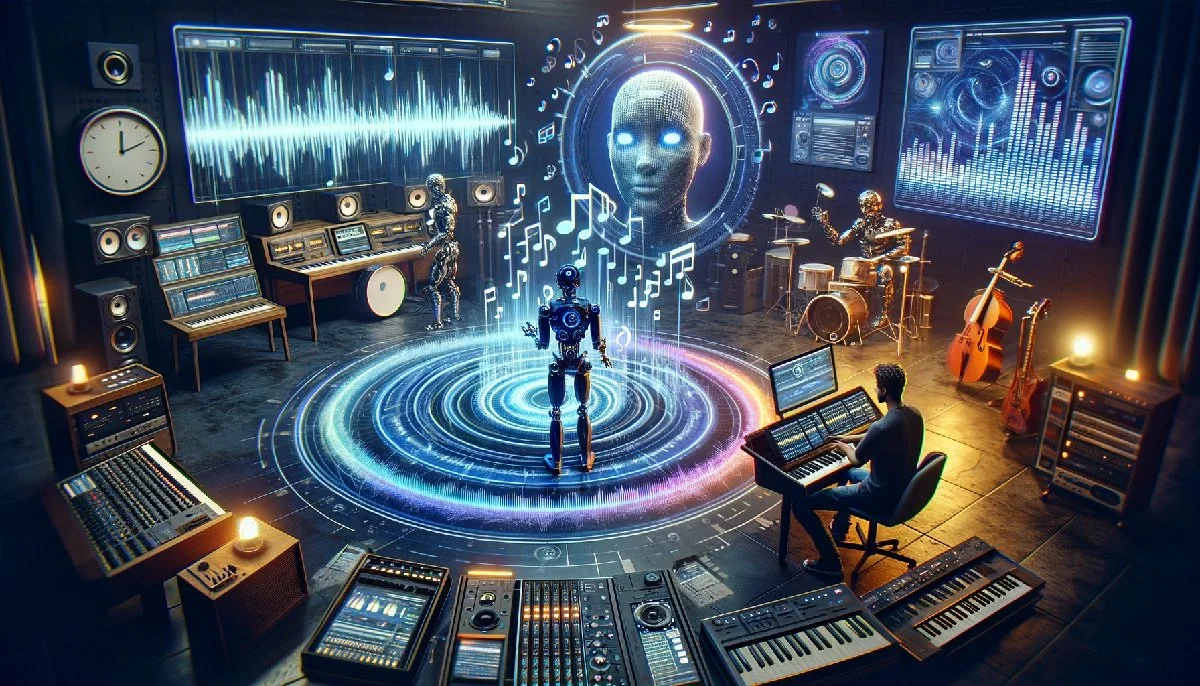
The Day the Music Changed Forever
There was a moment, somewhere in 2024, when the internet heard a song it couldn’t quite place. The production was crisp. The lyrics were emotionally resonant. The voice had a warmth that felt almost too familiar. It was streamed millions of times. People added it to their most personal playlists. Some cried to it in the dark. And then the truth trickled out: there was no artist. There was no late-night studio session. There was no heartbreak that inspired the bridge, no musician who had wrestled with the words at three in the morning. There was only a prompt, an algorithm, and a server farm humming somewhere in the cloud.
That moment – that rupture between what we felt and what was real – is where one of the most urgent, fascinating, and genuinely destabilizing conversations of our cultural moment begins. The debate over AI-generated music is not just a niche industry argument happening in boardrooms and on Reddit. It has exploded into mainstream discourse, landing on every platform, in every genre community, and at the center of conversations about what art even means in the twenty-first century. It is a debate about authenticity, ownership, identity, and the very soul of creativity. And in 2026, it has reached a kind of boiling point that cannot be ignored.
Over 100,000 new songs are uploaded to streaming platforms every single day. A significant and growing portion of those songs are generated entirely or substantially by AI tools. The barrier to creating music has never been lower. The volume of music has never been higher. And the question of what separates a meaningful human expression from a perfectly optimized simulation of one has never been harder to answer.
The Rise of the Machine Musician
To understand how we got here, you have to understand how fast things have moved. Just a few years ago, AI-generated music was a novelty – the kind of thing tech journalists demonstrated at conferences and music fans dismissed as a curiosity. The outputs were rough, obviously synthetic, occasionally eerie in that uncanny valley way that made your skin crawl. Nobody was confusing it for a Radiohead record.
Then the tools got better. Dramatically, almost shockingly better.
Platforms like Suno and Udio emerged and rapidly evolved, allowing anyone with an internet connection and a text prompt to generate full songs – complete with vocals, instrumentation, production, and lyrics – in a matter of seconds. You could type “melancholic indie folk song about losing someone to distance” and receive, within moments, something that sounded like it belonged on an alternative playlist. You could specify genre, mood, tempo, era, cultural influences, and the machine would deliver something that not only matched your brief but often exceeded your expectations.
The democratization was intoxicating. Suddenly, people who had always felt music inside them but lacked the technical skills to extract it had a tool. Hobbyists, filmmakers, content creators, podcast producers, game developers – an enormous ecosystem of people who needed music but couldn’t make it the traditional way suddenly could. For them, AI wasn’t a threat. It was a liberation.
But for working musicians, the picture looked very different.
The same tools that liberated the amateur threatened the professional. Session musicians who had spent years honing craft watched as producers began replacing them with generated backing tracks. Composers who had built careers scoring film and television found their rates undercut by AI systems that could deliver “good enough” music in a fraction of the time and at a fraction of the cost. Vocalists discovered their voices – their most intimate, irreplaceable instrument – being cloned and deployed without their consent. The legal frameworks simply hadn’t caught up. They still haven’t.
The Velvet Sundown Moment
Nothing crystallized the AI music debate quite like the rise and exposure of Velvet Sundown, a band that generated genuine viral traction before listeners discovered that the entire project – the music, the lyrics, the artwork, the constructed biography – was AI-generated. Every element of the band’s identity had been synthesized. There were no real people behind it. No human origin story. No lived experience that the songs were supposedly drawing from.
And yet people had connected with it. They had listened and felt something. That was the part that made people uncomfortable in a way they struggled to articulate.
The Velvet Sundown incident wasn’t just a story about fraud or deception. It was a story about the strange malleability of emotional experience. If you felt moved by a song and then discovered the song was made by an algorithm, does that retroactively invalidate what you felt? Does the emotion cease to have been real because its source was synthetic? These are not merely philosophical questions. They get at something fundamental about why we listen to music in the first place – what we are actually seeking when we put on headphones and close our eyes.
The incident fueled massive debate online, with camps forming almost immediately. On one side were the purists, who argued that the deception was a profound violation – that art implies a human author whose inner life is being communicated, and that removing the human from that equation without disclosure was a form of cultural fraud. On the other side were the pragmatists, who argued that the emotional response proved the art’s validity, that music has always been produced through layers of collaboration and technology, and that the romanticized idea of the solitary suffering genius was itself a myth that had always obscured the industrial reality of how popular music gets made.
Both sides had a point. Neither side could fully refute the other. And the conversation kept escalating.
What “Authentic” Even Means Anymore
The word “authentic” is doing an enormous amount of work in 2026, and it’s worth pausing to interrogate what it actually means when people deploy it in discussions about AI music.
When fans say they want “authentic” music, they typically mean several things at once. They want to feel that the music was made by a real person. They want to believe that the emotions expressed in the song correspond to actual experiences the artist had or witnessed. They want the sense that a human being made choices – chose this word over that word, this chord over that chord – and that those choices reflect a consciousness grappling with the world. They want the music to be, in some meaningful sense, true.
AI-generated music complicates every single one of those desires. Not because it is necessarily false, but because it decouples the emotional effect from the biographical guarantee. A song can sound like it was made by a person in pain because it was trained on thousands of songs made by people in pain. The model knows, in a statistical sense, what pain sounds like – what intervals and lyrics and production choices are associated with that feeling. It can reproduce the surface of authentic expression without any of the underlying experience. It is, in a very real sense, mimicry at an extraordinarily sophisticated level.
But here is where the counterargument gets genuinely interesting: is human music so different? Songwriters regularly write from perspectives that aren’t their own. They write characters. They exaggerate. They adopt personas. They borrow liberally from other artists’ emotional vocabularies, tonal choices, and structural templates. A session musician recording a country song about heartbreak may have never experienced heartbreak in the way the lyrics describe. A producer crafting a euphoric club track may be feeling deeply miserable that day. The idea that human music is a pure, direct transmission of lived experience is already a convenient fiction that the industry has been selling for decades.
So the debate about authenticity isn’t as clean as it first appears. It isn’t simply human equals real, AI equals fake. It’s messier, more layered, and more philosophically interesting than that. What it ultimately comes down to is a question of contract – what the listener believes they are receiving, and whether that belief is being honored or exploited.
The Economics of the Flood
Set aside philosophy for a moment and look at the raw economics of what is happening. Streaming platforms are being flooded. With over 100,000 songs uploaded daily and a significant portion generated by AI, the market for music is being structurally transformed in ways that are devastating to working artists.
Streaming royalties are already notoriously low. Artists earn fractions of a cent per stream, meaning you need millions of plays to generate meaningful income. The royalty pool that platforms like Spotify distribute is essentially fixed – it is divided among all streams in a given period. When AI-generated music floods the pool with millions of additional tracks, it dilutes the share available to human artists. The math is brutal: more songs in the pool, less money per stream for everyone.
It gets worse. AI-generated music often targets the same emotional and sonic niches that generate the most streams – lofi study music, ambient sleep tracks, background playlist fodder. These are categories where listeners aren’t particularly invested in who made the song, only whether it serves its functional purpose. AI fills these niches perfectly and cheaply, siphoning streams that would otherwise have gone to real artists who depended on that income.
For independent musicians without the security of a major label deal or a substantial fanbase, this is existential. It is not a hypothetical future threat. It is a present economic reality that is restructuring what kinds of music careers are even viable. The musicians who are most vulnerable aren’t the superstars. They’re the middle tier – the working professionals who built sustainable (if modest) careers by being reliably good at their craft. The craft is now being replicated for free.
Major record labels have responded to this crisis in a way that is characteristically self-interested: by partnering with AI companies. Several of the biggest labels in the world have quietly entered agreements that allow AI systems to train on their catalogs in exchange for a cut of future AI-generated revenues. This enrages artists, who argue that their music is being used as raw material without their consent and without fair compensation. The legal battles over what constitutes permissible training data are still unresolved, moving through courts with the usual glacial pace of institutional response to technological disruption.
Bandcamp, notably, took a more principled stance, implementing a ban on AI tracks that replicate artists’ styles or voices without permission in early 2026 – a decision that won widespread praise from musicians and widespread mockery from AI enthusiasts who called it an unenforceable gesture. They may both be right.
The Voice Cloning Crisis
Of all the AI music capabilities that have emerged in recent years, voice cloning has generated the most visceral outrage, and for understandable reasons. The voice is the most intimate musical instrument. It is literally biological – shaped by the specific anatomy of a human body, the habits and injuries of a lifetime, the irreplicable accumulation of what someone has lived through. When AI can replicate a singer’s voice with enough fidelity to fool casual listeners, something genuinely profound is being violated.
Cases of unauthorized voice cloning have multiplied. Artists have discovered AI-generated songs using their vocal signatures without permission, generating streams and revenue for others. In some cases, the cloned voices have been used to create content the original artists find objectionable – putting words and musical styles in their mouths that they would never choose. The legal protections for a person’s vocal identity are still being established and vary wildly across jurisdictions.
But the voice cloning debate has a more morally ambiguous dimension too. Some artists have actually chosen to license their vocal identities to AI systems, allowing fans to generate music using their voice in exchange for royalties. Grimes, the avant-garde musician, was among the first to openly experiment with this model, offering her voice for AI-generated music and inviting collaboration rather than resisting it. For some, this represented a forward-thinking adaptation. For others, it felt like a betrayal – a commodification of something that should remain irreducibly human.
The question of consent is central here. When an artist chooses to participate, the ethical calculus shifts significantly. The problem is when that choice is made for them, when their voice becomes raw material for someone else’s creation without permission or compensation. That is where the current legal vacuum is most dangerous and most urgently in need of resolution.
The Festival Stage Problem
Live music has always been the human artist’s last unassailable domain. You can stream an AI-generated song, but you can’t replace the irreducible energy of a human being performing for a crowd in real time – or so the argument went.
In 2026, that argument is being stress-tested. AI “performers” have begun appearing at festivals – not as novelties in a side tent, but as genuine headliners in some cases. Using sophisticated holographic projection technology combined with AI-generated real-time music synthesis, organizers have staged performances by virtual artists that draw large crowds and generate genuine emotional responses from fans. The experience isn’t identical to seeing a human performer, but it’s closer than most people expected, and it’s getting closer every year.
This has created a fascinating new front in the authenticity debate. For some festival-goers – particularly younger audiences who grew up with virtual influencers, gaming avatars, and digitally constructed social media identities – the distinction between a human performer and a digital one is less categorical than it is for older generations. The experience is real even if the performer isn’t. The collective energy of a crowd responding to music together is real regardless of where the music came from.
For others, the festival stage performance by a virtual AI act represents the final indignity – the last barrier between authentic communal experience and manufactured simulation falling away. If you can’t rely on live music to provide genuine human presence, what’s left?
The answer, for many artists, is the story behind the music. The biography, the vulnerability, the proof of existence. And this is where social media has become the new battlefield.
Proving You’re Human Online
In a world where AI can generate not just music but entire artist personas – complete with constructed backstories, AI-generated photographs, and algorithmically optimized social media presences – human artists have found themselves in the strange position of needing to prove their humanity as a differentiating feature.
This is not an abstraction. Artists are actively developing strategies to demonstrate their realness. They share unpolished process videos. They go live to show the imperfect, unglamorous reality of creating. They document failures, rewrites, the moments when a song isn’t working. They show the human cost of the creative process – the exhaustion, the doubt, the hard-won satisfaction of finally getting it right.
The logic is both pragmatic and poignant: in a market saturated with AI-generated perfection, the imperfect and the vulnerable become valuable signals. A voice that cracks. A lyric that’s a little clumsy but obviously personal. A live performance where the artist forgets the words and laughs it off. These are not liabilities anymore. They are proof of life.
This has had a genuinely positive cultural side effect. The hyper-polished, auto-tuned, algorithmically optimized aesthetic that dominated mainstream pop for the better part of a decade is losing ground to something rawer and more personal. Artists who lean into their humanness – their particularity, their flaws, their specific perspectives and experiences – are finding that audiences are hungry for exactly that kind of connection.
Listeners increasingly crave relationship, not just sound. They want to know who made the thing they’re feeling, and they want to believe that the person who made it is real. The artists who thrive in 2026 are the ones who understand that the music is no longer enough on its own. The music is the beginning of a relationship, and relationships require trust, and trust requires proof.
The Cultural Stakes Beyond Music
It would be a mistake to treat the AI music debate as purely a music industry problem. The questions it raises reverberate outward in every direction, touching on issues that matter profoundly for culture as a whole.
What happens to cultural memory when the archive of human experience – the songs that marked our moments, the music that consoled us, the sounds that defined generations – is drowned out by an infinite flood of algorithmically optimized content with no human origin? There is something genuinely at stake in terms of how cultures understand their own emotional histories through music. Songs have always been vessels for collective memory. The Beatles’ White Album. Marvin Gaye’s What’s Going On. Kendrick Lamar’s To Pimp a Butterfly. These records are documents of human experience at particular historical moments, inseparable from the consciousness that produced them. AI can produce the aesthetic surface of that kind of cultural artifact. It cannot produce the artifact itself.
There is also the question of what the AI music flood does to aspiring human artists. The data suggests that more people than ever want to be musicians – that music remains one of the most intensely desired forms of human expression. But the pathways to sustainability as a musician are narrowing dramatically. When the economic model that previously rewarded skill, craft, and dedicated work is disrupted to the point where those qualities don’t translate into viable income, what message does culture send to the next generation of potentially brilliant artists who might decide it isn’t worth trying?
The risk isn’t that AI replaces music. Music is too fundamental to human experience to be replaced. The risk is that AI transforms the conditions under which human musicians can develop, sustain themselves, and take the kind of creative risks that produce genuinely extraordinary work. Great art rarely comes from people who feel financially secure and culturally disposable. It comes from people who are deeply invested in the work because the work is deeply connected to who they are and how they’re trying to understand the world. Protecting the conditions for that kind of investment isn’t sentimentalism. It’s cultural strategy.
Where the Debate Goes From Here
As we move through 2026, the shape of this debate is becoming clearer even as the outcome remains genuinely uncertain. A few things seem likely.
The legal frameworks will eventually catch up. Courts and legislatures across multiple jurisdictions are actively grappling with questions of AI training data, voice cloning rights, ownership of AI-generated works, and the liability of platforms that host synthetic music. The regulatory picture will not be clean or uniform, but some framework will emerge, and it will change the economics of AI music significantly.
The technology will keep improving. The gap between the best AI-generated music and the best human-created music will continue to narrow on purely sonic terms. The argument “you can tell the difference” will become less and less reliable as a line of defense for human artistry. The meaningful distinctions will have to be found elsewhere – in the story, the relationship, the verifiable human origin.
And audiences will continue to sort themselves. There is already evidence of a growing segment of listeners who actively seek out music with verified human origin, who treat that provenance as a quality signal in the same way some food consumers seek out organic or locally sourced products. This “human-made” market may represent a significant and sustainable niche, supporting careers for artists who can credibly offer that guarantee.
What seems clear is that the easy, comforting narratives on both sides of this debate are inadequate. AI music is not simply a democratizing miracle that will liberate human creativity from gatekeepers. Nor is it simply an existential catastrophe that will destroy music as a meaningful form of human expression. It is something genuinely new, arriving too fast for our cultural institutions to process it properly, forcing questions that we don’t yet have the frameworks to answer.
The Song Remains – But the Singer Has Changed
Here is where we land, after all of this: music matters too much for this question to be left to the technology companies and their lawyers.
The debate over AI-generated music is ultimately a debate about what we believe art is for. If art is purely a product – a pleasurable sensory experience to be consumed and discarded – then AI-generated music is not just acceptable but optimal. It delivers more of what people want, faster, cheaper, tailored to their exact preferences. It’s a better product by almost every commercial metric.
But if art is something else – a form of human communication, a bridge between inner lives, a way of saying “I was here and this is what it felt like” – then AI-generated music, however technically accomplished, is something categorically different from the art it resembles. It is not communication. It is simulation of communication. It is not a bridge between inner lives. It is a bridge that connects to nowhere.
Most people, if they’re honest with themselves, believe it’s both. They want music that works, that sounds good, that serves the moment. And they also want to feel, sometimes, that they’re being addressed by someone real – that a human consciousness reached across time and circumstance and found them. Those two desires don’t always coexist comfortably. The AI music debate is the sound of that tension playing out at civilizational scale.
The song remains. The question is whether, somewhere in the signal, there is still a human being singing it – and whether, if there isn’t, we will still be able to tell the difference.
And whether, in the end, we’ll still care.












Drive sales and watch your affiliate earnings soar!
Refer and earn up to 50% commission—join now!