
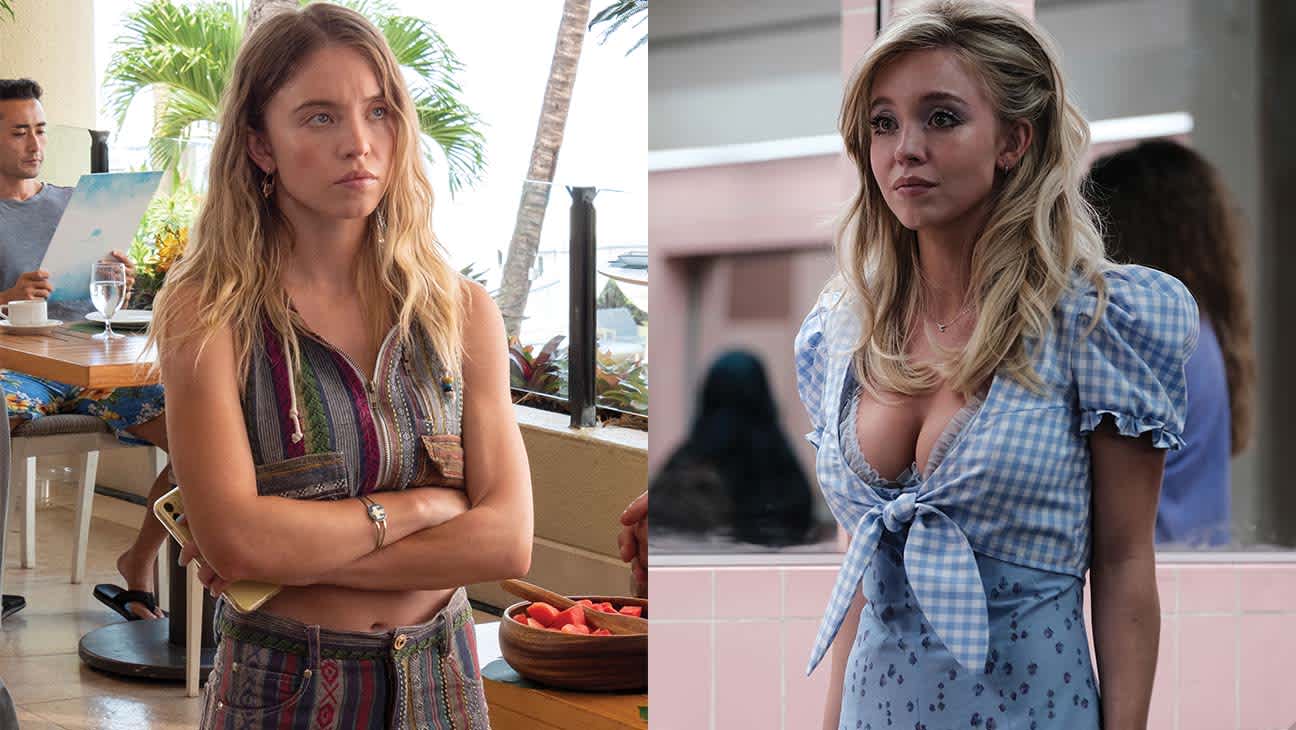
There are few entertainers in contemporary Hollywood who have managed to occupy every corner of the cultural conversation simultaneously – and almost never on their own terms. Sydney Sweeney, the blue-eyed, blonde actress who rose to fame playing traumatized teenagers and morally complicated women on prestige TV, has become something far more complex than a star. She has become a mirror – one that reflects back whatever a given corner of the internet most desperately wants to see, fear, celebrate, or destroy.
In less than five years, Sweeney has been accused of perpetuating eugenics, championing white supremacy, promoting unhygienic beauty products, cheating on her fiancé, covertly supporting Donald Trump, and selling her own bathwater to men who would eagerly buy it. Some of these controversies are rooted in real ambiguity. Others are the product of an algorithmically turbocharged outrage machine that has turned every advertising campaign into a political litmus test and every celebrity into a coded symbol of something sinister. Most of them are a confounding mixture of both.
What makes Sydney Sweeney’s case so uniquely instructive is that she has rarely, if ever, done anything overtly provocative. She has not gone on rants. She has not made inflammatory statements. She has not openly aligned herself with any political movement. And yet, controversy has followed her with a persistence that suggests the problem may not be anything she is doing – but rather what she represents in a culture that is desperately hungry for enemies and symbols in equal measure.
This is the full story of Sydney Sweeney’s controversies – and what they say about all of us.
The Making of a Modern Star
To understand why Sydney Sweeney became such a lightning rod, it helps to understand how she got famous in the first place. Born in Spokane, Washington, in 1997, Sweeney grew up in a small town called Spokane Valley and came from a working-class background that she has spoken about with notable candor. Her family struggled financially, and she has described using her early acting earnings not for luxuries but to help keep her family afloat – buying her mother a house and covering the cost of her brother’s education.
She broke through with a small role in HBO’s Sharp Objects and then landed the part that changed everything: Cassie Howard in Euphoria, HBO’s kaleidoscopically styled drama about addiction, trauma, and identity among high school students. Cassie is a character defined by her desire to be loved, her propensity for self-destruction, and her devastating physical beauty – and Sweeney played her with a raw, unguarded vulnerability that earned her an Emmy nomination and made her one of the most talked-about young actresses in Hollywood. A subsequent turn in HBO’s The White Lotus as a privileged yet pitiable young woman further cemented her reputation.
The attention, inevitably, brought with it scrutiny. And with scrutiny came controversy.
The Birthday Party That Started It All
The first major controversy of Sweeney’s public life had nothing to do with her career. In August 2022, photographs surfaced on Instagram showing Sweeney at what appeared to be her mother’s 60th birthday party. Several attendees were wearing red hats that, to many observers, looked startlingly similar to Donald Trump’s iconic “Make America Great Again” caps. Some guests were also photographed in Confederate flag imagery and other items associated with far-right culture. The photos spread rapidly across social media, and the verdict from a significant portion of the internet was swift: Sydney Sweeney was a MAGA supporter.
Sweeney responded quickly, taking to Twitter to write that “an innocent celebration for my mom’s milestone 60th birthday has turned into an absurd political statement, which was not the intention.” In interviews that followed, she clarified that the hats in the photos actually read “Make Sixty Great Again” – a play on her mother’s age – and that the attendees who appeared to be in far-right themed clothing were her mother’s friends, not hers, dressed for a country hoedown party. The Confederate flag imagery, she explained, had been misidentified.
Many people accepted the explanation. Many did not. The incident planted a seed of suspicion in certain corners of the internet, a suspicion that would only grow over the following years. Every subsequent controversy would be filtered through the prism of that birthday party, its imagery serving as a kind of original sin that colored every professional decision Sweeney made afterward.
The incident was also, in retrospect, a preview of what was to come: a woman who, rather than addressing controversy head-on, tended to issue brief clarifications and then retreat into silence, a strategy that often had the effect of keeping the controversy alive long after it might otherwise have faded.
The Swimwear Lawsuit
Before the politically charged controversies reached their peak, Sweeney was also entangled in a more conventional Hollywood legal dispute. In 2022, a swimwear company called LA Collective filed a lawsuit against Sweeney, alleging that she had entered into an oral agreement to serve as the face of their new swimwear line, “Somewhere,” and then backed out without cause. The company’s lawsuit claimed it had suffered losses of approximately $3 million as a result of Sweeney’s departure from the deal.
More damaging to the brand was the allegation that Sweeney had not only abandoned the agreement but had subsequently been seen wearing the approved bikini designs in at least five episodes of Euphoria – which, if true, would mean she had accepted the creative work and then taken the designs without compensation or credit.
Sweeney’s legal team fought back aggressively, arguing that LA Collective was a disreputable company with an “F” rating from the Better Business Bureau and a history of fraudulent business practices. The company, her attorneys argued, had a track record of scamming clients and business partners, and Sweeney had been right to terminate even an informal relationship with them once she discovered this. The case was ultimately dismissed approximately a year after it was filed, leaving no formal finding against Sweeney.
The lawsuit was relatively minor by Hollywood standards, but it contributed to a growing narrative around the actress: that she was either recklessly cavalier about her business decisions or, more charitably, a young woman still learning to navigate the treacherous landscape of celebrity brand management.
Glen Powell, Affair Rumors, and the Machinery of Celebrity Gossip
In 2023, Sweeney began filming Anyone But You, a Sony romantic comedy co-starring Glen Powell. The two played former lovers who rekindle their romance, and the chemistry they developed on screen – or appeared to develop – quickly became fodder for tabloid speculation. By the time the film’s promotional tour began, rumors of a real-life affair between Sweeney and Powell were widespread, amplified by social media posts that showed the two in what many observers read as intimate proximity.
The timing was particularly awkward: Powell was in a relationship with model Gigi Paris at the time, and Sweeney was engaged to Chicago businessman Jonathan Davino, with whom she had been in a relationship since 2018. Gigi Paris subsequently broke off her relationship with Powell, which many took as implicit confirmation of the affair rumors. Sweeney and Davino, however, appeared to remain together in the immediate aftermath of the speculation, with both parties declining to comment publicly on the rumors.
The affair narrative was never confirmed, but it was also never definitively extinguished. It hovered over the film’s release and its massive box office success – Anyone But You significantly outperformed expectations, earning over $220 million worldwide against a modest budget – adding an uncomfortable meta-layer to its story of on-screen romantic chemistry. In later interviews, Sweeney would attribute the rumor cycle entirely to the press, stating bluntly that “the tabloids and journalists created it and kept going.” Glen Powell echoed her denials, though the internet remained unconvinced.
The affair saga illustrates a particular challenge facing female celebrities in the contemporary media landscape: the way that professional chemistry – the basic occupational requirement of acting alongside a co-star – can be reconstructed as evidence of personal moral failing, with the woman in the partnership invariably bearing the heavier burden of public judgment.
The Bathwater That Broke the Internet
If the birthday party photos established Sweeney as a subject of political suspicion, and the Glen Powell rumors established her as a subject of romantic fascination, it was a bar of soap that established her as a subject of genuine cultural bewilderment.
In 2024, Sweeney partnered with Dr. Squatch, a men’s grooming brand known for irreverent and provocative marketing, for a body wash advertisement. The partnership was cheeky but conventional by modern standards. What followed was not. In May 2025, Dr. Squatch and Sweeney announced the launch of “Sydney’s Bathwater Bliss” – a limited-edition bar soap that, according to the brand’s marketing, was literally infused with water from Sydney Sweeney’s own bathtub.
The internet reacted with a mixture of fascination, revulsion, and the particular kind of mortified amusement that only the strangest corners of internet culture can produce. Hygiene concerns were immediately raised. Commenters questioned the sanity of both the brand and the actress. Critics argued the product was deeply degrading – a literal commodification of a woman’s body that reduced her to a consumable object for male consumption. Others pointed out, with a certain weary practicality, that it had sold out in seconds.
Sweeney addressed the backlash in an interview with The Wall Street Journal, and her response was striking for its unapologetic directness. She observed that the criticism had come primarily from women, and noted the apparent double standard with the observation that the same critics had been enthusiastic about a bathwater candle product connected to her Euphoria co-star Jacob Elordi. “It was mainly the girls commenting on it, which I found fascinating,” she said. “They all loved the concept of Jacob Elordi’s bathwater.”
Her point about gendered criticism was sharp and largely went unacknowledged by those making it. The controversy around the bathwater soap was, in essence, a controversy about who gets to profit from male desire and under what terms – and Sweeney’s willingness to engage commercially with the internet’s objectification of her body made many observers deeply uncomfortable in ways they struggled to fully articulate.
Great Jeans, Great Genes, and the Culture War That Consumed a Denim Ad
Nothing in Sydney Sweeney’s career prepared her – or the public – for what happened in the summer of 2025. On July 23 of that year, American Eagle launched a new denim campaign called “Sydney Sweeney Has Great Jeans.” The campaign was ambitious in scope: print advertisements, three-dimensional billboards including one at the Sphere in Las Vegas, Snapchat lens technology for digital consumer interaction, and a limited-edition denim style called the “Sydney Jean,” with all net proceeds going to the Crisis Text Line.
The tagline was a simple pun. “Jeans” and “genes.” Sydney Sweeney has great jeans – the pants. Sydney Sweeney has great genes – the genetics. It was the kind of pun that a department store copywriter might have scrawled on a napkin in thirty seconds.
What followed was anything but simple.
Within days of the campaign’s launch, a TikTok reaction video went viral – eventually accumulating hundreds of thousands of likes – arguing that the ad’s pun was not innocent wordplay but a deliberate invocation of eugenics and white supremacy. The logic ran as follows: Sydney Sweeney is a blonde, blue-eyed white woman. The ad suggests she has “great genes.” In the current political climate – one in which the Trump administration was actively dismantling diversity, equity, and inclusion initiatives and pursuing aggressive immigration enforcement – a campaign celebrating the genes of a blonde white woman carried distinctly racial overtones. The video’s creator drew comparisons to Nazi propaganda.
The reaction spread from TikTok to mainstream media with dizzying speed. Late-night talk shows covered it. National newspapers wrote analytical pieces. Cultural critics weighed in from every direction. Singer Lizzo, who had her own fraught relationship with public scrutiny, commented on the controversy. And then, in a development that would have seemed like satire even a few years ago, the President of the United States weighed in.
Donald Trump, upon learning from reporters aboard Air Force One that Sweeney had registered as a Republican voter in Florida in June 2024 – just weeks after his New York criminal conviction – posted about the campaign on Truth Social, praising Sweeney and her advertisement in terms that were as characteristically ungrammatical as they were politically charged. “Ooh, now I love her ad,” Trump reportedly said when told of her party registration.
The revelation that Sweeney was a registered Republican – having signed up in Florida roughly two weeks after Trump’s conviction for falsifying business records – exploded the controversy into a full-scale culture war. Conservatives rallied to her defense, praising her for embodying an alternative to what they framed as “woke” advertising norms. Trump’s spokesperson characterized the criticism of Sweeney’s campaign as “cancel culture run amok.” Right-wing commentators celebrated Sweeney as a symbol of defiance against political correctness.
On the left, the voter registration revelation was treated as confirmation of everything that had been suspected since the birthday party photos three years earlier. The “great genes” pun, for many critics, now looked not like an innocent double entendre but like a deliberate signal – a knowing nod to a constituency that celebrated a certain idea of physical and genetic superiority.
American Eagle attempted to neutralize the controversy with a statement asserting that the campaign was “and always was about the jeans. Her jeans. Her narrative.” The brand emphasized that the Sydney Jean’s proceeds were going to the Crisis Text Line, a mental health resource. It reported record-breaking denim sales in the weeks after the controversy erupted, including a double-digit increase in both men’s and women’s denim. The Sydney Jacket sold out in a single day. The Sydney Jean sold out in a week.
For months, Sweeney said nothing about the controversy beyond American Eagle’s official statements. Her silence was, in its own way, louder than any statement she could have made. Speculation about her intentions, her politics, and her character filled the vacuum with extraordinary ferocity.
The GQ Interview and the White Supremacy Question
During the height of the American Eagle controversy, Sweeney gave an interview to GQ that added another layer of complexity to the ongoing discourse. In a conversation that covered her career, her public image, and the controversies surrounding her, Sweeney was directly asked about the white supremacy accusations linked to the campaign. Her answer – or more precisely, her non-answer, her refusal to explicitly condemn white supremacy in the context of the ad’s controversy – was seized upon by critics as further evidence of her complicity.
This moment illustrated one of the more insidious dynamics of contemporary celebrity culture: the expectation that public figures must perform explicit ideological condemnation on demand, and the treatment of any failure to do so as evidence of secret sympathy. Whether Sweeney’s hesitance in that moment reflected genuine ideological alignment, a carefully managed strategy of political ambiguity, legal advice to avoid saying anything that could be construed as an admission of wrongdoing, or simple shock at being placed in such an extraordinary position is something that no outside observer can know. But the clip circulated widely, and for many viewers, it was damning.
The controversy also raised a genuinely difficult question about responsibility. An advertising campaign is not solely the product of the celebrity who appears in it. It involves creative agencies, brand executives, marketing strategists, and communications teams, all of whom approved the pun, the imagery, the timing, and the distribution. The decision to launch a campaign playing on the word “genes” with a blonde white woman in the summer of 2025 – a moment of acute racial and political tension – was not Sydney Sweeney’s decision alone. Yet she was the one who bore the full weight of public condemnation.
Breaking Up, Moving On, and the Scooter Braun Chapter
While the cultural debates raged, Sweeney’s personal life was also undergoing significant upheaval. In March 2025, after seven years together, Sweeney and Jonathan Davino officially ended their engagement. The timing was notable – just days before the breakup became public, she had been photographed attending the wedding of Glen Powell’s sister in Texas, which reignited the old affair speculation instantly.
Powell’s friends and family consistently denied any romantic involvement. His mother told the press that Sweeney was simply “a friend of the Powell family.” Powell himself, in an April 2025 television appearance, deflected questions about the relationship with characteristic humor, saying Sweeney was everything the world wasn’t – before clarifying that her presence at the wedding had been entirely about his sister.
Then, in the summer of 2025, Sweeney was linked to an entirely different figure: Scooter Braun. The former music manager – who became one of the most controversial figures in the entertainment industry following his acquisition of Taylor Swift’s masters and the very public war that followed – had recently retired from the music business. In June 2025, both Sweeney and Braun attended the Italian wedding of Jeff Bezos and Lauren Sanchez, and sources subsequently reported that the two had begun casually dating.
By November 2025, the relationship had progressed to the point where the couple was photographed sharing a kiss. Given Braun’s particular notoriety in entertainment circles, the association was immediately controversial. The same month, Sweeney was also seen reuniting with her ex-fiancé Davino in Los Angeles, adding further confusion to an already complicated romantic narrative.
For Sweeney, the Braun connection represented yet another front in a multi-directional cultural battle over her identity and her allegiances. To her critics on the left, dating one of the music industry’s most vilified figures was yet another data point in an accumulating case. To her defenders, it was simply a woman’s private romantic life, which is none of anyone’s business.
The “Transvestigation” Coda
In perhaps the most surreal coda to a story already full of surreal chapters, Sweeney found herself in early 2026 at the center of a new and entirely different right-wing obsession. Having been warmly embraced by conservative commentators as a symbol of traditional beauty and Republican values in the aftermath of the American Eagle campaign, she suddenly found herself subjected to so-called “transvestigation” by MAGA-adjacent corners of the internet – a conspiratorial practice in which social media users claim to identify celebrities as secretly transgender based on amateur anatomical analysis of photographs and videos.
This was, in its own deeply perverse way, the logical conclusion of the entire arc of Sweeney’s controversies. Having been lionized by the right as the embodiment of genuine, unambiguous femininity and genetic superiority, she was now being scrutinized by the same community for failing to meet its standards of authentic womanhood. The controversy had consumed itself.
It was also a useful reminder that in the contemporary culture war, no one is ever safe. Symbols are only ever useful until they aren’t. And celebrities who become symbols – whether they choose to or not – are always ultimately discarded.
Breaking Her Silence
In December 2025, more than five months after the American Eagle campaign had ignited its culture war, Sweeney finally addressed it directly in an exclusive interview with People magazine. Her response was measured, emotional, and carefully worded.
“I was honestly surprised by the reaction,” she said. “I did it because I love the jeans and love the brand. I don’t support the views some people chose to connect to the campaign. Many have assigned motives and labels to me that just aren’t true.”
She acknowledged that her previous strategy of silence had been a mistake. “In the past my stance has been to never respond to negative or positive press,” she explained, “but recently I have come to realize that my silence regarding this issue has only widened the divide, not closed it.”
She framed herself, ultimately, as someone who leads with kindness and is “always trying to bring people together,” and she expressed her opposition to “hate and divisiveness” without qualification. “I’m against hate and divisiveness,” she said simply. “Anyone who knows me knows that.”
The response was greeted, predictably, with a mixture of appreciation and skepticism, with the precise proportion depending entirely on which corner of the internet you were occupying when you read it. Her supporters argued it was a dignified and long-overdue clarification. Her critics argued it was insufficiently direct about the specific accusations. Neither side was fully satisfied.
That, perhaps, is the nature of Sydney Sweeney’s predicament. In a culture that has decided she is a symbol, no statement she makes can be processed as the words of a private individual. Every sentence she utters is immediately fed into a larger interpretive machine and processed for ideological content. She is simultaneously a talented actress, a savvy businesswoman, a cautionary tale about the dangers of ambiguity, and a Rorschach test for everything the culture is most anxious about: race, gender, beauty, politics, and the commodification of the female body.
What the Controversies Actually Tell Us
Step back from the specific incidents and a larger picture emerges – one that has less to do with Sydney Sweeney as a person and everything to do with the particular pressures of being a famous woman in the 2020s.
Each of Sweeney’s controversies follows a recognizable pattern. First, an event occurs – a birthday party photograph, a brand partnership, a casting decision – that is, on its face, entirely mundane. Second, a segment of social media finds within that mundane event a coded message, a hidden signal, evidence of secret ideological alignment. Third, the controversy goes viral, attracting commentary from increasingly prominent figures until it reaches a point of genuine cultural saturation. Fourth, Sweeney says either nothing or very little. Fifth, her silence is interpreted as confirmation by those who want to see confirmation, and as dignified restraint by those who want to see dignity.
The cycle repeats because it is driven by forces entirely beyond her control. The American Eagle “jeans/genes” controversy was not fundamentally about Sydney Sweeney. It was about anxiety over racial politics in Trump-era America, about the way beauty standards encode racial hierarchies, about the fear that even seemingly neutral cultural products are vessels for ideological messaging. Sweeney simply happened to be the face in the advertisement when these anxieties reached a boiling point.
Similarly, the bathwater soap controversy was not fundamentally about Sweeney’s personal values. It was about the ongoing cultural negotiation over female sexuality, the ethics of commodifying desire, and who gets to profit from male attention. Sweeney’s willingness to monetize the internet’s obsession with her body made explicit what is usually kept implicit, and the discomfort this caused was genuine even if the outrage was sometimes misplaced.
The MAGA connection – whether real or imagined – is the most politically loaded of all her controversies, and the most difficult to analyze dispassionately. It is possible that Sweeney is a committed Republican who has made careful, strategic choices to encode her political sympathies into her professional decisions. It is equally possible that she is a politically disengaged woman who voted Republican because she lives in Florida and didn’t think too hard about it, who threw a party with a silly hat pun for her mother, and who accepted a denim campaign that someone else wrote the punchline for. The available evidence cannot definitively establish which of these is true, and in the absence of certainty, the internet has predictably opted for whichever interpretation confirms its existing priors.
The Paradox of the Reluctant Symbol
There is a final irony at the heart of the Sydney Sweeney story, and it is one worth sitting with. She is an actress of genuine talent who has given performances of real emotional depth in Euphoria, The White Lotus, and Immaculate. She is a producer who has demonstrated considerable business acumen and creative ambition. She grew up struggling and built a career and a financial foundation largely through her own effort.
And yet the conversation about her has almost nothing to do with any of that. The conversation is about her genes, her jeans, her bathwater, her politics, her boyfriend choices, and the question of whether a pun on a billboard is a subtle endorsement of white nationalism. The work – the actual thing she set out to do when she decided to become an actress – has been almost entirely eclipsed by the meta-narrative.
This is not unique to Sweeney, of course. It is the condition of female celebrity in the contemporary moment – a condition in which a woman’s public image becomes a site of cultural contestation regardless of her wishes, in which her body and her associations and her silence are all treated as meaningful data in an ongoing argument that she did not choose to enter.
What makes Sweeney’s case so vivid and so instructive is the sheer density of the controversies, and the way they have compounded upon each other. Each new incident has been processed through the lens of every previous incident, creating a cumulative portrait that is inevitably more caricature than portrait.
The real Sydney Sweeney – whoever that is – remains, as she has always been, largely inaccessible. What we have instead is the idea of Sydney Sweeney: a screen onto which an anxious culture projects its arguments about beauty, race, gender, and power. And as long as those arguments remain unresolved – which is to say, for the foreseeable future – she will remain exactly what she has been for the past few years: not just an actress, but a controversy waiting to happen.
Whether you think she’s a covert political operative, a savvy businesswoman playing the system, or simply a talented actress caught in the crossfire of a culture that has lost the ability to let anything just be a pair of jeans – Sydney Sweeney is, undeniably, one of the most fascinating figures in contemporary Hollywood. The debate about what she represents says far more about us than it does about her.














Refer friends, collect commissions—sign up now!
Get started instantly—earn on every referral you make!
Monetize your audience—become an affiliate partner now!
Become our partner and turn referrals into revenue—join now!
Share our products and watch your earnings grow—join our affiliate program!
Promote our products and earn real money—apply today!
Share our products, reap the rewards—apply to our affiliate program!
Earn up to 40% commission per sale—join our affiliate program now!