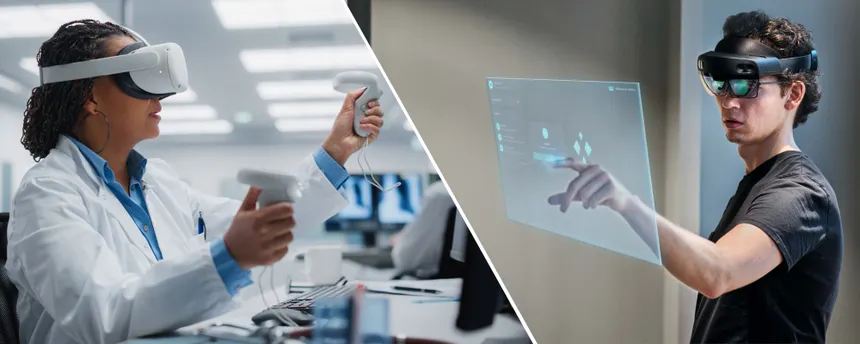
The Dawn of Seamless Immersion
The world stands at a remarkable crossroads where digital and physical realities merge with unprecedented fluidity. 5G Advanced networks represent more than just faster internet speeds. They’re fundamentally reshaping how we experience augmented and virtual reality, creating possibilities that seemed like pure science fiction just a few years ago. This technological leap transforms everything from how surgeons train for complex procedures to how students explore ancient civilizations without leaving their classrooms.
While previous network generations struggled to support the demanding requirements of immersive experiences, 5G Advanced delivers the bandwidth and responsiveness that AR and VR applications desperately need. The difference is night and day. Where 4G networks created frustrating lag and choppy visuals, 5G Advanced enables smooth, realistic experiences that feel genuinely present
Understanding the Technology Behind the Magic
5G Advanced isn’t simply an incremental improvement over standard 5G networks. It represents a comprehensive evolution that brings powerful new features and capabilities to mobile connectivity. The technology builds upon the foundation of 5G while introducing enhancements specifically designed to support demanding applications like extended reality.
The architecture of these networks fundamentally differs from what came before. Traditional networks sent data through centralized servers located far from users, creating inevitable delays. Edge computing changes this paradigm entirely by processing information much closer to where it’s actually needed. For someone wearing a VR headset, this means their movements translate into visual changes almost instantaneously, without the disorienting lag that plagued earlier systems.
Bandwidth capacity has exploded under 5G Advanced standards. These networks can handle massive amounts of data flowing simultaneously to multiple devices. Picture a crowded stadium where thousands of people simultaneously stream immersive AR experiences on their devices. Previous network generations would have buckled under such demand, but 5G Advanced manages it smoothly.
Speed That Changes Everything
Numbers tell an impressive story here. 5G networks deliver speeds up to 100 times faster than 4G could ever manage. That’s not a typo. We’re talking about the difference between watching a grainy, stuttering video and experiencing a crystal clear, responsive virtual environment that reacts to your every movement.
These blazing speeds enable AR and VR applications to stream high quality content without buffering. A virtual reality training simulation for medical students can now display intricate anatomical details in real time, allowing them to practice complex procedures with unprecedented realism. The experience stops feeling like a crude approximation and starts feeling like genuine preparation for real world scenarios.
Speed matters differently for various applications. Cloud gaming benefits enormously because players can access sophisticated games without owning expensive hardware. The processing happens remotely on powerful servers, with only the video feed streaming to the player’s device. This democratizes access to cutting edge gaming experiences that previously required thousands of dollars in equipment.
Latency: The Make or Break Factor
Here’s where things get really interesting for AR and VR. Latency refers to the delay between when you perform an action and when you see its result. In everyday applications, a tiny delay barely registers. But in immersive environments, even small delays can trigger motion sickness and completely shatter the illusion of presence.
5G Advanced networks have crushed latency down to as low as one millisecond. To put that in perspective, human reaction time typically ranges from 200 to 300 milliseconds. The network response has become faster than human perception can detect. When you turn your head in a VR environment, the view updates so quickly that your brain accepts it as natural movement.
For AR and VR applications to feel comfortable, end to end latency must stay below 20 milliseconds. This tight requirement demands not just fast networks but also edge computing infrastructure that processes data locally rather than sending it halfway across the country and back. Private 5G networks often prove crucial for meeting these stringent requirements, especially in industrial and enterprise settings.
The practical implications ripple across industries. Architects can now collaborate in shared virtual spaces, manipulating 3D models of buildings with no perceptible delay between their actions and the results. A change one architect makes appears instantly for their colleague on another continent. Remote collaboration suddenly feels genuinely collaborative rather than awkwardly disconnected.
Transforming Entertainment and Gaming
Gaming represents perhaps the most visible frontier where 5G Advanced networks are making dramatic impacts. Virtual reality gaming has long promised fully immersive experiences, but network limitations kept tripping up that promise. Players would turn their heads and the world would lag behind, creating what gamers call “judder” – a momentum killing disconnect.
Modern 5G powered VR gaming eliminates those frustrations. Players inhabit hyper realistic environments where their actions trigger immediate responses. Multiplayer experiences become genuinely social as players interact in virtual spaces with the same fluidity they’d have meeting face to face. The technology enables persistent virtual worlds where hundreds or even thousands of players coexist simultaneously.
Augmented reality gaming takes familiar environments and overlays digital elements onto them. Imagine walking through your neighborhood while digital creatures appear around every corner, or turning your living room into a battlefield where virtual opponents hide behind your actual furniture. 5G Advanced networks make these experiences smooth and responsive rather than choppy approximations.
Cloud gaming platforms benefit tremendously from 5G capabilities. Players access console quality or PC quality gaming experiences on smartphones, tablets, or lightweight devices. The heavy processing happens on remote servers while the network streams back the results fast enough that players experience no noticeable difference from local processing. This shift has profound implications for accessibility and cost.
Revolutionizing Healthcare and Medical Training
Healthcare applications of AR and VR powered by 5G Advanced networks extend far beyond entertainment. Surgical training has been transformed by realistic simulations where medical students practice procedures in consequence free virtual environments. The low latency ensures that when a student manipulates virtual surgical instruments, they respond with the precision necessary for developing genuine skill.
Remote medical assistance represents another breakthrough application. A specialist surgeon can provide real time guidance to a colleague performing a complex procedure in a remote location. Through AR glasses, the remote surgeon sees exactly what their colleague sees and can overlay instructions, highlight specific anatomical structures, or even demonstrate techniques that appear as holographic guides.
Telemedicine extends beyond simple video calls when augmented by AR capabilities. Doctors can examine patients remotely with much greater detail when AR overlays provide additional diagnostic information. A patient might use a smartphone to scan an injury while the network transmits high resolution imagery to a specialist who can make more informed recommendations.
Physical therapy and rehabilitation programs leverage VR to create engaging exercises that patients actually want to complete. Instead of repetitive movements that feel tedious, patients might play immersive games where the therapeutic movements are integrated into entertaining challenges. Compliance improves dramatically when treatment feels less like work and more like play.
Mental health treatment has found innovative applications for VR exposure therapy. Patients dealing with phobias or PTSD can confront triggering situations in controlled virtual environments where therapists guide them through the experience safely. The immersion that 5G enables makes these simulations effective while keeping the patient secure.
Educational Revolution Through Immersive Learning
Education might see the most profound long term impacts from 5G enabled AR and VR. Traditional teaching methods work well for some learners but leave others struggling with abstract concepts. Immersive technologies offer alternative pathways to understanding that can reach students who learn differently.
History lessons transform when students can virtually visit ancient Rome, walking through the Forum as it appeared two thousand years ago. Science concepts become tangible when students manipulate molecular structures with their hands, seeing how chemical bonds form and break. Geography stops being memorization when students explore rainforests and coral reefs through immersive experiences.
Technical training benefits enormously from AR assistance. An automotive technician learning to repair a new engine model can see step by step instructions overlaid directly onto the physical engine. The system can highlight which bolts to remove, display torque specifications, and even show cutaway views revealing internal components. This reduces training time while improving retention.
Rural and remote areas face particular educational challenges due to limited access to specialized resources and instructors. 5G Advanced networks help overcome these barriers by enabling high quality immersive educational experiences even in locations far from urban centers. A student in a small village can access the same quality virtual laboratory experiences as one attending a well funded urban school.
Language learning becomes more natural through immersive environments where students practice conversations with virtual characters in realistic settings. Rather than memorizing vocabulary lists, learners order food in a virtual restaurant or ask directions in a virtual city, developing practical communication skills through contextual practice.
Industrial Applications and Workforce Training
Manufacturing and industrial sectors have embraced AR and VR powered by 5G Advanced networks with remarkable enthusiasm. Factory workers use AR glasses that overlay maintenance instructions, safety warnings, and quality control information directly onto equipment. This real time assistance reduces errors, speeds up processes, and helps newer workers become productive more quickly.
Remote expertise becomes accessible even in specialized situations. When complex machinery breaks down, a local technician can receive guidance from a distant expert who sees exactly what they see through AR glasses. The expert can circle problem areas, point to specific components, and walk the local technician through repairs step by step. This dramatically reduces downtime while eliminating travel costs.
Training simulations for dangerous jobs provide risk free environments where workers develop skills before facing real hazards. Pilots practice emergency procedures in virtual cockpits. Firefighters navigate virtual burning buildings. Construction workers operate virtual heavy equipment. The low latency of 5G Advanced networks ensures these simulations feel realistic enough to build genuine muscle memory and decision making skills.
Quality control processes benefit from AR overlays that highlight defects or deviations from specifications. Instead of comparing physical parts to diagrams or specifications sheets, workers see acceptable tolerance ranges displayed directly on the parts they’re inspecting. This speeds up inspection processes while reducing the likelihood of defects reaching customers.
Retail Transformation and Virtual Shopping
Retail experiences are being reimagined through AR capabilities enabled by 5G networks. Customers can visualize furniture in their homes before purchasing, seeing exactly how that couch will look and fit in their living room. The high bandwidth allows for detailed, accurate 3D models that represent products faithfully, reducing the uncertainty of online shopping.
Virtual showrooms let customers explore products that might not be physically available at their local store. An automotive buyer can customize a vehicle’s features and colors, then walk around the virtual result examining details from every angle. The experience captures much of the benefit of visiting a physical showroom without requiring the inventory space.
Try before you buy extends beyond furniture. Shoppers use AR to virtually try on clothing, accessories, and makeup. While this technology existed before 5G Advanced networks, the improved capabilities make the experiences much more realistic and responsive. A customer can see how sunglasses look from multiple angles, how a dress moves as they turn, or how different lipstick shades complement their complexion.
Interactive shopping experiences engage customers in ways traditional ecommerce cannot match. A home improvement customer might point their phone at a wall and virtually paint it different colors, seeing instant realistic results. A gardener could visualize how different plants would look in various arrangements before committing to a design
Architecture and Real Estate Innovation
Architecture and real estate have found powerful applications for AR and VR enhanced by 5G capabilities. Architects collaborate on building designs in shared virtual spaces where all stakeholders can walk through structures before construction begins. Design flaws that might go unnoticed in 2D drawings become obvious when people virtually inhabit the spaces.
Client presentations become far more effective when buyers can experience proposed buildings rather than trying to visualize them from blueprints. A developer can give dozens of potential buyers simultaneous virtual tours of a building that hasn’t been constructed yet. Customers make more confident decisions when they truly understand what they’re purchasing.
Renovation planning benefits enormously from AR that overlays proposed changes onto existing spaces. A homeowner considering a kitchen remodel can see exactly how different cabinet styles, countertop materials, and appliance configurations would look in their actual kitchen. This reduces costly mistakes and ensures satisfaction with final results
Urban planning takes on new dimensions when city officials and residents can experience proposed developments through immersive visualization. A controversial building proposal becomes less abstract when community members can virtually stand at street level and see its actual visual impact. This democratizes planning processes and leads to better informed decisions.
The Technical Infrastructure Making It Possible
Understanding how 5G Advanced networks actually deliver these capabilities reveals impressive engineering. Massive MIMO technology uses many more antennas than previous network generations, allowing simultaneous communication with multiple devices while maintaining high speeds for each. This technology proves essential in crowded environments where many people use bandwidth intensive applications simultaneously.
Millimeter wave frequencies enable the enormous bandwidth that 5G Advanced networks provide. These high frequency radio waves carry massive amounts of data but don’t travel as far as lower frequencies. This limitation gets addressed through dense networks of small cells that blanket areas with coverage. While building this infrastructure requires significant investment, the capabilities it enables justify the cost.
Network slicing allows providers to create virtual networks optimized for specific applications. An AR navigation application might get a network slice prioritizing low latency. A VR video streaming service might get a slice prioritizing bandwidth. This flexibility ensures that diverse applications all receive the network characteristics they need most.
Artificial intelligence and machine learning increasingly manage network resources dynamically. These systems predict demand patterns, optimize routing, and allocate resources to maintain quality of service even as conditions change. The networks become smarter over time, learning from experience to better serve users.
Overcoming Remaining Challenges
Despite remarkable progress, challenges remain in delivering seamless AR and VR experiences through 5G Advanced networks. Device limitations still constrain what’s possible even when networks provide ample capability. VR headsets need to become lighter and more comfortable for extended use. AR glasses must shrink while improving display quality and battery life. These hardware challenges are gradually being overcome as technology advances.
Content creation for immersive experiences requires specialized skills and expensive equipment. While tools are becoming more accessible, producing high quality VR and AR content still demands more resources than creating traditional media. As the market grows and tools improve, these barriers are falling.
Mobility remains a consideration for 5G Advanced networks. While coverage continues expanding, gaps still exist, particularly in rural areas. Ensuring consistent experiences as users move between different network zones requires sophisticated handoff mechanisms. Private 5G networks address some of these concerns for specific use cases but don’t solve the broader challenge.
User comfort and safety need ongoing attention as immersive experiences become more convincing. Motion sickness affects some users even with low latency networks. Extended use of VR headsets can cause eye strain. AR applications that overlay information on real world views must avoid creating dangerous distractions. These human factors require continued research and thoughtful design.
Looking Toward the Future
The evolution continues beyond current 5G Advanced capabilities toward 6G networks already being researched. These future networks promise even more dramatic improvements that will enable applications we’re only beginning to imagine. Holographic communication where life size 3D projections of remote people appear in your space could become routine.
Extended reality frameworks may blur the lines between AR, VR, and mixed reality into seamless experiences that fluidly transition between modes. You might start collaborating with colleagues in an AR overlay on your physical office, then transition into a fully virtual shared workspace, then overlay those results back onto physical prototypes without the technology getting in the way.
Spatial computing could become ubiquitous as AR capabilities integrate seamlessly with the physical world. Every surface might become an interactive display. Every object could have digital information available through a glance. Navigation through complex buildings or cities could become intuitive through always available AR guidance.
The democratization of these technologies continues as costs fall and capabilities spread. What requires expensive specialized equipment today might work on affordable mass market devices tomorrow. Geographic barriers diminish as networks extend to previously underserved areas. Access to immersive experiences shifts from privilege to expectation.
The Human Experience at the Center
Ultimately, the technical capabilities of 5G Advanced networks matter because of how they enhance human experiences. The technology succeeds when it disappears, when users stop thinking about networks and latency and bandwidth and simply engage with the experiences made possible. A student captivated by exploring the solar system. A surgeon confidently performing a life saving procedure. A grandparent sharing a virtual tea party with distant grandchildren. These human moments justify the massive infrastructure investments and ongoing innovation.
The transformation extends beyond individual experiences to reshape how we work, learn, play, and connect with each other. Remote collaboration becomes genuinely effective rather than a pale substitute for in person interaction. Training and education reach people regardless of their location or circumstances. Entertainment evolves into participatory experiences rather than passive consumption.
Privacy and ethical considerations deserve serious attention as these technologies become more capable and pervasive. Immersive experiences collect detailed data about users’ behaviors, preferences, and even emotional responses. Clear policies protecting this sensitive information while still enabling valuable services require ongoing attention from technologists, policymakers, and society broadly.
The social implications ripple outward in ways we’re only beginning to understand. Virtual presence could reduce travel and its environmental impacts while maintaining human connections. But over reliance on virtual interactions might also affect how we relate to physical spaces and face to face relationships. Balancing the benefits with potential downsides requires thoughtful consideration
A Connected Immersive Tomorrow
5G Advanced networks represent more than impressive technological achievement. They’re the infrastructure enabling a fundamental shift in how humans interact with digital information and with each other across distances. The seamless AR and VR experiences these networks power are transforming industry after industry, creating possibilities that reimagine what technology can do for people.
We stand at the beginning of this transformation rather than its conclusion. Each advance in network capability enables new applications that push the boundaries further. Each new use case discovered inspires additional innovation. The interplay between network infrastructure, device capabilities, content creation, and user adoption creates a virtuous cycle accelerating progress.
The promise extends far beyond novelty or convenience. These technologies address real challenges facing education, healthcare, industry, and human connection. They create opportunities for people in remote locations to access resources and experiences previously available only in urban centers. They enable new forms of creativity and expression that weren’t possible before.
As 5G Advanced networks continue expanding their reach and refining their capabilities, the boundary between what we consider normal and what seems futuristic keeps shifting. Applications that would have seemed like science fiction a few years ago are becoming routine. The truly transformative applications likely haven’t been imagined yet, waiting to be discovered by creative people exploring what becomes possible when networks finally deliver on the promise of seamless immersive experiences that feel completely natural and present.